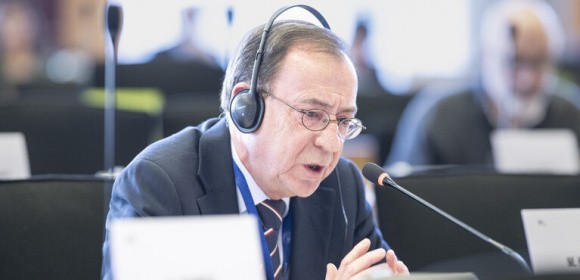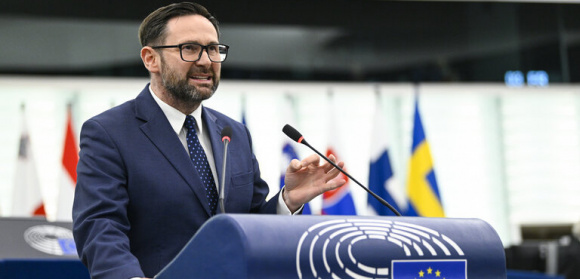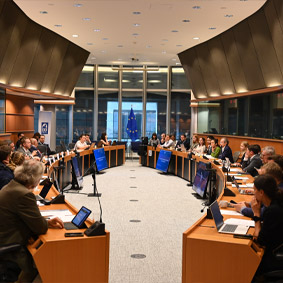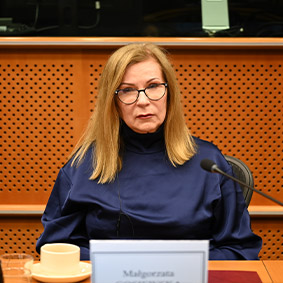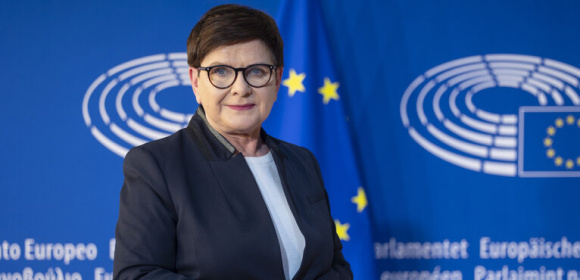
Today in Brussels, during a meeting of the Committee on Industry, Research, and Energy (ITRE), a draft report on energy supply security in the EU—for which Beata Szydło is the rapporteur—was presented.
This own-initiative report by the European Parliament, authored by the former prime minister, is intended to address key challenges such as the Council’s planned conclusions on security of supply, a review of the energy security architecture, and a strategy for phasing out Russian energy imports.
“The era of the peace dividend is over, and we must reevaluate our current approach to energy security,” said the MEP, emphasizing the need to reduce energy dependence on aggressor states and to increase the role of nations in managing critical resources. The report also highlights the weak security of energy infrastructure.
At the same time, the rapporteur asked the European Commission about the delay in presenting the long-awaited roadmap for phasing out Russian raw materials from the European market, as well as specific regulations requiring member states to develop plans to diversify their supplies. “Why isn’t this roadmap being processed, and why has this item disappeared from the Commission’s agenda?” she asked.
The former prime minister pointed out that transparency regarding existing imports must be ensured. “It’s no secret that the actual volume of Russian imports is significantly higher than what is declared, a situation facilitated by swap transactions and ghost ships,” she said. The Polish politician emphasized that the report also calls for a stronger focus on affordability by incorporating affordability risks into national risk assessments.
Continuing her remarks, the MEP called for a realistic approach to the issue of security of supply and for avoiding extremes. “We import 60 percent of our energy. And despite various measures—including electrification and energy efficiency—the EU will continue to import fairly significant amounts in the near future,” she added. Therefore, as the Polish politician noted, “natural gas is also an important raw material for, among others, the chemical and fertilizer industries.” Szydło, also citing Draghi’s report, appealed: “We must be aware that Europe needs to develop its industry; it needs to arm itself. To do this, we need sufficient energy and fuel, but above all, we must realize that Europe’s energy security will be the guarantee of the development of the European defense industry.”
Szydło clearly emphasized that resuming imports of Russian fuels would not be a win-win solution and “would not ensure any peace.” The Polish politician recalled the Munich Agreement of 1938, when nations also sought to buy peace. Quoting Churchill, Szydło noted that “they returned with neither peace nor honor.” “Those who speak of ‘business as usual’ with Russia are closer to repeating that scenario,” the MEP concluded.
At the end of her remarks, the former prime minister emphasized that the issue of supply security is a very broad one. “Only a clear, transparent report with unambiguous messages will matter in the discussion,” the Polish politician concluded.