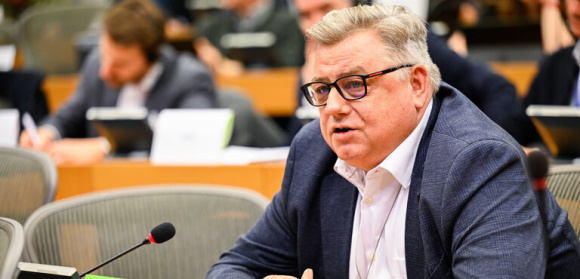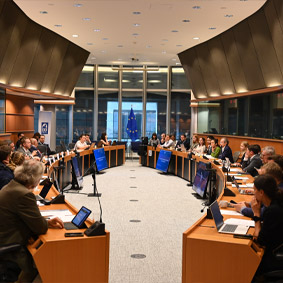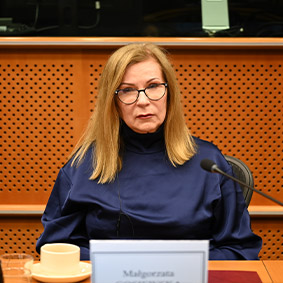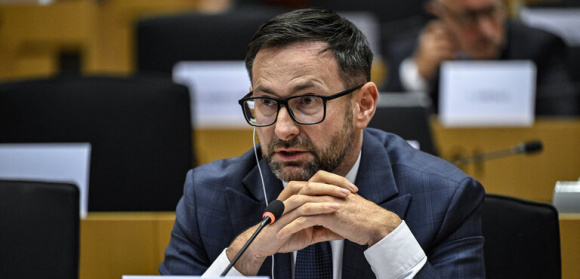
Today, during a meeting of the Committee on Industry, Research, and Energy (ITRE), an exchange of views took place with Krzysztof Paszyk, Minister of Economic Development and Technology, regarding the priorities of the Polish Presidency of the Council in the economic sphere. Daniel Obajtek, the ECR Group’s coordinator in ITRE, spoke during the discussion and asked about the presidency’s efforts to address the EU’s competitiveness crisis.
Daniel Obajtek spoke about the crisis affecting European economies. “We often discriminate against other EU countries and compete among ourselves, instead of competing with China or the U.S. economy,” he noted, pointing out that Poland is often the one to suffer as a result. In this context, he noted that Poland is one of the largest producers of electric car batteries. “We are a leader in production, even though our energy prices are very high,” he pointed out. Obajtek explained that until now, the energy mix of a given factory was the determining factor, “which is why these factories have invested heavily in renewable energy sources.” “And suddenly, the draft implementing act states that the energy mix of a given country will be taken into account,” the MEP noted, pointing out that in practice this would mean the closure of electric battery factories in Poland. “What do you intend to do about this?” he asked.
The ECR coordinator also addressed the issue of public procurement, noting that it will be subject to the same provisions, which will mean that “no manufacturer from Poland will be competitive, and no Polish company will be competitive.” He added that this is set to take place during the Polish presidency and asked for the government’s position on the matter.
“We keep discussing the fact that we have 13,000 different legislative acts, while the United States has 3,000. But in reality, look—month after month, quarter after quarter, is slipping away, and we’re not actually doing anything about it,” — appealing to the presidency to step up efforts to accelerate work on revising and implementing legislation and ensuring competitiveness. “Our ports are being flooded with other goods, our agricultural markets with fertilizers—not to mention other sectors—which is causing European and Polish companies to go under,” he warned.
Krzysztof Paszyk responded in general terms to a question regarding the carbon footprint of batteries. “As the presidency, we do not participate in the process of drafting delegated acts. This is a process led by the European Commission, but we recognize the importance of developing a methodology that will work across various sectors,” the Polish minister said evasively. He mentioned that last year Poland “sought to develop an EU-wide solution, rather than a national one, so that we could rely on a European mix that gives all member states equal opportunities for investment.”
He also stated that “improving the regulatory environment for European businesses, including reducing regulatory burdens, is a priority for the Polish presidency.” “As part of the Competitiveness Council’s work, we will prioritize initiatives aimed at radically combating bureaucracy,” he added.
As he put it, “the EU’s competitiveness depends on our deregulation efforts, and we are fully committed to this.” At the same time, he stated that “environmental and social standards cannot be lowered.”