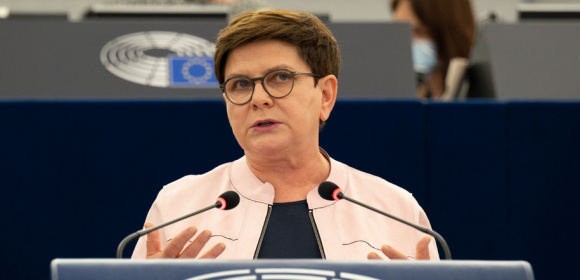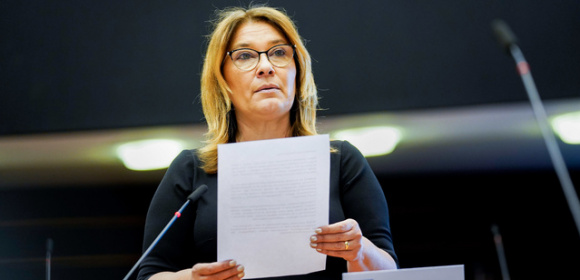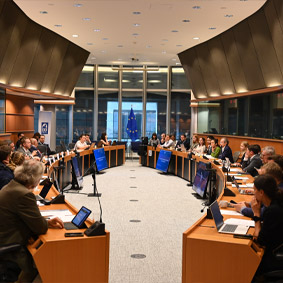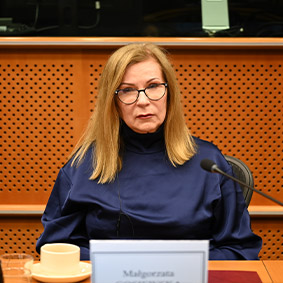
On the first day of the European Parliament’s plenary session in Strasbourg, a debate was held on the review of the Energy Performance of Buildings Directive (EPBD). ECR MEPs Jadwiga Wiśniewska, Adam Bielan, Patryk Jaki, and Beata Mazurek took the floor during the debate.
Jadwiga Wiśniewska noted that the climate push is gaining momentum. “On the horizon: zero-emission buildings, a ban on heating with fossil fuels, and mandatory solar panels on residential buildings,” she listed. She also stated that the revision of the Energy Performance of Buildings Directive should translate into benefits for citizens, but unfortunately, the opposite will be true. As she pointed out, the regulations will hit citizens hard—the middle class will become poorer, and the poor will become even poorer; there will also be a rise in housing prices, which will exacerbate the housing crisis. “You are hypocrites, because on the one hand you lament that young people cannot afford housing, and on the other hand you are preparing regulations that will cause a radical increase in housing prices,” stated the Polish politician. Jadwiga Wiśniewska noted with concern that MEPs also want to interfere with citizens’ freedom—specifically, their freedom to decide how to manage their own property—by forcing them to install solar panels on their roofs. She pointed out that the largest manufacturers of photovoltaic panels—namely, China—will benefit from this. She also added that citizens who cannot afford renovations will bear the cost, as they will pay higher taxes.
“A document sent by the current Polish government to Brussels indicates that in the coming years, nearly 1.5 million Polish families will face energy poverty. This means that 1.5 million Polish families will not be able to afford to pay their basic energy or gas bills,” — Adam Bielan said, referring to the shocking news published in the Polish media. The MEP also drew attention to last year’s estimates published in the liberal weekly Newsweek Polska, which indicate that the mandatory modernization of old buildings is set to cost Poles “well over one trillion zlotys.” The Polish politician noted that while one trillion zlotys is an astronomical sum, in practice no new financial instruments are being created to help residents meet these horrendous costs. “This is absolute madness. We cannot agree to this,” commented Adam Bielan.
The Polish politician also appealed to all Polish Members of the European Parliament, particularly those representing the so-called “December 13 Coalition” in the European Parliament. “Stop being hypocrites and saying one thing at home while voting differently in this chamber. Have the courage to throw this harmful proposal in the trash tomorrow,” he urged, calling for its rejection in the upcoming vote.
“Next year, you’ll introduce a ban on funding for gas stoves across the entire European Union, followed by a total ban on heating with fossil fuels; by 2030, all new buildings are to be zero-emission. Next, all old buildings where the poorest people live are to undergo mandatory renovation, for which they themselves will have to pay, because they won’t receive any new funds for this purpose,” — Patryk Jaki listed with concern, summarizing the changes that the directive in question will introduce. He added that the implementation of these changes is to be overseen by environmental agencies that will verify all energy performance certificates for buildings. “Apartments will become even more expensive; people won’t be able to afford to keep their own children warm; Europe will grow poorer and poorer,” he said, listing the negative consequences of this proposal. “But why should you care about some poor person whose life’s work you’re taking away?” the Polish politician asked. “How many times has Europe committed such a ‘beautiful’ act of suicide? This time, not because of red communism, but green communism,” mused Patryk Jaki, expressing his opposition to the proposal.
Beata Mazurek said that this directive is yet another attempt to impose—under the guise of combating climate change—regulations associated with enormous costs that will ultimately be borne by ordinary citizens. “This directive is a Brussels diktat that fails to take into account the actual capabilities and needs of citizens,” she added.
The MEP also pointed out that the requirement to renovate buildings with lower energy efficiency will push the poorest into even greater poverty, and that the obligations regarding photovoltaic installations are just another link in the chain of “bureaucratic madness.” In this context, she recalled the recent farmers’ protests in Brussels and other countries, which clearly demonstrate how the attempt to push through the Green Deal’s unrealistic goals has led to a decline in the competitiveness of European agriculture. She noted that these are the consequences of prioritizing ideology over rational, evidence-based resource management.
“Stop ill-conceived and irresponsible green policies that are impoverishing our people. There is still time to put a stop to this madness. Let’s show that we are capable of pursuing rational policies that are close to the hearts of citizens in all member states, not just the wealthiest ones,” the Polish politician urged.