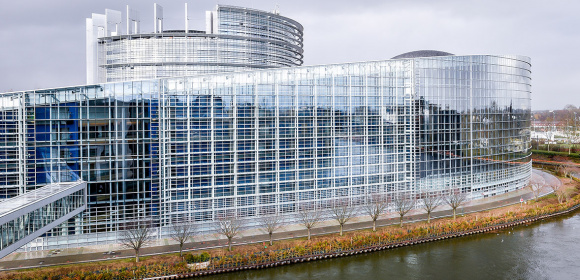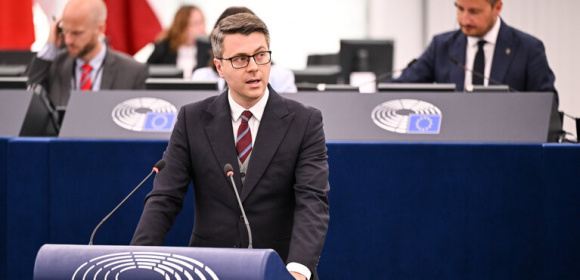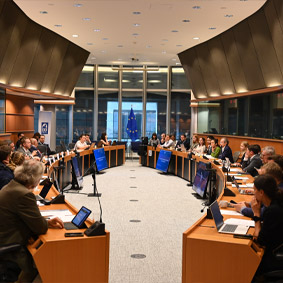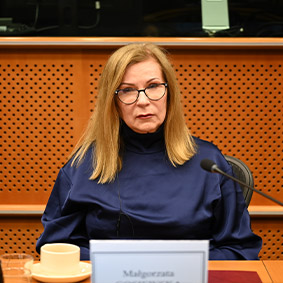
During the European Parliament’s plenary session in Strasbourg, a debate was held titled “Cases of Espionage for Russia in the European Parliament,” which focused on the threats posed by the activities of Russian intelligence services and agents of influence within European Union institutions. Law and Justice MEPs Mariusz Kamiński and Maciej Wąsik took the floor during the discussion, calling for decisive action and full transparency in investigating Russian influence, including within the European Commission, citing the example of the ties of former Justice Commissioner Didier Reynders.
Mariusz Kamiński noted that the debate is directly linked to the recent conviction by a British court of former MEP Nathan Gill for treason in favor of the Russian Federation.
“A few months before his arrest in 2021, Polish intelligence services arrested Janusz N., a member of the same spy ring. I am familiar with this case, as at that time, as a member of the government, I personally oversaw the intelligence services,” he emphasized.
The MEP drew attention to the scale and nature of the Russian network’s activities within the European Parliament.
“Janusz N. was extremely active within the European Parliament, posing as a representative of a non-governmental organization called the ‘European Center for Democracy and Human Rights.’ He managed to recruit several members of the European Parliament from various countries who, in exchange for Russian money, promoted the Kremlin’s political line in their public speeches,” he noted.
Mariusz Kamiński also reported that in 2023, he shared information on this matter with European Parliament President Roberta Metsola, and that Polish counterintelligence prepared a special presentation for MEPs detailing the methods used by Russian intelligence services.
“Unfortunately, due to the change of government in Poland, this initiative was not carried out,” he added.
Although—as he noted—the Russian agents of influence linked to this case did not constitute a key decision-making force in the European Parliament, the PiS MEP pointed to a much more serious problem.
“There is the issue of Russian influence, which may affect the very heart of the European Union’s decision-making process. This is the scandalous case of Commissioner Reynders’s dirty money. Clarifying the nature of his contacts with Putin’s friend, the Russian oligarch Oleg Deripaska, must be a priority for the European Parliament and the European Commission,” he emphasized.
“Stop burying your heads in the sand. We won’t let you sweep this matter under the rug,” he concluded.
Maciej Wąsik pointed out that the European Commission is avoiding key issues related to possible Russian influence. The MEP recalled the allegations against Commissioner Didier Reynders, including accusations of money laundering.
“This commissioner blocked funding for Poland. Ask yourselves—and me—whose interests this served, precisely at a time when Poland was providing real assistance to Ukraine as it fought?” he asked.
Maciej Wąsik also cited other controversial aspects of Reynders’s activities, including his involvement in the case of Pablo Gonzales, a Russian spy arrested in Poland, Belgium’s stance on the expulsion of Russian diplomats following the Skripal case, and media reports about the commissioner’s close ties to Russian oligarch Oleg Deripaska.
The MEP also drew attention to financial matters concerning the commissioner’s family. “Has anyone answered the question of how much money the commissioner’s family members earned from contracts with the Russian embassy in Brussels, and for what? Has it been explained where the hundreds of thousands of euros came from that were laundered through lotteries?” he asked.
“These questions must be answered at some point,” he concluded.
PiS MEPs emphasized that effectively combating Russian infiltration of EU institutions requires political courage, full transparency, and a genuine willingness to clarify all doubts—regardless of whom they concern.