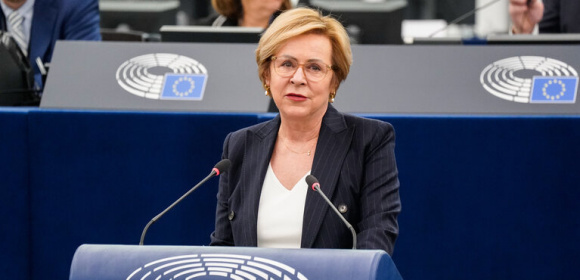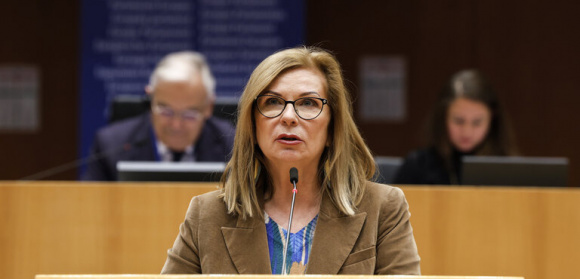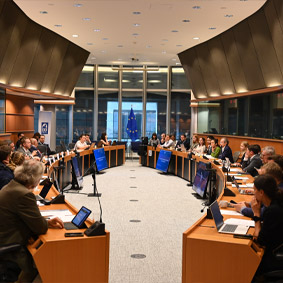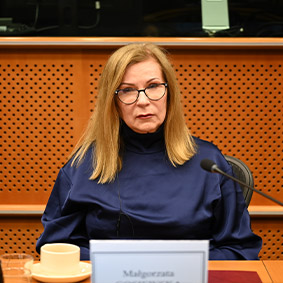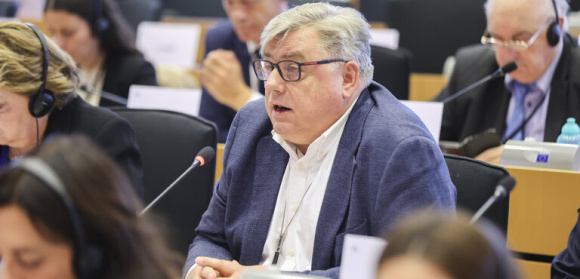
A public hearing was held this week at the European Parliament in Brussels during a meeting of the Committee on Transport (TRAN) on strengthening the enforcement of passenger protection regulations and improving multimodal travel through new EU legislation.
Kosma Złotowski, deputy coordinator of the ECR Group in the TRAN Committee, participated in the discussion alongside experts and representatives of the transportation sector.
The hearing covered two main topics: the enforcement of passenger rights and multimodal travel.
On the topic of passenger rights, Kosma Złotowski spoke about the unfair practices engaged in by some airlines. He noted that this year, Spain set a precedent by imposing fines totaling over 150 million euros for such practices. In this regard, the MEP asked José Luis Lozano Lozano, Director of Safety Management and Flight Crews at the Spanish Aviation Safety and Security Agency, for details on this situation and wondered whether a change in regulations aimed at standardizing the rules could prevent such problems.
In response, the speaker told him: “When it comes to penalties and sanctions, it is important to have standardization within European authorities so that they, too, have sanctioning powers equivalent to those of the member states. In Spain, a specific agency is responsible for imposing penalties for non-compliance with certain EU regulations. However, some sanctions are beyond our jurisdiction.”
The PiS MEP then directed another question to Steven Berger, a representative of the European Consumer Organization. It concerned the call contained in last year’s Parliament resolution to standardize regulations on carry-on luggage. The PiS politician noted that operators’ internal regulations are inconsistent and involve hidden costs, which make it difficult to compare actual prices or combine services from different carriers. The MEP asked whether this issue is being monitored and whether there should be a single carry-on baggage standard for all carriers, depending on the aircraft model used.
Berger emphasized that the regulations regarding carry-on baggage “are closely monitored” by his organization. “We want binding standards proposed by the Commission. And if that is not possible, then we must strengthen the provisions in the Air Services Regulation, which should also be subject to revision during this legislative term,” he explained.
Kosma Złotowski noted that although airlines are legally required to guarantee a seat for children next to a parent on board, in practice, they impose fees for reserving a seat for the other parent and often require an additional fee for infants traveling on a guardian’s lap. He asked whether, in the opinion of Sebastian Loerke of Airlines for Europe, such practices are ethical and whether it would be worthwhile to adopt regulations that are more family-friendly as part of this review.
The expert noted that when it comes to seat selection for families, fees for infants, and carry-on baggage allowances, it is important to balance the need to ensure freedom of business operations with the need to provide passengers with accurate information during the booking process. “Users must know what they’re getting into when they buy a ticket, especially in the context of multimodal travel,” he emphasized.
In the second session, devoted to multimodal travel, Złotowski asked Christina Russe of the European Travel Agents’ and Tour Operators’ Association about the role of travel agents and tour operators, who serve as the first point of contact when travel issues arise. “Is the industry able to resolve issues in situations where one of several legs of a trip is delayed or canceled?” he asked.
Russe noted that travel agencies are best positioned to provide alternative modes of transportation when problems arise. According to the expert, thanks to access to data, the modes of transportation proposed by travel agents are often more effective than air travel. “However, it comes down to access to data and travel itineraries from operators. We’d like to offer more rail options, but due to a lack of data, we’re unable to do so. There should be regulations regarding baggage size. Travel agencies and operators are able to respond to obstacles in multimodal travel; we are able to do so for single-mode transport, so we would be able to do the same for multimodal travel," said the Deputy Secretary General of ECTAA.
Złotowski also addressed the digital ticket booking process. As he noted, the ability to book a multimodal ticket covering multiple segments requires interoperability among the booking systems of different carriers.
“To what extent are these existing systems ready to allow for the quick and easy purchase of such a multimodal ticket right now? Are major investments needed, for example, from a cybersecurity perspective? Won’t the cost of these investments ultimately make such a multimodal ticket very expensive?” asked Gabriela Donę of Trenitalia.
The representative of the Italian rail operator noted that, when it comes to digitization for purchasing multimodal tickets, standards or dynamic QR codes would allow for expanding the range of services offered. “We could bundle different modes of transport onto a single ticket encoded in a QR code. From a technical standpoint, there’s no problem at all, and we’re already capable of doing this; the only remaining issue is the relevant regulations. It would also be possible to combine multimodal trips using an app; such solutions are already in place in some regions,” added Dona.
The PiS MEP also raised the issue of problems with providing cabotage services faced by bus carriers within the EU, which reduce the profitability of long-distance routes. He therefore asked Raluca Marian of the International Road Transport Union (IRU) whether the multimodal transport market is at all attractive to bus operators and whether there are already examples of successful cooperation with other modes of transport.
The IRU expert noted that regarding cabotage in transport services—particularly for coaches—“there have been successes, for example in Spain.” “There, the entire market in this sector is organized in such a way that all operators are subject to public service obligations. There are about 600 companies, with an average of 16 buses per company. In this way, the entire country is covered by these companies’ services. Another example of success is Flixbus, which operates both trains and coaches. They offer integrated tickets. The situation is more problematic when there are many small companies and it is difficult for them to integrate, but it is technologically feasible,” she explained.