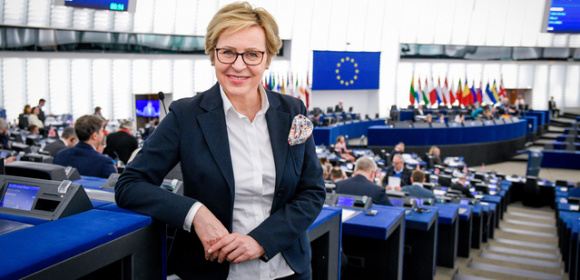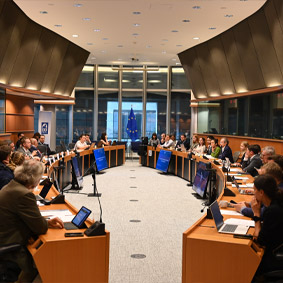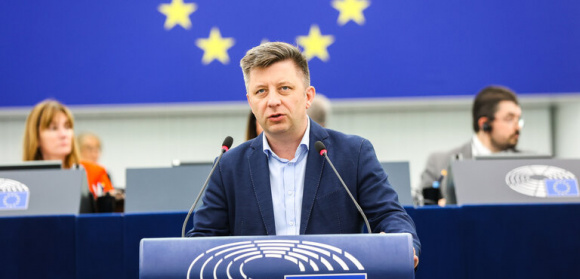
Today in Brussels, during a meeting of the Committee on the Internal Market and Consumer Protection (IMCO), there was an exchange of views on Mario Draghi’s report on the future of European competitiveness. PiS MEP Michał Dworczyk spoke during the discussion, criticizing the document’s failure to address the perspective of Central and Eastern European countries
Michał Dworczyk noted that Draghi’s report painted a bleak picture of the European economy’s decline, highlighting a number of problems the EU has been grappling with for decades. “It is a pity that the experience of Central and Eastern European countries—which account for 40 percent of EU members, including my country, Poland—was not taken into account in the preparation of this report,” – stated the MEP, noting that since 1990, Poland has increased its GDP 3.5-fold and already allocates more than 4 percent of its GDP to defense. In Dworczyk’s view, it is therefore difficult to consider this report complete.
The MEP drew attention to one issue addressed in the report that relates to defense. He noted that Draghi’s report highlights the fact that the European Union imports nearly two-thirds of its armaments from the U.S., yet at the same time it does not invest in joint military projects and does not utilize its capabilities to modernize its armed forces, while advocating for European defense independence. “Meanwhile, in the face of the ongoing war in Ukraine, we are seeing once again that NATO is the guarantor of Europe’s security,” – the Polish politician emphasized, adding that the United States remains the leader of this alliance, and the presence of U.S. troops—including U.S. weaponry—is a vital component of Europe’s defense capabilities. “Therefore, we should not view the EU and the U.S. as competitors, but rather focus on technology exchange and the creation of joint projects that will ultimately serve to strengthen transatlantic relations in this area,” the MEP believes.
The PiS politician also posed two questions to the European Commission representatives present at the meeting. He asked whether, in the Commission’s view, the omission of the opinions of experts from Central and Eastern Europe —including those from Poland, which is a European leader in military and armaments transformation—in the section of the report concerning defense policy, does not disqualify the document in this regard. Furthermore, he wanted to know how the Commission views the fact that the report largely overlooks the issue of removing barriers in the services market, which is fundamental to every sector of the modern economy.