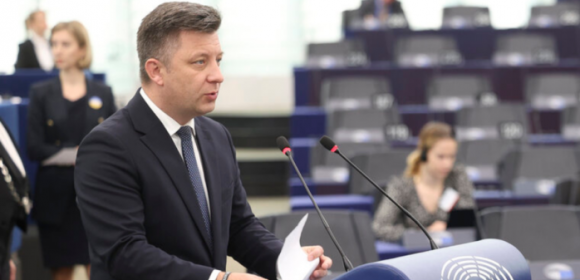
During a plenary session of the European Parliament in Strasbourg, PiS MEP Michał Dworczyk spoke in a debate titled “Drones and New Systems of Warfare—The Need for the EU to Adapt to Current Security Challenges.” In his remarks, he emphasized that Russia’s full-scale aggression against Ukraine has fundamentally changed the way security is perceived and the realities of the modern battlefield.
“The war in Ukraine has shown that Europe’s security is not an abstract concept, but a real challenge that requires immediate and bold decisions,” the MEP noted.
Michał Dworczyk identified three key challenges facing European Union member states today.
The first is building a resilient industrial ecosystem. The MEP drew attention to the dangerous dependence of European unmanned systems on components sourced from China, describing it as a sign of strategic short-sightedness. “Without control over supply chains, there can be no real security or production autonomy,” he emphasized. In his view, it is essential to relocate the production of key components to Europe and significantly increase funding for dual-use projects so that civilian innovations can rapidly enhance military capabilities.
The second challenge is the scale and pace of adaptation. As Dworczyk noted, on the modern battlefield, numerical superiority and the ability to rapidly modify systems are just as important as their technological sophistication. “European procurement procedures still operate according to the logic of a bygone era. We must simplify and accelerate them,” he urged, pointing to the need to create a sustainable system of incentives for private capital and startups so that key technologies can be developed in Europe.
The third element highlighted by the SEDE Vice Chair is domain convergence and the protection of critical infrastructure. “Drones are blurring the boundaries between domains of warfare, which necessitates the full integration of reconnaissance, command, and defense systems,” he said. He also emphasized the need to ensure effective anti-drone protection for critical infrastructure, such as ports, airports, and other strategic facilities.
Concluding his remarks, Michał Dworczyk called for drawing lessons from Ukraine’s experience. “If Europe wants to be secure, it must be technologically independent and prepared for the realities of next-generation warfare. Let’s draw on the experiences of our Ukrainian partners to build a credible and effective deterrent capability,” he concluded.