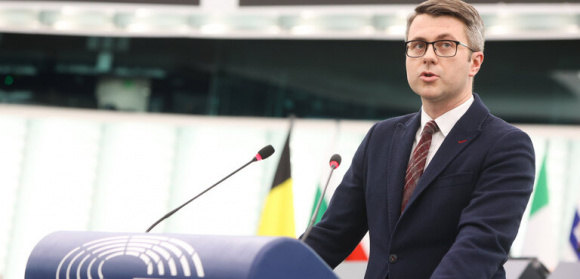
At the European Parliament in Brussels, during the ongoing hearings of the candidates for commissioners, PiS MEPs Jacek Ozdoba and Daniel Obajtek debated with Stéphane’em Séjourné, who is running for the position of Vice President of the European Commission and Commissioner for Prosperity and Industrial Strategy. The MEPs called for urgent action to address the crisis facing European industry.
Jacek Ozdoba stated: “Today, we are no longer discussing whether products are ‘made in Poland,’ ‘made in Germany,’ or ‘made in Europe’; rather, we are discussing whether industry will function at all, whether it will even exist in Europe.” According to the MEP, the conditions the EU has created for industry—and the ongoing debate surrounding them—are a kind of science fiction. “Because the truth is that we are ‘driving production out’ of Europe,” he said. The MEP mentioned the mass layoffs taking place in Europe as a result of the EU’s ill-advised climate policy. “Therefore, if we don’t get a handle on what we ourselves have created, industry will be pushed out of the European Union, and other countries will benefit from this,” he emphasized. In this regard, Jacek Ozdoba asked the commissioner-designate whether he was aware that “we are facing a European crisis today.” “And it’s not just about coal and steel. Because soon we’ll end up in a situation where Europe will function solely on services,” he warned.
Referring to the issue of electric car production, Séjourné stated that China and the United States “are likely significantly ahead of us technologically in this area, and if we want to have cars manufactured in Europe in the coming years, we must transform our industry.” Otherwise, the former French foreign minister said, there will be no European cars “and no industry at all.” “And that is not our goal,” he emphasized. In Séjourné’s view, one of the tools is the ETS. “Member states should recognize the value inherent in this European Emissions Trading System. The ETS can be used to save the industry and help it grow,” he said.
Daniel Obajtek referred to the Clean Industry Pact, which is intended to “strengthen business cases and support industry in becoming competitive, but above all, everything must be based on the speed of capital.” He emphasized that this is particularly important in the context of development and new investments.
The MEP also mentioned the role of public aid in stimulating business, though he noted that this is unrealistic in the long run. Obajtek asked the commissioner-designate whether he envisages a mechanism offering incentives to companies that want to decarbonize and invest quickly, in the form of the ability to deduct the costs of low-carbon investments from the costs required to purchase emission allowances. “That way, we’ll free up capital for these companies to invest quickly and undergo rapid transformation,” the Polish politician believes.
Stéphane Séjourné emphasized that member states must be encouraged to mobilize the EU Emissions Trading System (ETS). He noted that in the case of Poland, “there are approximately 5 billion euros in the ETS.” “So please start using the existing ETS now so that we can decarbonize strategic sectors that, of course, want to do so,” he added. He stated that it is necessary to review the current regulations and consider their possible revision in order to, among other things, translate them into national policy. At the same time, he declared that he is open to discussions about all effective mechanisms.