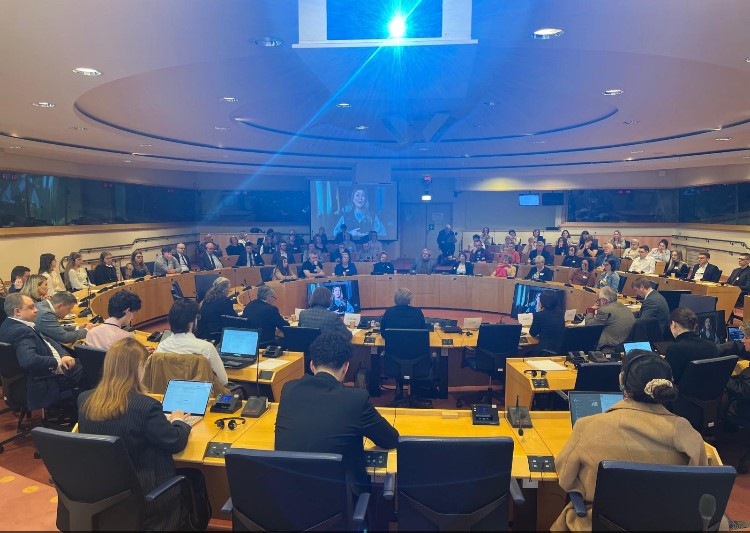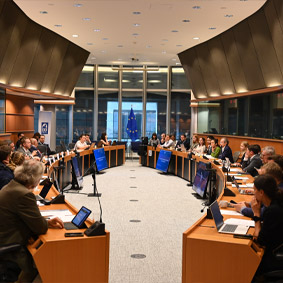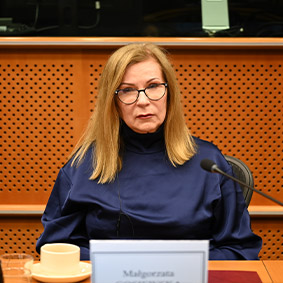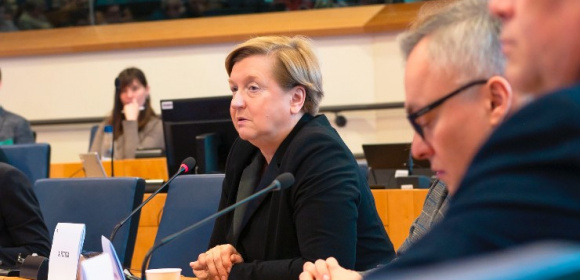
A conference titled “A Decade of the Occupation of Crimea – European Security Held Hostage by Russian Imperialism” was held at the European Parliament in Brussels. The event, organized by ECR MEPs Anna Fotyga and Alexander Vondra, was attended by, among others, Ukraine’s Deputy Minister of Foreign Affairs Emine Dzhaparova, Robert Pszczel, former director of the NATO Information Office in Moscow and an expert at the Center for Eastern Studies, as well as experts from the United States, Georgia, and Ukraine.
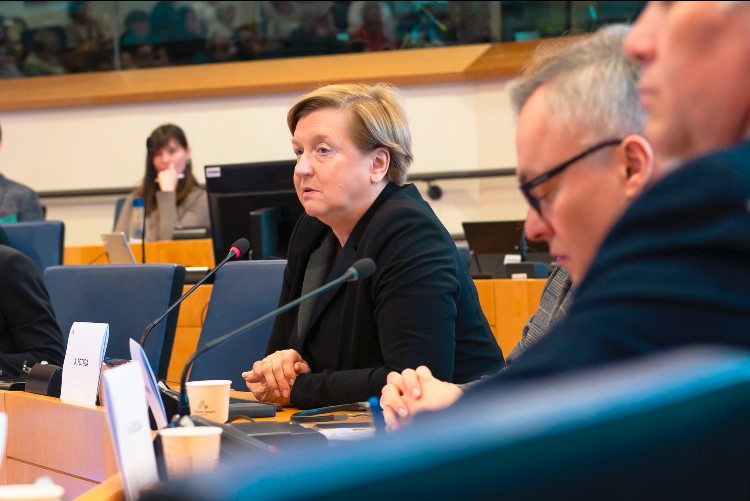
“Crimea is used not only to launch attacks on Ukraine, but also to destabilize the entire Black Sea region, and even more broadly—to launch attacks in Syria,” said Anna Fotyga. “Without a decisive defeat of Russia in Ukraine, we will face problems around the world—not only in our eastern neighborhood, but also in the Middle East, Africa, Latin America, and elsewhere,” the MEP emphasized. According to the Polish politician, Crimea is essential for Russia to pursue its imperial ambitions, and one of the international community’s concerns is that the occupied peninsula will be used to block freedom of navigation and treat the seas as Russia’s internal waters. Fotyga pointed out that Russia is attempting to implement the A2/AD (Anti-Access/Area Denial) strategy it uses in Crimea in the Baltic Sea region as well. “I participated in the launch of the Crimean Platform in Kyiv in 2021. I hope to be able to take part in its deliberations in a liberated Crimea,” concluded the former head of Polish diplomacy.
“Ten years ago, the world witnessed a brutal violation of international law. By occupying my native Crimea, Russia paved the way for further aggression against the Donetsk and Luhansk regions in 2014, as well as full-scale aggression in 2022,” said Emine Dzhaparova. The Deputy Minister of Foreign Affairs of Ukraine spoke about Russia’s destruction of the heritage of the Crimean Tatars and its forced Russification, but also about the courage and resistance of Crimea’s residents against these actions.
“If we stop fighting, Russian aggression will not stop. It will only embolden the Russians to take hostile actions against other nations. Only the full restoration of Ukraine’s sovereignty and territorial integrity within its internationally recognized borders, including Crimea, will enable a just and lasting peace. Reclaiming Crimea will be a blow to Russian imperialism,” Dzhaparova said.
“It hasn’t always been easy to draw the international community’s attention to the issue of the occupation of Crimea. That is why I would like to thank Anna Fotyga, who has been one of the leaders on this issue from the very beginning. “Today’s anniversary is a bitter reminder of a crime that has gone unpunished by the international community,” said Ukrainian diplomat Oksana Diakun “The persecution that has been a daily reality in occupied Crimea since 2014, as well as the mechanisms and legal measures that were tested there, are now being used to silence critical voices within the Russian Federation,” she added.
Olga Skrypnyk, co-chair of the Crimean Platform, reported that more than 70 countries are already participating in its work. “I was forced to leave Crimea ten years ago. Today, I see rockets being fired from the area around my home in Crimea toward my new home in Odessa,” she said. Skrypnyk reported that over 200 people, mostly Crimean Tatars, are currently being held in Russian prisons. Their situation is very difficult, as no international observers have access to them. “Despite the persecution and pressure, Crimea has not become part of Russia. Over the past two years, there have been more protests and acts of resistance in Crimea than anywhere else in the Russian Federation. Only an end to the occupation of Crimea can restore human rights on the peninsula,” she concluded.
“What is happening in Crimea today is something we know very well from the history of Central and Eastern Europe. This is a classic case of ethnic cleansing—in this instance, de-Ukrainization, de-Tatarization, and Russification,” said Robert Pszczel. The former director of the NATO Information Office in Moscow stated that we must not forget that in 1991, the majority of Crimea’s residents voted in favor of Ukraine’s independence. “There were no complaints filed with UN bodies. Instead, we saw a buildup of disinformation and manipulation leading up to the annexation, aimed at imposing the Russian narrative on the world,” the expert said. He noted that if a fair referendum had been held in 2014, the result would have been different. “This issue must be constantly emphasized, as it is part of Russia’s ongoing aggression not only against Ukraine, but also against the West as a whole and the entire civilized world,” he commented. Robert Pszczel emphasized that the annexation of Crimea is of monumental significance and essentially marked the death of the European security architecture in 2014. “Although Putin had already spoken publicly about his plans in Munich in 2007, the world still harbored illusions, basing its partnership with Russia on the principle of respecting other countries’ borders. After 2014, all illusions of any partnership with Russia vanished,” Pszczel said. “The operation in Crimea was a well-prepared and well-executed military operation,” he noted. He explained that Russia immediately gained a dominant position in the Black Sea by destroying or seizing the Ukrainian navy, which was then the second-largest fleet in the Black Sea. “Today, thanks in part to Western support, Ukraine is able to carry out effective operations that have significantly reduced the Black Sea Fleet’s capabilities,” concluded the expert from the Center for Eastern Studies.
According to Bat Kuteli, Georgia’s former deputy defense minister, the war against Ukraine is a global conflict. “It does not concern only a specific territory, but values and international law, and its outcome will affect global security,” said the former Georgian ambassador to Washington. “The West already made a mistake during the negotiations on the Treaty on Conventional Armed Forces in Europe. Believing that the gradual withdrawal of Russian troops from the territories of independent states would promote stability, it provoked today’s problems not only in Ukraine,” said Kutelia, recalling that Russian military bases were left in Crimea after the collapse of the USSR. According to the expert, despite numerous warnings—including the aggression against Georgia—Russia was rewarded by the West for too long, remaining a NATO partner until 2016.
"The Black Sea has become the theater of Russia’s struggle against the West and democracy. This would not have been possible without control of Crimea. The A2/AD (anti-access/area denial) strategy did not merely block Ukrainian exports. Key fiber-optic cables and power lines run along the seabed of the Black Sea. It serves as a gateway to the South Caucasus and the countries of Central Asia. Without the return of Crimea, these regions cannot hope for lasting security. Therefore, any attempt to impose a peace that does not include Crimea’s return to Ukraine will contribute to further, systemic problems extending far beyond Europe,” Kutelia concluded.
Steven Horrell noted that ten years after the illegal annexation of Crimea, Russia’s imperialist ambitions remain unchanged. He added that Putin is directing his expansion not only toward Ukraine or the Black Sea region, but also toward the Middle East. “By occupying Crimea, Putin announced to the world that he wants to redraw the world map and impose a new security architecture. Today we see that Russian troops are in Syria and Africa, and that Russian influence is expanding more and more,” the American noted. The expert from the influential American think tank, the Center for European Policy Analysis, also noted that the Euro-Atlantic community has for many years lacked a comprehensive and coherent security strategy in the Black Sea region. Crimea, meanwhile, has been and remains key to Moscow’s expansion plans. “I’m referring not only to the military dimension, but also to freedom of navigation and trade, natural resources, critical undersea infrastructure, and political influence,” he listed. “The key to victory, but also to ensuring European security in the long term, is the return of Crimea to a sovereign Ukraine,” Horrell concluded.