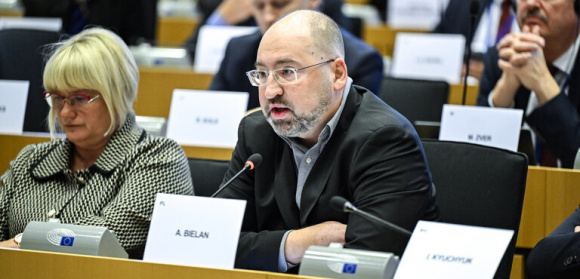
In Brussels, during the hearings of candidates for new EU commissioners, Adam Bielan, the ECR coordinator on the Committee on Foreign Affairs (AFET), held discussions with Marta Kos, who is set to take on the portfolio of Commissioner for Enlargement.
Adam Bielan emphasized that the outlook for the Eastern Partnership “is undoubtedly complex,” as it must balance aspirations with rigorous standards. The PiS MEP raised the issue of Ukraine, stating that “there is no doubt that the war waged by Russia on Ukrainian territory has accelerated the prospect of Ukraine’s membership in the European Union.” He added that the same applies to Moldova.
“Although we realize that there is no ‘fast track’ option and that these rigorous accession criteria must be met, one cannot underestimate the geopolitical significance of Ukraine’s potential integration into the EU and NATO,” the Polish politician stated. In this context, he asked what the plans are for Ukraine’s integration process in the coming years and what the main obstacles are on its path to European integration.
Marta Kos stated that Ukraine “brings a new dynamic to the entire enlargement process.” “We are living in a historic moment when the enlargement process is becoming a priority for the European Union, partly because of Ukraine. Never before have we had a candidate country that was at war,” she noted. She emphasized that Ukraine has made visible progress and stated: “Ukraine’s accession to the European Union, the reconstruction of that country, aid to Ukraine, and the rebuilding of everything that was previously destroyed will be my priority.”
The PiS MEP also raised the issue of Georgia, mentioning the “sad and, unfortunately, persistent” developments in that country regarding democracy and human rights. He stated that the recent elections had revealed the growing influence of anti-democratic forces. “And this is the assessment not only of Georgian society but also of the international community,” he added. Referring to the goal outlined in the Georgian constitution—membership in the European Union and NATO—Bielan noted that “it seems this progress has been halted by the current government.” “What path do you see for EU-Georgia relations? What minimum requirements would have to be met to reactivate this process? And how do you view the issue of the European Union’s support for democratic reforms in Georgia in the coming years?” asked the PiS MEP.
Marta Kos appealed to Georgians not to “lose hope.” “We are ready to continue our work on enlargement and to support Georgia on its path to European Union membership,” she assured them. Speaking about the conditions that must be met, she emphasized that the Georgian government “must demonstrate that it wants to follow this path.” “We expect two laws that have been adopted to be repealed—first, the one regarding internal interference, and second, the one concerning values and the family,” she noted. The Slovenian politician also mentioned a package of necessary reforms that has been prepared, concerning not only the government but also civil society. “Nothing has been fully implemented yet, but I hope that, in cooperation with the European Parliament, we will be able to help Georgia together,” she emphasized.