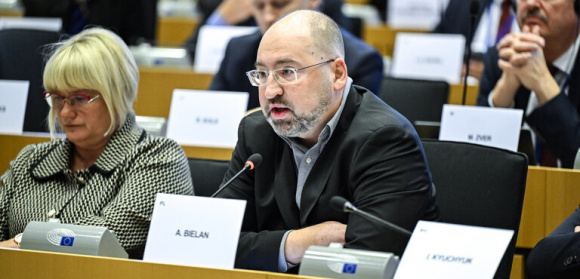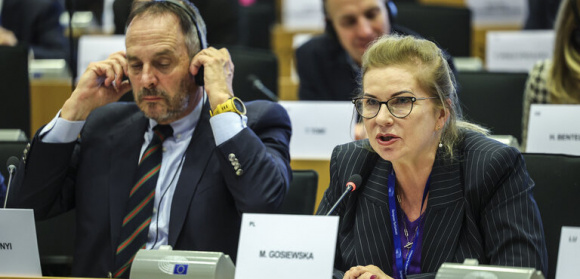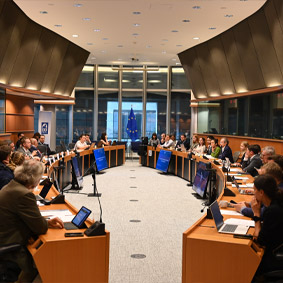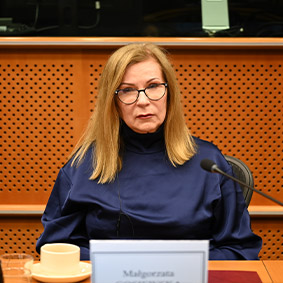
During the ongoing hearings in Brussels for commissioner positions in the new European Commission, PiS MEPs Małgorzata Gosiewska and Mariusz Kamiński questioned Czech candidate Jozef Síkel for the position of Commissioner for Jozef Síkela, about issues related to development policy.
Malgorzata Gosiewska, MEP and ECR Group coordinator on the Committee on Development (DEVE), argued that civil society organizations and nongovernmental organizations—particularly those based in smaller, recently admitted to the European Union, as well as faith-based organizations, churches, and missionaries, are key partners in development who work closely with local communities and are therefore best positioned to understand their needs. “It’s this close contact with the local community, but also less corruption and lower costs associated with administering such aid,” she added, referring to the openness toward such organizations mentioned by Sikel. The PiS MEP asked what specific support the future commissioner envisions for such organizations, given the difficulties they have faced so far in gaining access to EU funds.
Józef Sikela emphasized that greater support for nongovernmental organizations compared to the previous budget period means there will be sufficient information from the field, “because local communities can help us not only identify appropriate opportunities but also alert us when something goes wrong.” He also noted that it will be necessary for the relevant authorities to monitor these organizations for potential financial irregularities. “Education and cooperation with civil society organizations are something I am committed to,” he emphasized.
Gosiewska also asked about the Global Gateway strategy, which aims, among other things, to foster cooperation between the European Union and Africa as part of an investment package supporting infrastructure projects. “In your opinion, how could this strategy help create jobs in developing countries and, thereby, address the root causes of migration?” the PiS MEP wanted to know.
The candidate for Commissioner for International Partnerships stated that the role of development aid is to provide “the lubricant that will keep the engine running smoothly,” and—as he explained—the engine is the Sustainable Development Goals. “We must focus on creating new jobs, building sustainable economies, and investing in projects that will foster development and bring these countries to a medium level of development so that they can become part of global trade,” he emphasized.
The Polish politician also drew attention to the difficult situation of women, children, and people with disabilities, who are the main victims of wars, natural disasters, and poverty. She noted that when such conditions persist and aid fails to reach them, they fall into a vicious cycle from which it becomes increasingly difficult to break free. Gosiewska asked the future commissioner what steps he would take to ensure more effective use of development aid to improve the lives of those in the most difficult situations, particularly in developing countries. In addition, the PiS MEP addressed the issue of countries ruled by authoritarian regimes in the context of European development aid, specifically mentioning Cuba. “I would just like to remind you of the excellent church-run organizations that operate schools, provide meals, offer medical care, and teach life skills. They are close at hand and offer help. Let’s help them more effectively by granting them access to European funds,” she appealed.
Sikiela agreed with Małgorzata Gosiewska: “Indeed, we must use every opportunity to help these people.” He also stated that religious organizations—partners affiliated with specific faiths—are most welcome as EU partners, “as long as they agree to operate in accordance with European values.” On the issue of ensuring that aid reaches people in need, the Czech politician stated that “this is very difficult” and requires close cooperation with local NGOs.
Mariusz Kamiński said: “We both come from countries where communism reigned just four decades ago. We remember those times when, despite the difficult situation, none of us expected the West to provide financial support to the regimes of Jaruzelski or Gustav Husák. On the contrary, we believed that any funds provided to the regime—even in the form of humanitarian aid—would only strengthen it.”
In this context, the PiS MEP raised questions about partnerships, agreements, and the provision of development aid to countries ruled by authoritarian regimes. “Most organizations in these countries are tied to the regime, as is the case in Cuba, for example, where the Communist Party of Cuba controls every aspect of life in the country, freedom of association does not exist, and private economic activity is extremely limited,” he noted. Kamiński asked what steps would be taken to ensure that, while assisting people in difficult situations in authoritarian countries, the regimes ruling there are not strengthened. “In your opinion, given the number of political prisoners and Havana’s stance toward Russian aggression in Ukraine, shouldn’t the agreement on political dialogue and cooperation with a country like communist Cuba be suspended, as we demanded in a recently adopted resolution?” the Polish politician asked.
“In the case of dictatorships, juntas, and hostile regimes, aid must be limited to basic needs so that there is as little possibility as possible of that aid being misused,” Sikiela stated, announcing that he would explore ways to provide aid to the people of Cuba while bypassing the regime.