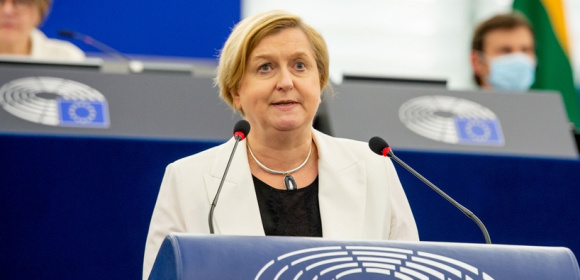
PiS MEP Anna Fotyga submitted a question to the European Commission regarding the stabilization of the European agricultural market.
The PiS MEP stated that the European Union allows the import of Russian “blood grain” into the internal market, but also permits its transport through EU ports and terminals. “On the one hand, we are helping Ukraine, and on the other, we are allowing Russia to profit from grain exports, take over markets where Ukrainian grain is blocked, and even sell stolen Ukrainian grain. All of this is happening at the expense of European farmers,” she emphasized.
Anna Fotyga pointed out that Latvia is one of the main importers of Russian agricultural products, including grains and oilseeds. “Since the outbreak of full-scale Russian aggression, grain imports from Russia to Latvia have more than tripled. According to unofficial data, the figure is even higher, as the vast majority of these imports flood the common European market—causing problems for farmers outside Latvia—and are also transshipped in ports and exported outside the EU. It is taking the place of Ukrainian grain, which in turn is entering the European market, with European farmers bearing the costs,” she said. The Polish politician added that this has been confirmed by Latvia’s Minister of Agriculture himself, while the Latvian EU Commissioner responsible for this portfolio is failing to take appropriate action on the matter.
In light of the above, Anna Fotyga asked whether the Commission recognizes the ambiguity of a situation in which it allows European markets to be flooded with Russian grain, causing problems for European farmers, and also facilitates its export to global markets, pushing Ukrainian producers out of their traditional markets.
The MEP also asked whether, given the example of Latvia mentioned above, the EU should not impose sanctions on the import and transport of Russian grain and other agricultural products.