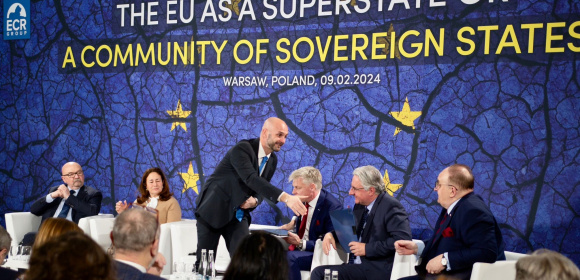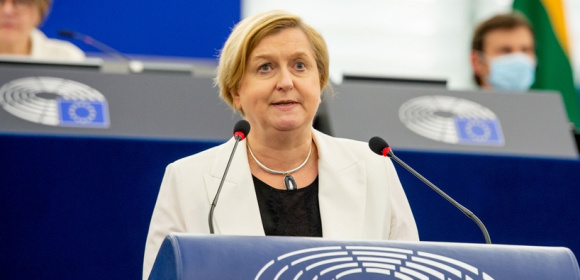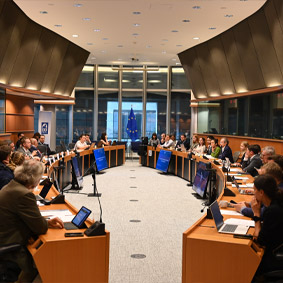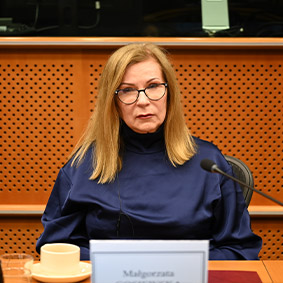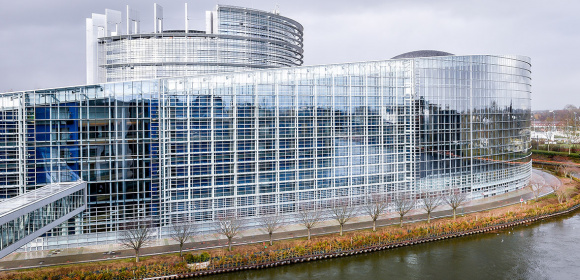
A debate titled “Combating Hate Speech and Disinformation: The Responsibility of Social Media Platforms Under the Digital Services Act” took place at the European Parliament in Strasbourg. MEPs from the ECR Group—Adam Bielan, Beata Mazurek, Kosma Złotowski, Elżbieta Kruk, and Joachim Brudziński—spoke during the discussion.
Adam Bielan noted that we are living in an era of extremely rapid development of digital technology, particularly the Internet, which is the primary source of information for most citizens today—and certainly for the vast majority of young people. He stated that this poses major challenges for us, particularly regarding disinformation online. The Polish politician noted that he is aware of the gravity of these threats, which is why exactly one year ago, together with the ministers for digital affairs from Poland and Ukraine, he organized a major conference at the European Parliament on Russian disinformation.
The MEP urged that, in combating these problems, we should “not throw the baby out with the bathwater” and remember that freedom of speech is the foundation of democracy. “Freedom of speech must be accompanied by responsibility, which is why there is a great need to educate citizens, but we cannot allow unjustified censorship or restrictions on freedom of expression,” he argued. He stated that he supports clear and consistent standards for moderating online content. “As a co-rapporteur on the Digital Services Act—the so-called DSA—I fought to create a safer, more transparent internet, so as not to give large online platforms and social media outlets excuses to remove content,” Bielan pointed out. He appealed to MEPs not to use the positive provisions adopted in the DSA against freedom of speech. The Polish politician also expressed concern about certain ideas being considered by some political factions regarding the removal of anonymity for Internet users. “I believe this could lead to very dangerous censorship, and I repeat that freedom of speech is a great value on the internet and a great value in a democracy,” the politician concluded.
Beata Mazurek stated that there is no place for censorship in a free Europe. She expressed deep concern over the tendency to impose restrictions on freedom of speech under the guise of combating illegal content on the Internet.
The MEP recalled that the concept of “hate speech” has its roots in totalitarian regimes, such as the Soviet Union, where it served as a tool to silence political opposition. “Today, we see how the same mechanism is being used by certain political forces to eliminate competition and stifle political debate,” she stated, adding that she had personally experienced this. “My colleagues from the ECR and I had our parliamentary immunity revoked simply for liking a post by our political group on social media that clearly illustrated the aggression and threats posed by illegal immigrants to residents throughout the European Union,” — Beata Mazurek said, referring to her own experiences.
“Can you imagine that someone in the European Parliament would have their immunity revoked simply for liking a post that attacks Christian values, conservative values, or the Catholic Church?” —the MEP wondered, noting that such a situation would never arise because attacking these values is all the rage among the European left.
“Let’s not allow freedom of speech to be trampled by European neo-Marxists who want to impose their worldview on us,” she urged.
Kosma Złotowski said that the internet has become the main arena for public debate today. “Social media is no longer just a source of entertainment; it has become a space for expressing views, a source of information, and a tool for communication between politicians and citizens,” he said.
The MEP noted that no one doubts that content promoting or inciting violations of the law should be removed. “However, under the pretext of combating so-called hate speech, we often see efforts to suppress views, opinions, or beliefs that do not align with the narrative the left wants to impose on Europe across all possible issues —from the definition of family, through the threats posed by illegal immigration, to climate protection,” he said, expressing his concerns.
“Any attempt to censor or restrict freedom of speech is always a step toward undermining democracy and the values on which it is based,” he argued. Kosma Złotowski also noted that this is how authoritarian states manage the internet, removing and blocking content that does not align with the ruling regime’s ideological line, and added that the European Union cannot employ similar methods.
Elżbieta Kruk stated that “hate speech” is a controversial, ambiguous term that can be interpreted subjectively and is, moreover, embedded in a political context. “We are seeing cases where it is used to restrict basic rights and freedoms, including the fundamental right to free speech and the right to criticize,” she pointed out. The MEP noted that after the fall of communism—and what seemed to be the fading into oblivion of the censorship that had been its ubiquitous companion—censorship is returning in an even more dangerous form.
The Polish politician wondered what goal those advocating for the criminalization of hate speech are pursuing. In this context, she referred to existing provisions in the legal code that provide protection for those affected by hate. She explained that these provisions protect everyone, including, for example, people with a different “sexual orientation.” “So this is not about protection, but about creating a tool to fight political opponents whom they wish to discredit,” she noted.
The Polish politician noted that, under the guise of noble slogans, influential political minorities are striving to make the rest of the world afraid to speak their minds, call things by their proper names, or reveal uncomfortable facts. “Today, it is not minorities that are under threat, but the freedom of public debate,” she commented. Elżbieta Kruk described the threat to ban Twitter from operating in the European Union as scandalous and symptomatic of this trend.
Joachim Brudziński recalled that the very concept of hate speech originated in the Soviet Union as early as the 1940s, when the communists used it for ideological warfare against the regime’s political opponents. “We see how the contemporary neo-Marxist left is eagerly embracing this Soviet invention today,” Brudziński noted, recalling the recent vote by the left-wing majority to strip PiS MEPs of their immunity for liking a post that depicted the true situation regarding the aggression and criminal activities of illegal migrants. “Will it soon become standard practice to send people to prison for invoking natural law or Christianity online?” Brudziński wondered, noting that court cases are already underway in Europe for quoting the Bible. “The fight against hate, online hate speech, and terrorism on the Internet cannot be a cover for a war against reason and common sense,” he urged. According to the PiS politician, this is a mechanism that inevitably leads to silencing political opponents and that clearly restricts one of the fundamental freedoms: freedom of speech. “That is why this Chamber must resound loud and clear with the call: ‘Stop online censorship,’” he emphasized.