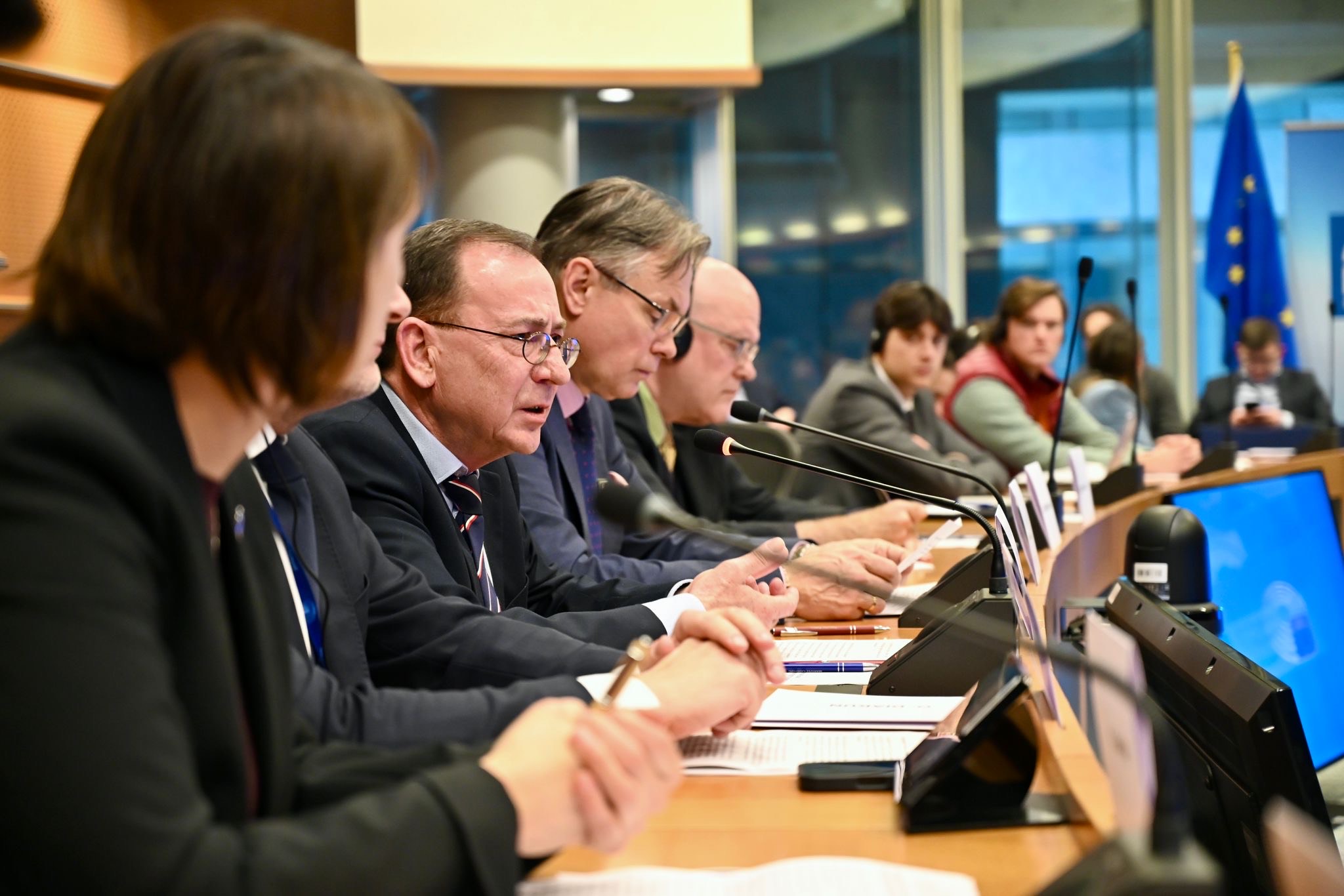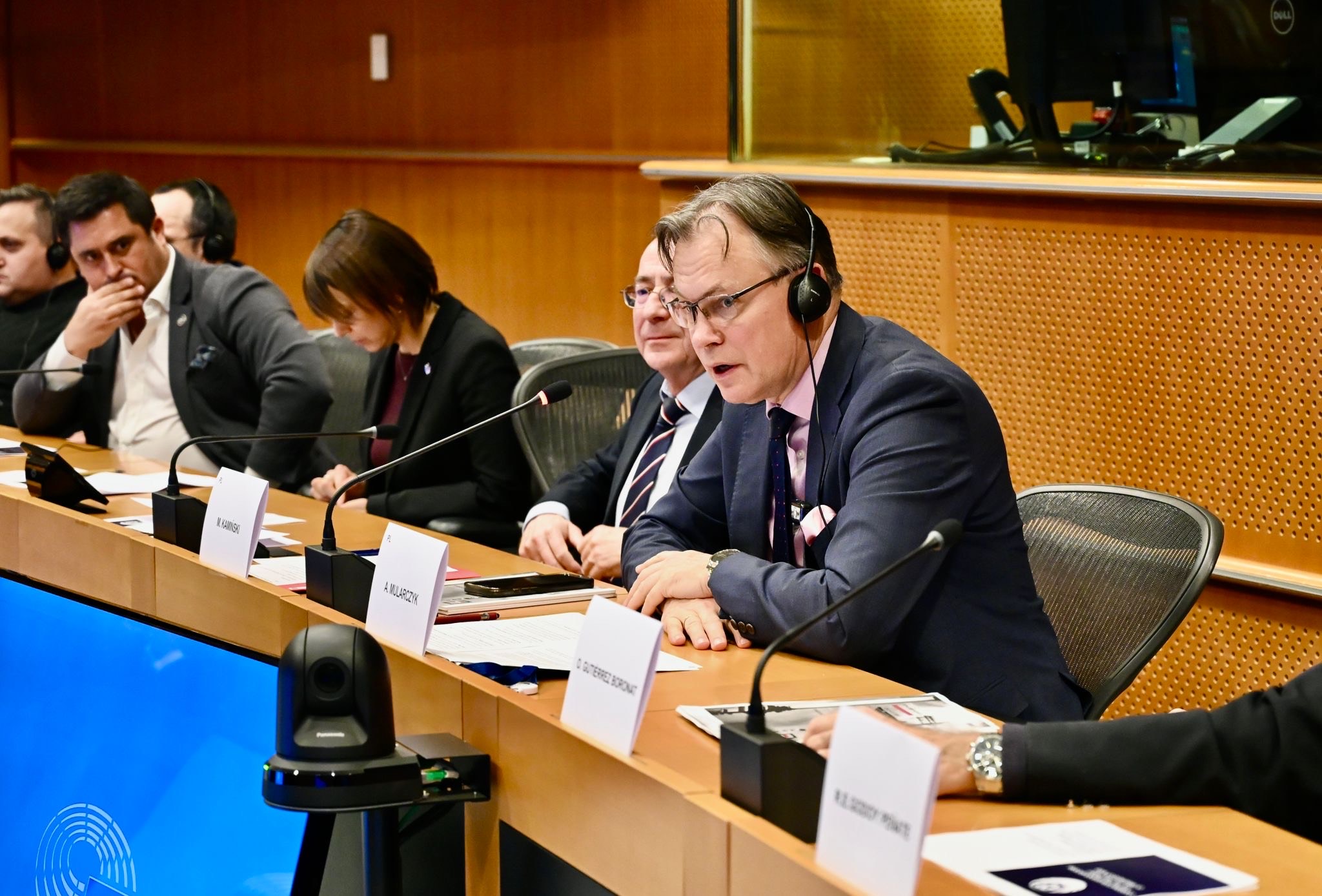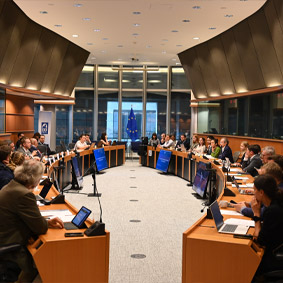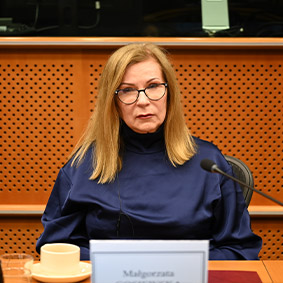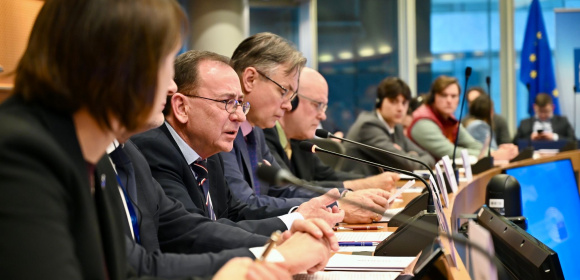
A conference titled “Cuban Mercenaries in Russia’s Aggression Against Ukraine” was held at the European Parliament, dedicated to exposing and analyzing the involvement of Cuban citizens fighting on the side of the Russian Federation in the war against Ukraine. The event brought together Members of the European Parliament and politicians from Europe, the United States, and Latin America, as well as representatives of the Ukrainian government, security experts, and representatives of the Cuban democratic opposition.
The conference was organized by MEPs Mariusz Kamiński, Carlo Fidanza, and Arkadiusz Mularczyk.
In his opening remarks, MEP Mariusz Kamiński emphasized that Russia’s aggression against Ukraine is part of a broader system of cooperation among authoritarian regimes aimed at undermining Europe’s security. He noted that without external support—economic, technological, and military—Russia would not be able to wage war on such a scale. “Alongside China, Iran, and North Korea, the role of Cuba is also becoming increasingly evident, though it remains insufficiently acknowledged in the European public debate,” he noted.
Kamiński pointed out that, according to information provided by Ukrainian sources and members of the Cuban democratic opposition, thousands of Cuban mercenaries are fighting in the ranks of the Russian military. “Under a repressive dictatorship, such a massive participation of Cuban citizens in a foreign armed conflict could not take place without the knowledge and approval of the regime in Havana,” he emphasized. He also noted that Cuba is on the U.S. list of state sponsors of terrorism and that its security officials have for years been involved in protecting and stabilizing allied dictatorships, including in Venezuela.
The MEP sharply criticized the European Union’s current policy toward Cuba, which is based on the 2016 Political Dialogue and Cooperation Agreement (PDCA). “This is a naive and harmful policy. Every year, the EU transfers millions of euros to a regime that systematically violates human rights, detains political prisoners, and simultaneously supports the Russian war machine,” he said. According to Kamiński, Brussels should immediately suspend the agreement with Havana and cease its political and financial support for the communist dictatorship.
In his speech, MEP Arkadiusz Mularczyk drew attention to Cuba’s often underestimated but extremely effective intelligence and security apparatus. He recalled that just a few days earlier, news had spread around the world about the deaths of several dozen Cubans who served as the elite security detail for Venezuelan dictator Nicolás Maduro. “This shows that the Cuban apparatus of repression operates globally, far beyond the island’s borders,” he noted.
Referring directly to the war in Ukraine, Mularczyk emphasized that available and confirmed information points to the mass recruitment of Cuban citizens into the Russian army. “Estimates range from several thousand to as many as over ten thousand people. Many of them were lured by false promises of work or high wages, only to end up on the front lines as cannon fodder in Putin’s imperial war. Others went there with the full knowledge, and even complicity, of the authorities in Havana,” he said.
The MEP noted that this is not a new phenomenon, but rather a continuation of the Cuban regime’s longstanding practice of exporting force and repression—from Africa during the Cold War, through the Middle East, to modern-day Venezuela. “Today, in 2025–2026, Cuba is facilitating the formation of one of the largest groups of foreign fighters supporting Russian aggression—second in size only to North Korea,” he assessed.
Mularczyk emphasized that the Russian invasion of Ukraine is an attack on the entire rules-based international order. “A regime that supplies human resources for this war becomes an accomplice to war crimes and a threat to Europe’s security,” he noted, calling for tougher sanctions against Cuba, the identification and prosecution of mercenaries, and consistent support for Ukraine until victory.
Representatives of the U.S. Congress and Senate also spoke via video messages, including Mario Díaz-Balart, Alexis Calatayud, and Carlos A. Giménez, who unanimously criticized the European Union’s funding of the Cuban regime and called for redirecting those funds to aid Ukraine. “The Western Hemisphere is sometimes viewed as a place where everything is in order and has always been supposed to be fine. But that is not the case. We see this time and again through the influence of terrorist and narco-terrorist regimes in the Western Hemisphere. These regimes not only threaten the national security interests of the United States but also affect Europe. We see this very, very directly in the form of hundreds of Cuban mercenaries—soldiers—who are currently in Europe and are, in fact, fighting and killing Ukrainians on Putin’s behalf,” said Congressman Díaz-Balart.
“The problem, however, is that at the very same time that our European allies—and I think rightly so—are asking the United States for help in defeating Putin in Europe, many of our European friends are simultaneously helping to strengthen, support, finance, and legitimize Putin’s strongest ally, located just 90 miles from the United States. “This must stop,” the congressman urged, referring to the aid provided by the EU to Havana under the PDCA agreement
“The Cuban regime is an extremely important ally of Russia in its genocidal aggression against Ukrainians—on the diplomatic, military, and intelligence fronts. Mercenary units of the Cuban regime are stationed in Venezuela, Belarus, and Ukraine, where they have been carrying out Russia’s expansionist foreign policy for years,” said Senator Alexis Calatayud. “From the moment the Castro dictatorship seized power in 1959 until today, this regime has sent its mercenary units and terrorist forces to every foreign military operation, every occupation and every invasion ordered by Moscow. From Algeria to Syria, from Ethiopia to Angola, and now from Venezuela to Ukraine, the Castro terrorist dictatorship acts as the enforcer of Russian imperialism,” she said.
The conference was also attended by representatives of the Ukrainian government, including Oksana Diakun from the Mission of Ukraine to the EU, members of the Verkhovna Rada of Ukraine, and representatives of Ukrainian military intelligence, who presented current data on the involvement of Cuban mercenaries in the war.
“The Russians are actively recruiting mercenaries—from Asia, through Africa, to Latin America,” said Ambassador Diakun. The diplomat noted that although the Cuban authorities officially deny the participation of their citizens in Russia’s war against Ukraine, the facts on the ground point to something entirely different. “Cuban citizens have been captured on multiple occasions by Ukrainian defense forces on the front lines, fighting side by side with Russian troops. According to available information, thousands of Cuban citizens have signed contracts to join the ranks of soldiers directly involved in combat operations on Ukrainian territory. This mass recruitment is not a matter of isolated cases of Cubans acting on their own. It is a systemic practice involving illegal networks operating openly, with the tacit approval of the authorities in Havana. “The Cuban government’s reluctance to stop the mass dispatch of its own citizens to participate in Russia’s war against Ukraine constitutes complicity in an act of aggression,” Diakun said.
One of the leaders of the Cuban opposition, Orlando Gutiérrez Boronat, stated that the Castro regime is not merely a casual ally of Russia, but its systemic servant. Boronat highlighted Havana’s military ties not only with Moscow but also with Belarus. “Let’s not forget the military agreements signed in Minsk, which also cover the training of Cuban soldiers in Belarus. The Castro regime openly states that we are dealing with a much broader struggle against the United States and the West. ‘It is obvious which side the regime in Cuba is on,’ the opposition figure concluded.
Rosa Maria Paya also presented a timeline of Russia’s military cooperation with communist Cuba. The opposition figure pointed out that in the Western Hemisphere as well—in Venezuela, Nicaragua, and Cuba—a struggle against the same enemy is underway. “We must be more united so that freedom can triumph there as well,” said Paya, citing examples of controversial support provided by the EU to the regime in Havana.
Andrei Yusov, spokesperson for the Main Intelligence Directorate of the Ukrainian Ministry of Defense, reported that the issue of mercenaries in the Russian army is very significant and continues to grow. “We know of 24,000 mercenaries whom we have managed to identify and whose names we know. Cubans are at the top of that list,” Yusov said. “As of the end of 2025, we had data on over 1,000 Cubans, but the actual number is much higher. We have also managed to identify more than 40 Cubans who were killed in action,” added the HUR representative. “For Putin, these represent fewer losses among his own forces. The cost of a mercenary is also lower than paying wages, allowances, or compensation to native Russians,” said Yusov. He also noted that mercenaries take part in the most dangerous and high-risk attacks on the front lines. "In 2025, the number of foreigners who surrendered doubled. We currently have 166 prisoners from 40 countries. Thanks to pressure from the U.S. and the EU, many countries have made recruitment more difficult, but this pressure must be stepped up even further,” concluded Yusov.
Ukrainian lawmaker Marian Zabłocki reported that just last week, four Cuban mercenaries were taken prisoner by Ukraine, providing details of a conversation he had with them. “Ukraine estimates that 5,000 Cuban mercenaries are fighting on Russia’s side. Given that North Koreans are fighting under duress, Cubans constitute the largest national group among the mercenaries. Europe must be aware of this,” Zabłocki urged.