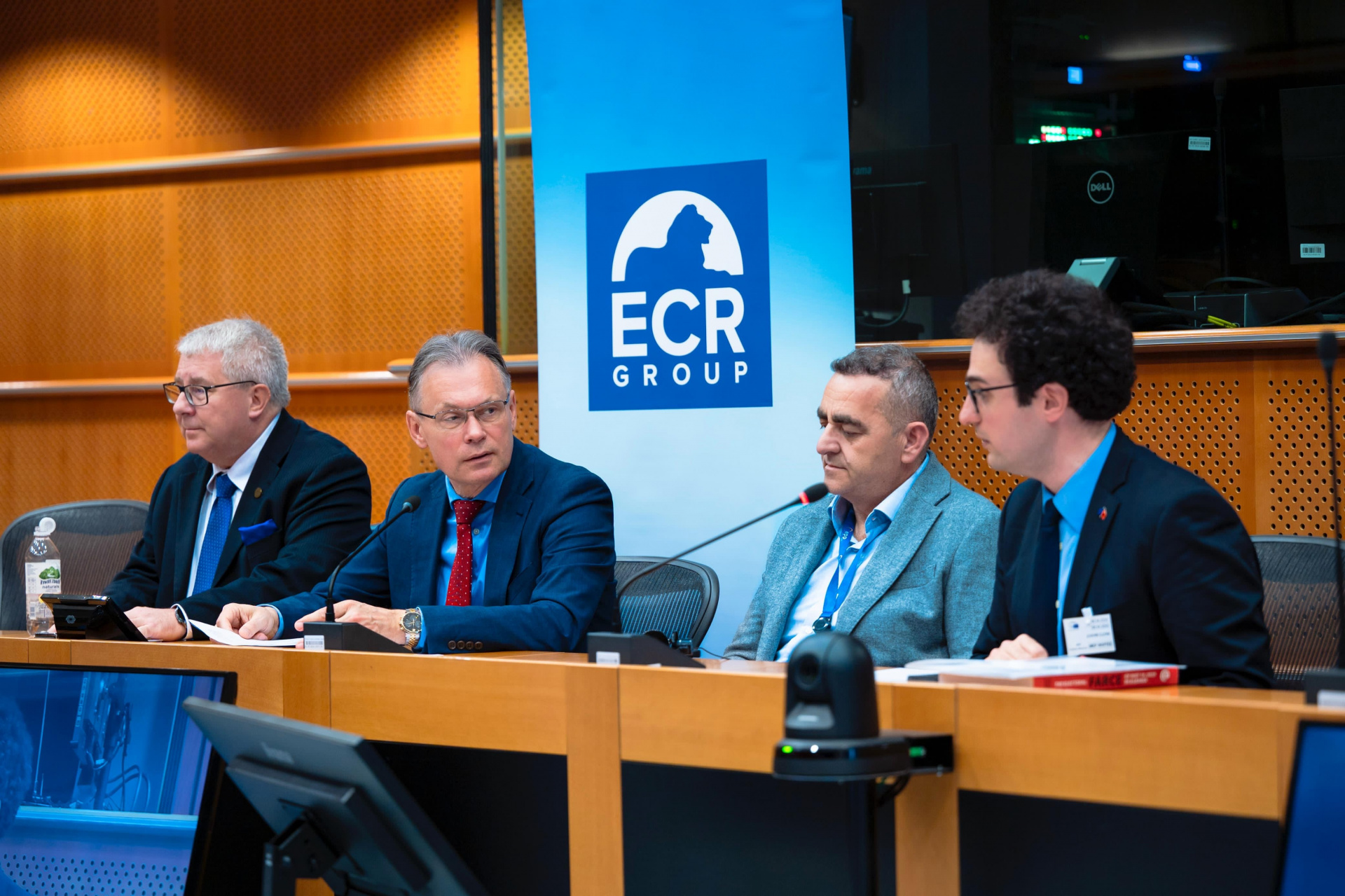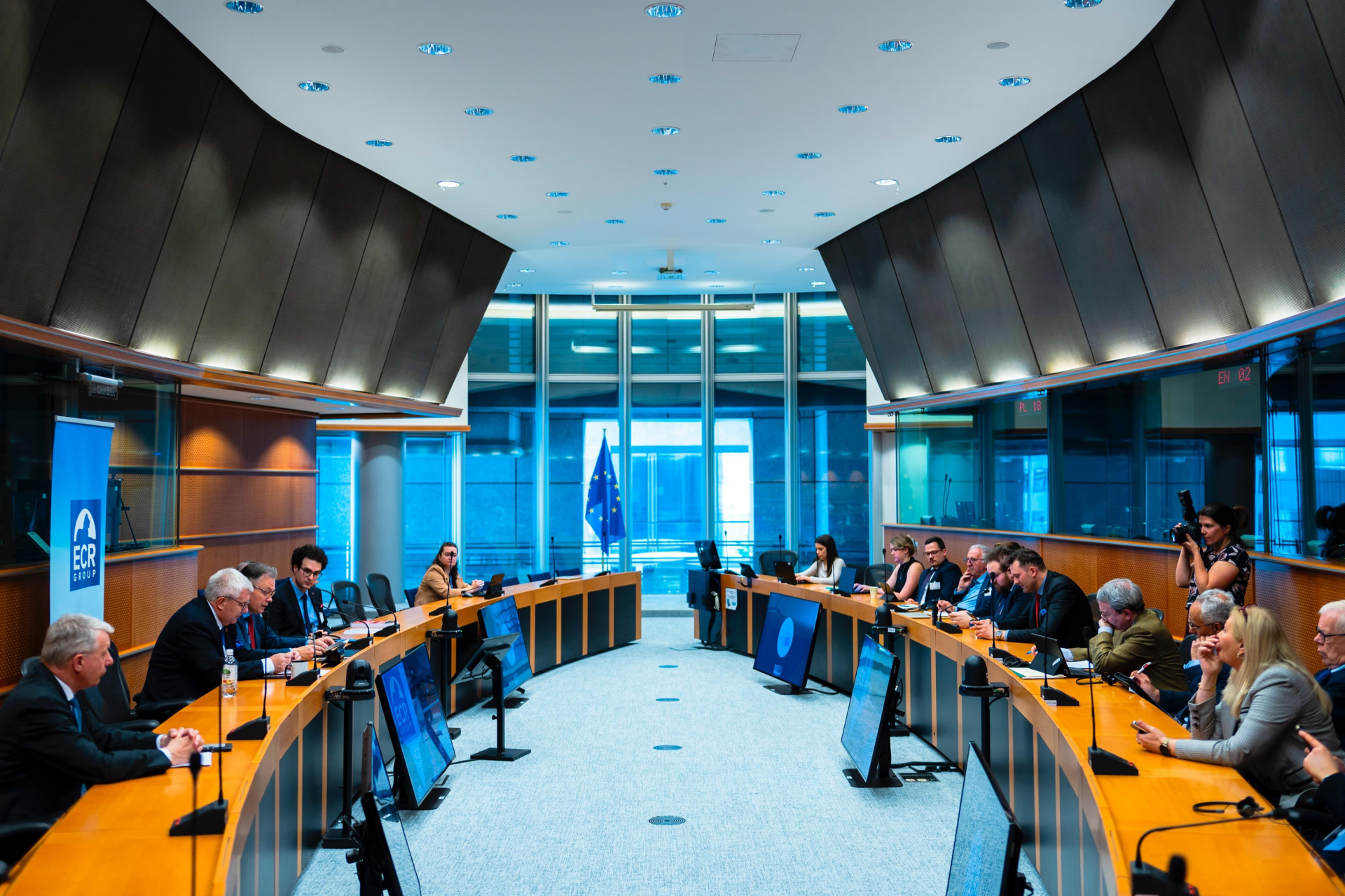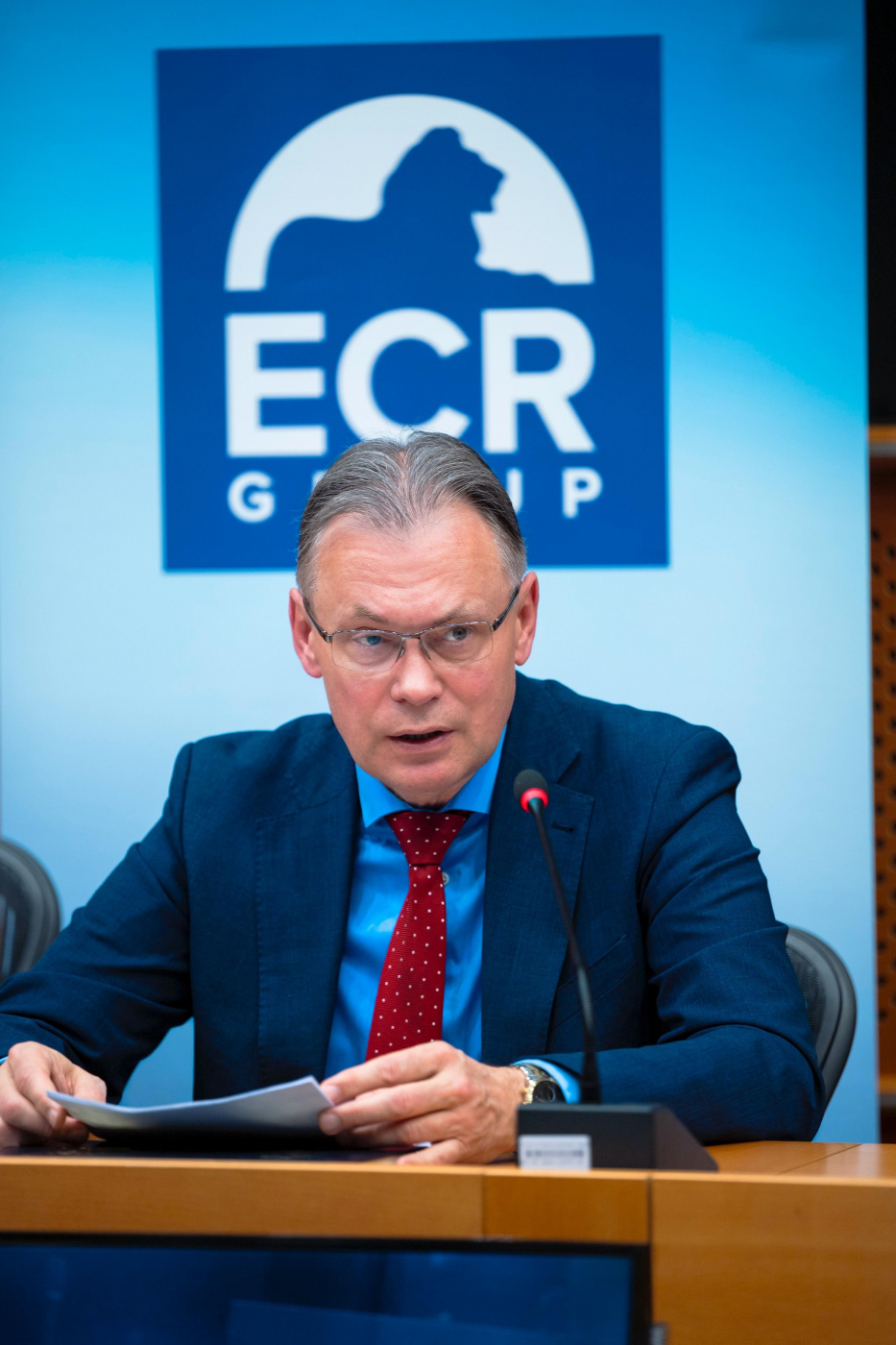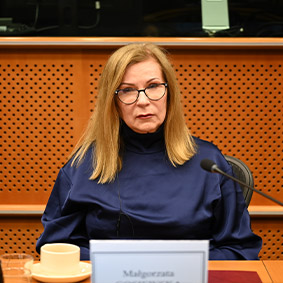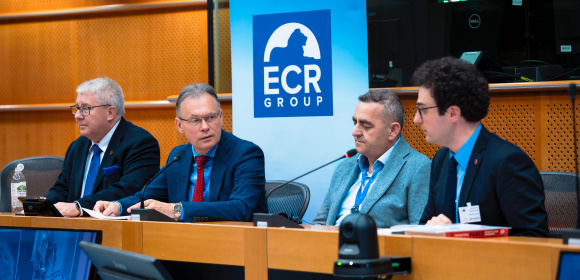
Today in Brussels, at the initiative of PiS MEP Arkadiusz Mularczyk, a conference titled “Quo Vadis Albania: Between Democracy and Authoritarianism” took place. The event focused on discussing the state of democracy and the integrity of elections in Albania and the broader Western Balkans region.
Arkadiusz Mularczyk stated that “one cannot speak honestly about Albania’s democratic challenges without simultaneously acknowledging the broader crisis of democratic standards and trust that is affecting the entire European space.”
He highlighted issues that “should be obvious but, unfortunately, often go unspoken,” such as the decline of democracy, political pressure, and the manipulation of institutions among EU candidate countries. He also noted that these are problems the European Union itself faces—sometimes in an increasingly visible and alarming manner. In this context, he recalled that European institutions, and in particular the European Commission, have in recent years begun to interfere in national political processes in a way that raises serious questions about neutrality and respect for sovereignty. “Let’s be clear: no unelected body—no matter how powerful—should have the right to influence or manipulate electoral processes in sovereign democratic states,” — Mularczyk emphasized, pointing to examples such as the recent elections in Romania, the situations in France and Italy, as well as interference in Poland’s internal affairs during the PiS government.
"This is deeply troubling. Elections are the cornerstone of democracy. They are the purest expression of the people’s will,” he stressed, adding that “if citizens are to maintain trust in democratic institutions, those institutions must remain impartial, respect national elections, and be completely separate from electoral competition.” “Any attempts by EU structures to influence the results—directly or indirectly—undermine the very legitimacy of the European project,” — Mularczyk argued, pointing out that this is precisely what is currently happening in Albania, where “there is an alarming trend of behavior that runs counter to the principles of political pluralism and equal opportunity.”
The event’s organizer described in detail the situation in Albania, where the treatment of the opposition—particularly the Democratic Party of Albania, one of the country’s main center-right forces—“raises serious questions about the state of democracy,” and the Socialist Party, which has been in power for years under Prime Minister Edi Rama, is systematically seeking to marginalize dissent, consolidate power, and control the political narrative.
He said that a striking example of this was the opposition’s boycott of the 2019 local elections. “This boycott should not be seen as a sign of weakness or retreat. It was a desperate and justified attempt to draw international attention to the manipulation of the democratic process,” Mularczyk stated, pointing out that as a result, nearly all local government power ended up in a single set of hands—the Socialist Party declared victory in 60 out of 61 municipalities. “This is not a sign of political consensus—it is a sign of political takeover,” he said.
The PiS MEP said, however, that the problems run deeper — including harassment, intimidation, and the exclusion of opposition members, as in the case of former Prime Minister Sali Berisha, who was subjected to politically motivated sanctions and attempts to silence him. As the PiS politician argued, the fragmentation of the opposition, often cited by analysts, is not organic—it is the result of deliberate state-led strategies aimed at weakening any serious alternative to the current government. “This is not how a democracy should function—especially in a country aspiring to European Union membership,” — the MEP emphasized, stating that from the perspective of fundamental European values—freedom of speech, political pluralism, and equality before the law—this is “an unacceptable situation.” “The EU cannot turn a blind eye to these violations. We cannot apply one standard to member states and another to candidate countries. And we certainly cannot pretend that Albania is on a clear, fair, and credible path to EU accession if the democratic playing field remains so skewed in one direction,” he stressed.
Arkadiusz Mularczyk noted: “As a Member of the European Parliament from Poland, representing the Law and Justice Party, I express my full and unwavering solidarity with the Albanian opposition.” As he emphasized, the Democratic Party of Albania and other anti-government forces must be guaranteed the space to operate, campaign, and participate freely in the political process. “Their voices are essential—not only to maintain balance, but for the health of Albanian democracy as a whole,” added the Polish politician, calling on EU institutions to monitor the situation in Albania much more closely and to speak out against any violations of democratic norms. “Turning a blind eye for the sake of stability or geopolitical convenience would be a betrayal of our fundamental values,” he emphasized.
The PiS MEP also noted that the European Union cannot demand standards from candidate countries that it is not prepared to uphold itself. “But you, too, deserve clarity, honesty, and commitment on our part. And you deserve a clear and realistic path to membership,” he noted.
He recalled that Poland has long been a strong advocate for the integration of the Western Balkans into the EU. “We believe that the European family will only be complete once your countries are admitted to the community—not as second-class members, but as full-fledged and equal partners,” he added. Mularczyk also mentioned that during the United Right’s time in government, Poland was one of the most active participants in the Berlin Process. “We believed in building partnerships, not hierarchies. We believed in helping countries with reforms—not in punishing them for political reasons,” he added.
However, as he noted, the path to EU membership is becoming increasingly unclear, with new requirements being added and more and more technical barriers being raised. “This process has become less a matter of shared values and more a matter of moving the goalposts. And this creates a dangerous vacuum, because when societies begin to believe that EU membership is a distant, unattainable goal—when the finish line keeps getting pushed further away—they lose faith. Not just in Brussels, but in democracy itself. They become disillusioned. And into that space step instability, frustration, and even extremism,” stated Mularczyk, emphasizing that this must not be allowed to happen—neither in Albania, nor in the Balkans, nor anywhere in Europe. “That is why today I appeal to European institutions and other member states: let us restore credibility to the enlargement process. Let us uphold true democratic standards—at home and abroad. Let us support, not sabotage, the democratic opposition. Let us treat Albania and its people with the respect and fairness they deserve,” he urged.
“There is no democracy without a genuine choice. There is no legitimacy without fair elections. There is no European future without a fair partnership.
Yes to democracy. Yes to accountability. Yes to a European future for Albania built on trust, transparency, and mutual respect," he emphasized.