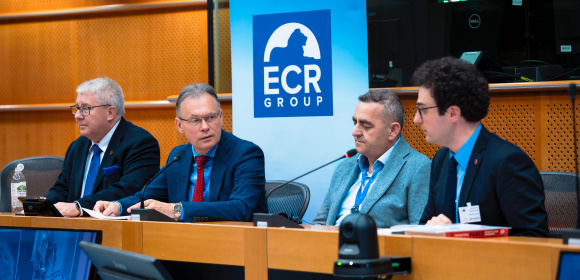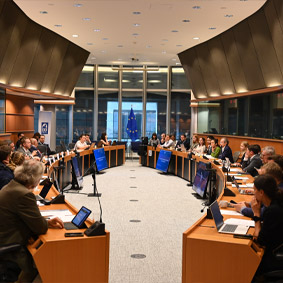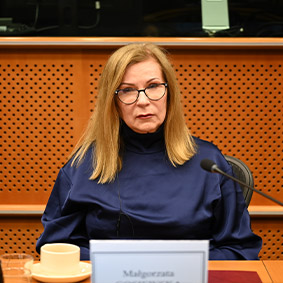
Today in Brussels, during a meeting of the Special Committee on the European Democracy Shield (EUDS), an exchange of views took place with Michael McGrath, Commissioner for Democracy, Justice, the Rule of Law, and Consumer Protection. MEPs Mariusz Kamiński and Beata Szydło spoke on behalf of the ECR Group.
Beata Szydło noted that the meeting was taking place at a particularly significant moment for Poland, on the very day that a court in Warsaw revoked the broadcasting licenses of two independent television stations. She pointed out that this occurred in the midst of the ongoing election campaign in Poland. “As a result, millions of Poles have been deprived of access to information and the truth, because the television stations whose licenses were revoked are independent,” said the PiS MEP, noting that one of them is currently the largest news channel and enjoys enormous popularity. The former head of the Polish government noted that journalists from these stations have recently been barred from press conferences organized by the prime minister or the current government. “How do you assess a situation where, during an election campaign, independent TV stations are stripped of their licenses simply because they are politically inconvenient?” Szydło asked, emphasizing that in her opinion, “this is a scandal.” Referring to McGrath’s statement that the media must be strengthened as the fourth estate, the PiS MEP noted that Poland is currently governed “by a team that violates the rule of law at every turn and goes so far as to commit acts that absolutely violate the principles of democracy.” She also asked for comment on situations where citizens are deprived of access to information during an election campaign.
Mariusz Kamiński referred to the 2023 report on the state of the rule of law in the EU, which included criticism of the conservative Polish government regarding the arrest of Pablo Gonzales, a left-wing Spanish journalist. As he recalled, this case was supposed to be evidence of violations of the rule of law in Poland and restrictions on freedom of speech, but in reality, Pablo Gonzales turned out to be a dangerous Russian spy, Pavel Rubtsov, who was handed over to the Russians last August as part of a high-profile spy swap and was personally greeted by Putin at the airport.
Kamiński stated that the criticism of the Polish authorities for arresting Rubtsev contained in the report was clearly intended to pressure them into releasing the Russian spy. “It was also an attack on the most anti-Putin government in the EU, which at the time was extremely active in supporting Ukraine in its war against Russia,” – added the PiS politician, pointing out that the circumstances of Rubtsov’s detention had not been verified in any way by the Commission, and that the Polish government had not been asked for information on the matter. “Nor were the Spanish authorities asked to take a position; despite having information from Polish intelligence services, they did not come to the defense of their citizen, who was allegedly being unjustly persecuted,” Kamiński noted, once again calling for a full explanation of the matter. “The defense of Gonzales contained in the Commission’s report served the interests of the Russian intelligence services. It is your duty to determine whether it was inspired by them,” he emphasized.