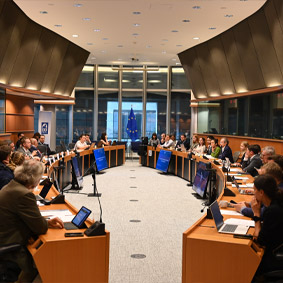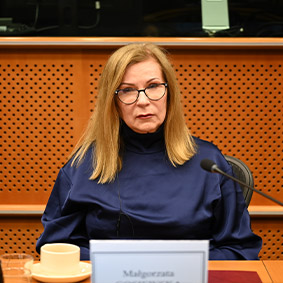
An international conference titled “Belarus: Laying the Groundwork for Democratic Change” was held at the European Parliament in Brussels, focusing on the future of Belarus’s transition and the challenges facing a society striving for freedom. The event brought together representatives of EU institutions, international organizations, and leaders of the democratic opposition. The conference was co-organized by Małgorzata Gosiewska, Chair of the European Parliament’s Delegation for Relations with Belarus.
Participants included, among others, Kaja Kallas, the EU’s High Representative for Foreign Affairs and Security Policy and Vice-President of the European Commission, Nicolae Ștefănuță, Vice-President of the European Parliament; EU Commissioner for Enlargement Marta Kos; Sviatlana Tsikhanouskaya, leader of the democratic opposition in Belarus; and Dr. Kevin Casas-Zamora, Secretary General of International IDEA.
The event’s moderator, Małgorzata Gosiewska, emphasized during the panel discussion “Rebuilding Public Trust in State Institutions Through Transitional Justice: Lessons from Poland and Implications for Belarus” that the experiences of Poland’s post-1989 transformation —both its successes and its mistakes—could prove to be of inestimable value to Belarus. She highlighted the need for comprehensive vetting and the removal of the former elites from power, the development of independent media and transparent institutions, the provision of social protection during the reform period, the adoption of well-considered geopolitical decisions, and the modernization of national defense. “Belarus faces a historic opportunity to carry out these processes more effectively, building a just, transparent, and sovereign state, free from Russian influence,” she noted.
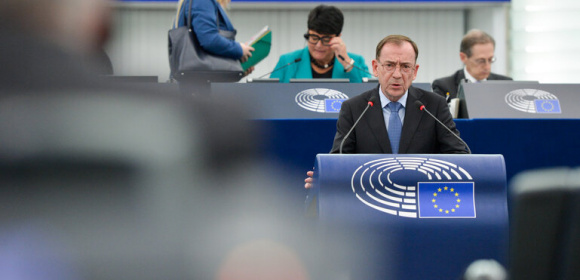
During a panel discussion on creating an anti-corruption framework for a future free Belarus, the founder and first head of the Central Anti-Corruption Bureau, PiS MEP Mariusz Kamiński, who emphasized that corruption is one of the most serious threats to statehood, and that its presence in mainstream public life leads to the collapse of the state. In presenting Poland’s experience, he recalled both the scale of corruption in the 1990s and the turning point marked by the establishment of the CBA, which helped curb everyday corruption—including in the healthcare system and the police—and halted the oligarchization of the state. “Corruption that is mainstream in a country’s political and economic life means that the state must be classified as a failed state,” he warned.
“Don’t waste time! I believe that from the perspective of the fight against corruption, the 1990s in Poland were lost years. When the day of a free Belarus arrives, those who rule today at the expense of the nation must be held accountable. Corruption must not pay off. Society—ordinary citizens—must have a sense of order and purpose,” said Kamiński, also pointing to the need to introduce strict criminal laws, confiscate assets derived from corruption, and ensure full transparency in political financing. He warned against repeating the mistakes of other countries in the region, emphasizing that failures to combat corruption could weaken the young state’s position on the international stage.
Kamiński emphasized that the key to the effectiveness of anti-corruption agencies is the high morale of their members and a complete break from the regime’s structures. In his view, future Belarusian agencies should be built from the ground up, relying on young, well-educated, and principled professionals—lawyers, economists, and IT specialists. “We need a fresh perspective, a new quality. Young people must be the driving force behind these institutions. It must be an ideologically driven institution operating under the political umbrella of the new Belarusian state and the true Belarusian elite. Certainly, those who fight corruption will face brutal attacks, but it is worth it and must be done. It is a difficult struggle, full of sacrifices, but necessary—for history, for the nation, for the state,” he emphasized.
Conference participants agreed that Belarus must begin laying the foundations for future transformation today—from planning institutional reforms, through building effective mechanisms to combat corruption, to strengthening European standards of the rule of law. The conference served to develop concrete solutions and draft legislation to be implemented after the fall of Lukashenko’s regime. The common message was unequivocal support for the democratic aspirations of the Belarusian people and the conviction that preparing for change is the key to building a sustainable, sovereign, and modern state.