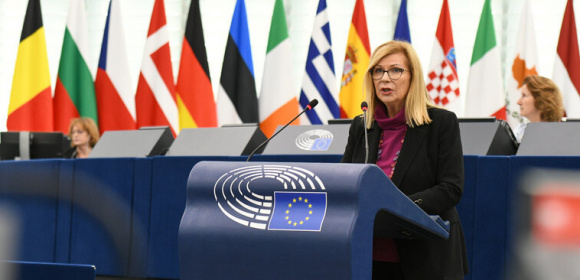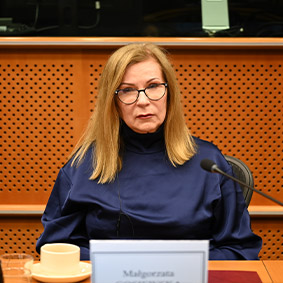
On the third day of the European Parliament’s plenary session in Strasbourg, a debate was held on organized crime as the main threat to the internal security of the European Union and European citizens. ECR MEPs Joachim Brudziński, Jacek Ozdoba, Patryk Jaki, and Małgorzata Gosiewska took part in the discussion.
Joachim Brudziński noted that organized criminal groups operate across borders, and the vast majority of criminal groups in the European Union include members of various nationalities. He also emphasized that organized crime highlights the links between external and internal security.
“The ECR Group supports the fight against organized crime, and the security of European Union citizens is one of our top priorities,” stated the co-chair of the European Conservatives and Reformists. He recalled that the group has been working intensively for years to strengthen border protection, equip law enforcement agencies with the necessary tools, and promote cross-border cooperation.
“That is why we support increasing the budget for Frontex, which helps member states protect external borders and combat cross-border crime, thereby also supporting the fight against organized crime,” explained the Polish politician. He emphasized that Frontex should have access to Interpol’s databases, and that Eurojust should be able to exchange operational information with Interpol. Furthermore, he noted that the Commission should explore the possibility of excluding the Russian Federation from Interpol’s systems.
Joachim Brudziński stated that human trafficking and the smuggling of illegal immigrants remain a lucrative business for criminal organizations in Europe, and in some cases even with the support of third-country governments. “We must use access to development funds as an incentive for genuine cooperation in managing migration flows, including facilitating returns and combating criminal networks,” the politician argued.
He also stated that, to ensure security and prevent abuse of the asylum system, international protection should be granted only to those who are genuinely fleeing persecution and whose lives are in danger. “We advocate that applications for international protection be processed in countries with which the applicants have close cultural, religious, or geographical ties,” the MEP proposed. He added that in those countries, asylum seekers would await a decision on whether they could enter Europe after undergoing thorough security screening.
He added that the EU is succumbing to a reckless ideology regarding illegal migration. “First, there was Germany’s ‘herzlich willkommen’ policy, and when the situation spiraled out of control, Berlin—in violation of the treaties—closed its internal borders and tried to pass this hot potato on to countries like Poland,” the MEP stated. He also recalled that Poland had been criticized—including in this Chamber—for protecting the EU’s external border with Belarus against Putin’s attempts to push illegal migrants into the EU. “If we do not put a stop to this ideologized policy in favor of common sense, these tragedies will keep happening,” Brudziński warned.
Jacek Ozdoba stated that, on the subject of crime, it is worth paying attention to what is happening in Poland. He pointed out that “an illegally appointed individual, who seems to think he is the National Prosecutor, has led to a constitutional crisis”. He noted that Donald Tusk’s government is forcibly taking over the Prosecutor’s Office, even though it does not de facto have the right to do so due to the lack of the president’s signature. He stated that, as a result, constitutional guarantees have been trampled upon.
“In Poland—a country that borders Belarus and Ukraine and is subject to hybrid warfare—prosecutors specializing in cybersecurity, who had been assigned to the National Prosecutor’s Office, were fired overnight” the MEP said. He noted with concern that Poland had let go of its best specialists in combating crime.
Jacek Ozdoba referred to the investigation into the forcible takeover of public media in Poland. He pointed to Minister of Culture Bartłomiej Sienkiewicz, who was present in the plenary hall and who had unlawfully taken over Telewizja Polska. In the context of the takeover of public media, the Polish politician also recalled notary Joanna K., who left the country because she feared the consequences of her actions. The MEP pointed out that when, in violation of the law, an attempt was made to dismiss the National Prosecutor, the new National Prosecutor—appointed unlawfully—decided to strip the prosecutor overseeing the investigation into the forcible takeover of public media of his authority. “And this is what some EU politicians call the rule of law,” commented Jacek Ozdoba. “That is why today, in the face of aggression by the Russian Federation, dismantling the security system and firing prosecutors who are tasked with combating spies is anti-EU and anti-European,” the politician stated.
Patryk Jaki emphasized that the EU has no jurisdiction over organized crime. “But since you’re already talking about organized crime, I want to tell you about one of the most dangerous gangs—the ‘smiling gang’” said the MEP. As he explained, they seized power illegally by freezing people’s funds during the most difficult times—the outbreak of the war in Ukraine and the COVID-19 pandemic—by colluding with an external force to blackmail the public. He added that they later seized state institutions by force—the media, the prosecutor’s office, and now the courts—and “are using them for gangster-style score-settling.” “The ‘smiling ones’ are also sick; they suffer from the same disease as those in the Kremlin—they see Nazis everywhere, and anyone they deem a Nazi is to be subjected to denazification,” Patryk Jaki pointed out. He added that “they also have a recognizable symbol, which is the 8 stars, because it’s a vulgar slogan characteristic of the rabble and criminal groups.” “If you’re wondering how it’s even possible for such a gang to operate in the 21st century, my answer is: it has powerful backers. If you ask, ‘Where?’ then look at the front rows, check your phones, and look in the mirrors,” the MEP commented.
Małgorzata Gosiewska stated that Western Europe is grappling with rising crime, for which “immigrants are to blame—or perhaps rather, those who invited them to Europe.” She pointed out that groups of young, unemployed, aggressive men are an increasingly common sight on European streets. “As members of the European Parliament, we receive warnings about where we shouldn’t go in Brussels at night. It’s a shame that only parliamentarians are protected in this way, while ordinary citizens are forgotten,” commented the Polish politician.
The MEP cited statistics showing that in Spain, one in two perpetrators of sexual assault is a foreign national, and that immigrants from Africa, though they make up only 2.5 percent of the population, are responsible for 20 percent of sexual crimes in that country. She noted that in Sweden, approximately 33 percent of prisoners are immigrants. “A report on crime in Germany shows that immigrants are overrepresented in cases of homicide, murder, serious bodily injury, and rape,” said Małgorzata Gosiewska. She added that “the German interior minister herself has emphasized that Germany remains one of the most dangerous countries in the world.” “We firmly reject the continued bringing in and acceptance of immigrants. We demand safety for our families,” the Polish politician appealed.