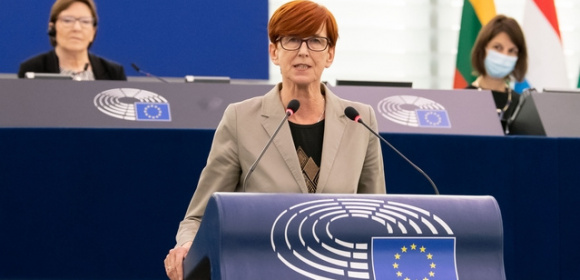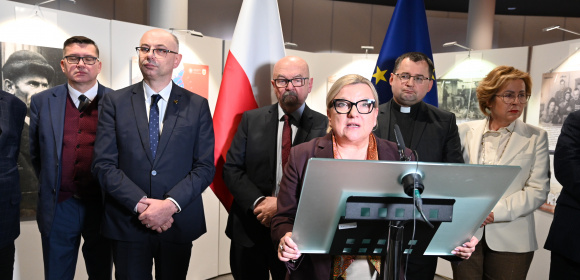
During the European Parliament’s plenary session in Strasbourg, a joint debate was held on the implementation of the Treaty’s provisions concerning national parliaments and EU citizenship. ECR MEPs Beata Kempa and Jacek Saryusz-Wolski spoke during the discussion.
Beata Kempa stated that amending the Treaties is a very broad topic requiring an extremely in-depth analysis. She presented a position that challenged the mainstream view of the discussion. “Although this discussion within European institutions is extremely necessary for us, unfortunately it is not taking place in the member states, nor is it being conducted by the public or by citizens,” —stated the MEP, adding that, in the opinion of the majority of the European Parliament, everything is supposed to move in one direction. The Polish politician recalled that, as part of the Conference on the Future of Europe, proposals opposing further federalization and seeking to build a Europe of Homelands and free, sovereign nations were rejected.
The ECR MEP asked whether a federation is the solution to the problems plaguing Europe today. “Will more decisions made in Europe, without any consultation with member states, solve, for example, the plight of the poor or the declining competitiveness of industry?” the MEP asked. She also wondered whether the forced introduction of the euro in countries that have not yet adopted the single currency would resolve the issue of high energy prices, and whether a common army would prevent products from being sent to Russia in circumvention of European sanctions. “Unfortunately not. A federal Europe governed solely by a handful of institutions will not solve these problems; unfortunately, it will only exacerbate them,” she stated.
Jacek Saryusz-Wolski stated that both reports under discussion—the one on the implementation of the Treaty’s provisions regarding national parliaments, and the report on the implementation of the Treaty’s provisions regarding EU citizenship, demonstrate the extent to which the mainstream of European centralism is attempting to seize the powers of Member States and transfer them to the European level.
The MEP noted that the report on national parliaments proposes very radical centralist solutions, where everything revolves around the political family. “What we are dealing with here is interference in the rights of Member States. National parliaments are not treated appropriately as autonomous political actors; rather, they are subordinate to the European Parliament,” he pointed out. He noted that the “red card” procedure—intended to repeal EU law during work on Treaty amendments—has been rejected, which contradicts the ECR Group’s proposals.
“The report recommends the direct involvement of European political parties in campaigns leading up to European elections and even referendums in Member States. This is detrimental to the diversity and autonomy of the political landscape at the Member State level,” the politician commented, adding that the ECR Group will vote against this report.
Referring to the second report, Jacek Saryusz-Wolski stated that it is even more controversial. “It concerns European Union citizenship and aims to strip Member States of their most fundamental and exclusive prerogatives,” he explained. He noted that citizenship is always linked to being a member of a given nation, and that the granting of citizenship is the exclusive prerogative of a Member State. “There should be no other way to obtain EU citizenship than by being a citizen of one of the Member States, in accordance with the rules, traditions, culture, and constitutional order prevailing in that state,” he argued. As he emphasized, granting EU citizenship to third-country nationals without requiring them to obtain citizenship of a Member State is contrary to the provisions of the Treaty, and he added that the ECR Group would not support this report.