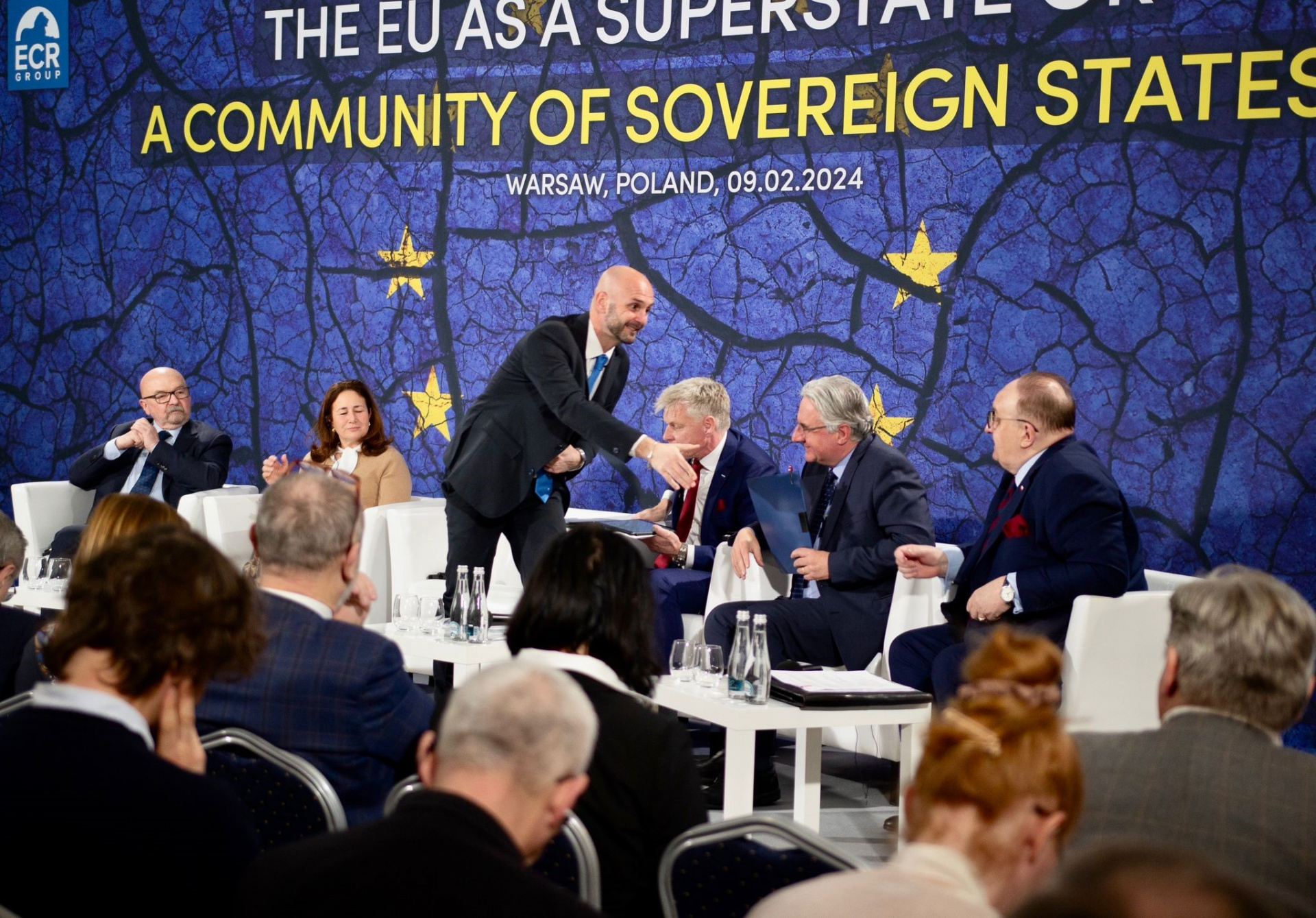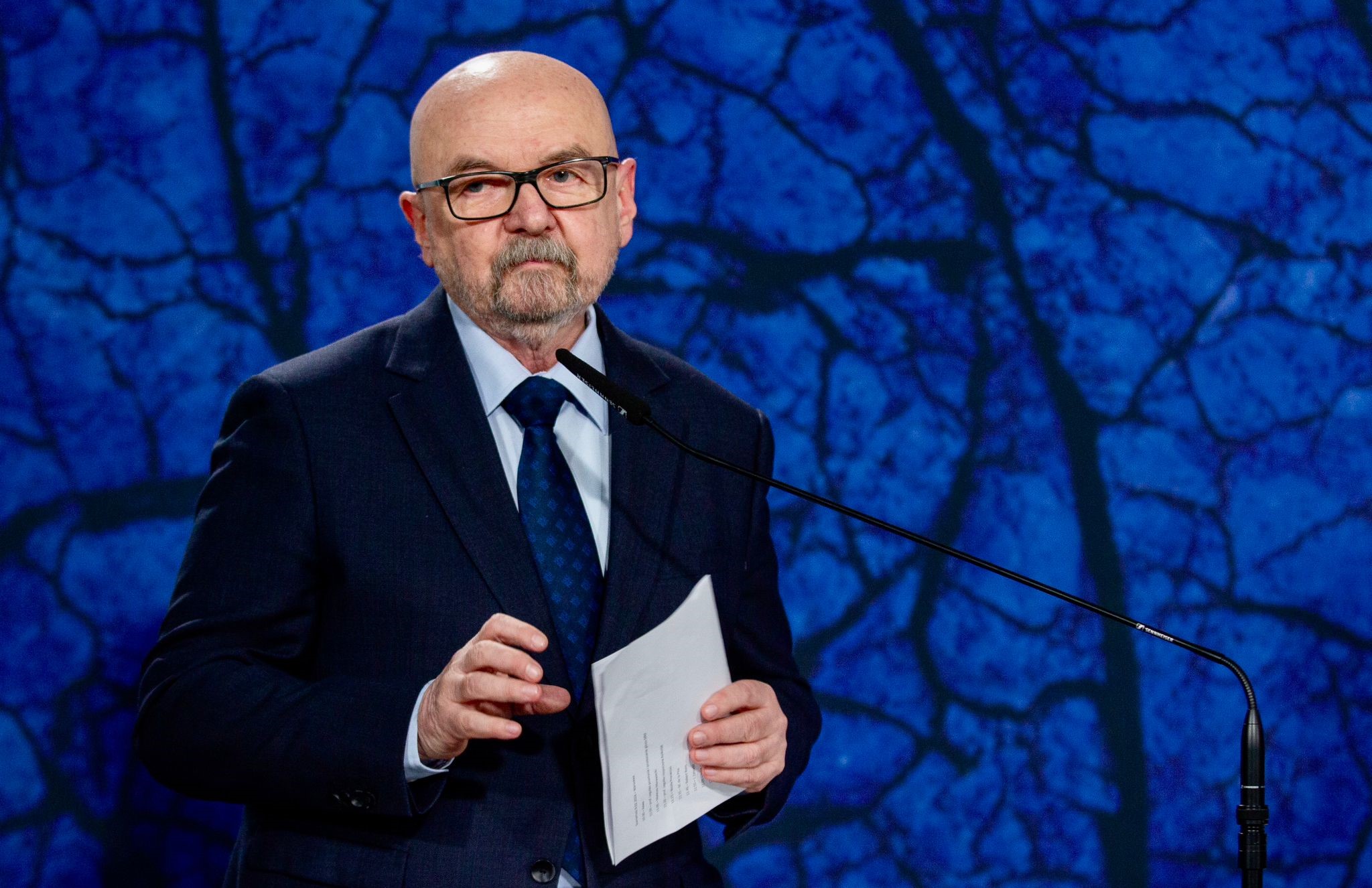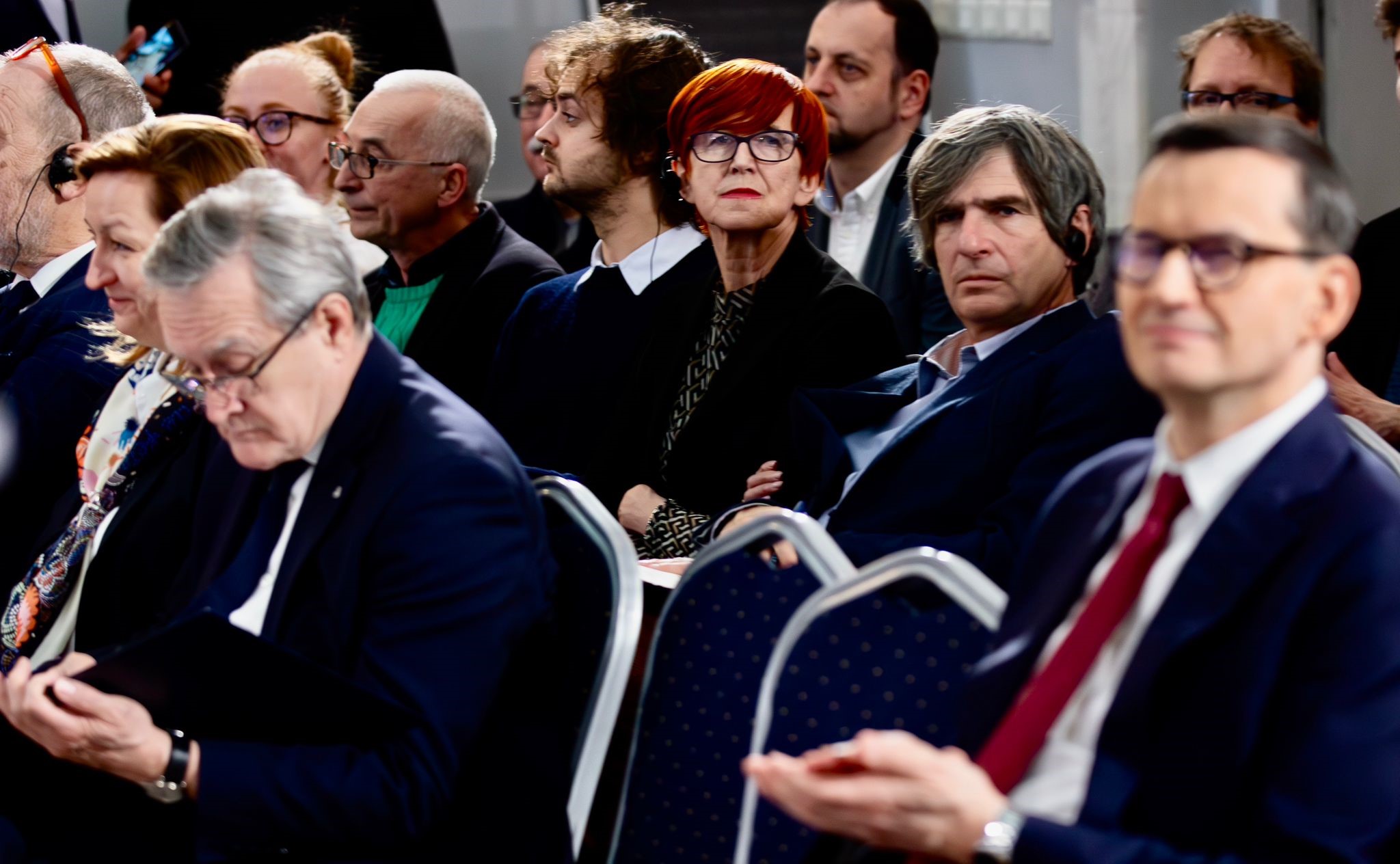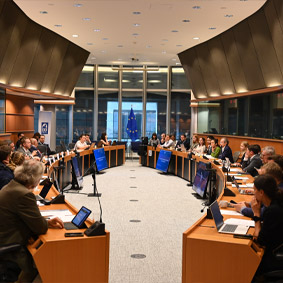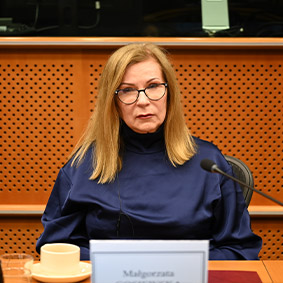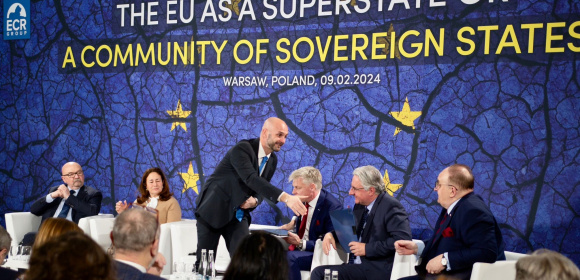
On Friday, a conference organized by the ECR Group was held in Warsaw under the title “The EU: A Superstate or a Community of Sovereign States?” During the event, moderated by ECR Co-Chair Prof. Ryszard Legutko and featuring MEPs Nicola Procaccini, Jacek Saryusz-Wolski, Rob Roos, Jan Zahradil, and Margarita de la Pisa, the MEPs discussed possible scenarios for the future of the EU and considered their implications.
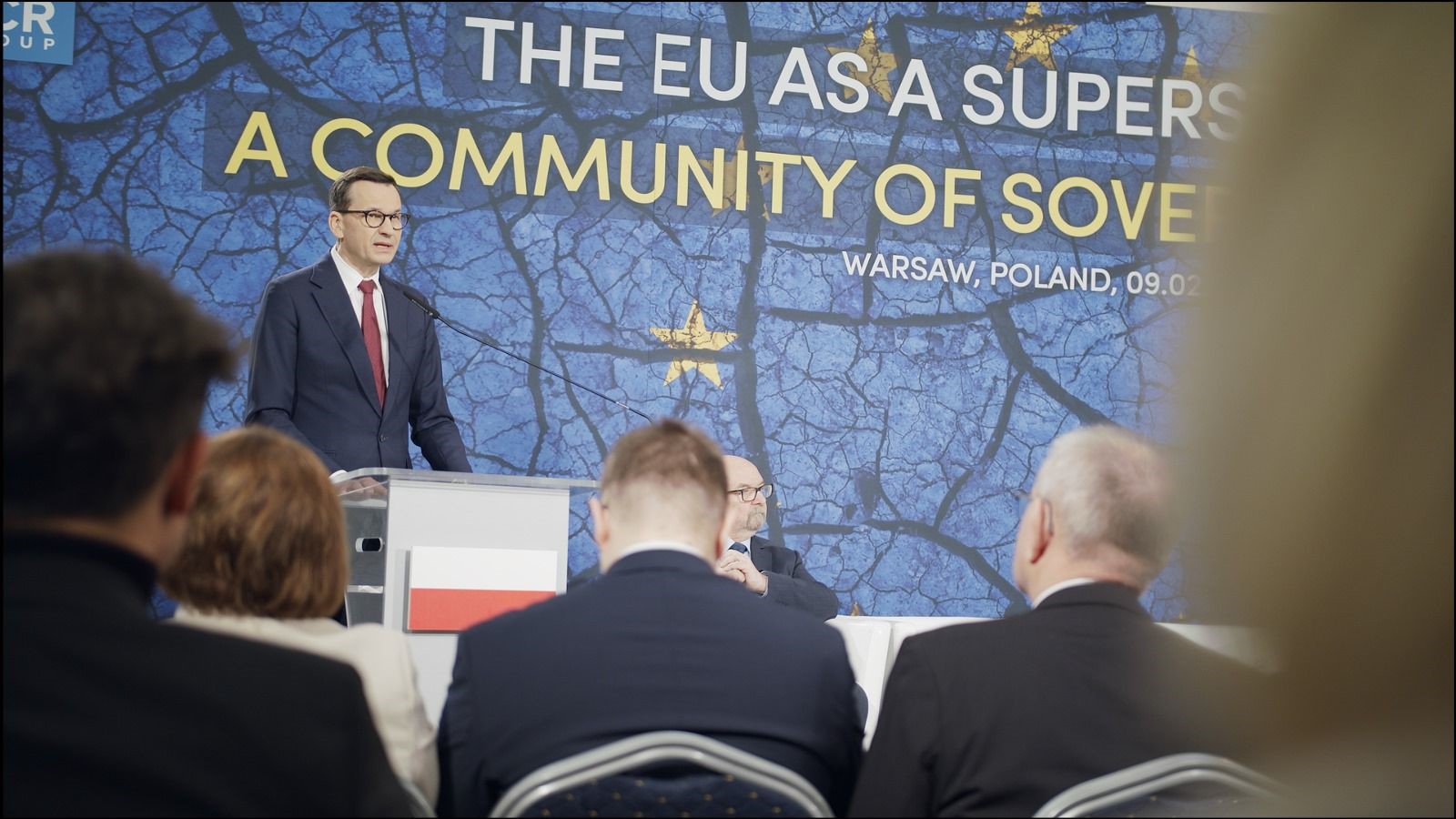
Prime Minister Morawiecki, opening the conference, stated: “We stand at a crossroads today.” He said that there are two models for the European Union’s development—the first path is a potential transition toward a superstate with its capital in Brussels, and the second is a Europe of nations. “Some may think that the first option is a continuation of the Roman Empire, but in reality, it is a deconstruction of Europe’s rich history. The second option is the recognition that the Union is a community of independent states. This is a concept according to which Europe consists of nations; Europe respects local differences while at the same time being based on free trade and cultural and economic exchange,” said the PiS politician.
Mateusz Morawiecki shared his thoughts on equality, diversity, and inclusion, emphasizing that these are the most important principles of the European Union. “The Union is not a feast for the strongest. We expect equality. Every member state’s voice must carry equal weight at the table,” he emphasized. He also noted that the Union should be open to every member state and recognize that it is the member states themselves that determine their domestic policies. “We also demand diversity. Every member state has its own culture, its own laws, hundreds of years of history and traditions. Our nations have been through too much and come too far to now become mere provinces of a superstate governed from Brussels,” he stated.
The Polish politician spoke about the problems the EU is facing today in the context of the migration crisis and the EU’s migrant relocation policy. “The European Union’s migration policy can be shaped only on the basis of unanimity, and its instruments must be voluntary in nature, in accordance with international conventions,” he emphasized. Speaking about penalties for refusing to accept illegal migrants, the Prime Minister stated that no one should be forced to embrace European values. “That is why the forced relocation of illegal migrants will harm Europe. Europe will be a true home only for those who believe in European values,” Morawiecki noted.
“Europe is our home. At home, we should feel safe; we should feel free. That is what we want, but at the same time, we want an ambitious Europe—a Europe that is at the forefront of technological and economic change. We want to compete at the highest level in the world, and therefore we must protect Europe’s identity and heritage. I believe that this is our future,” he concluded.
Professor Ryszard Legutko said that the European Union is heading toward a troubling transformation into a superstate. “We face a choice. On the one hand, we have those who want sovereignty; on the other, those who are against it. It is astonishing that the concept of sovereignty, which has such a noble tradition, currently enjoys a negative reputation among those who govern the European Union,” he stated.
The MEP also drew attention to the enormous danger posed by political monopoly within the European Union. “The consequences of the political monopoly emerging in Europe are such that those at the helm of the European Union are simply unable to accept the fact that someone might hold opinions different from their own. This also concerns issues related to certain legal regulations, certain practices, and the institution of a ‘cordon sanitaire’—something unimaginable, yet already in place in the European Parliament,” the Polish politician noted with concern.
Professor Lekutko added that the danger posed by a political monopoly and an ideological monopoly is becoming increasingly clear. “The very idea that the European Commission should be responsible for issues of freedom of speech is as absurd as giving matches to an arsonist,” he stated.
Jacek Saryusz-Wolski recalled that the Union, as a community of sovereign states, stems directly from the vision of one of the Union’s founding fathers, Robert Schuman.
He quoted Schuman, who wrote in *Pour l’Europe* (1963): “My idea is not to bring countries together to create a superstate. Our European nations are a historical reality. From a psychological standpoint, it would be impossible to do away with them. Their diversity is a good thing, and we do not intend to reduce it or force uniformity.”
The MEP pointed out that the concept of the EU as a centralized, oligarchic superstate—as pushed by mainstream left-liberal parties—essentially amounts to institutional violence against rebels who oppose centralization and will lead to a clear division between the rulers and the ruled, hegemons and the periphery, based on deep inequalities and the “logic of force and coercion.”
As Saryusz-Wolski noted, there are three fundamental myths that must be debunked regarding treaty amendments.
The first idea he mentioned was the issue of federalization, or a “United States of Europe,” which in reality leads to the creation of a superstate. He pointed out that the foundation of a federation is that its constituent parts are equal, regardless of size. As an example, he cited the small and large federal states in Germany, which have virtually an equal number of votes in the Bundesrat. He also referred to the cantons in Switzerland, which have equal representation, and the states in the U.S., each of which has two representatives in the Senate.
“Although the so-called political mainstream claims that the proposed treaty amendment is a federal project, in reality it is downright anti-federal, and calling it a federation or the United States of Europe is the greatest deception, because in reality we are witnessing centralization,” —the MEP explained. He noted that currently, within the European Union, the larger a country’s population, the more influence it has, while the entire project is aimed at ensuring that the influence of the largest EU member states will increase even further in the future.
Jacek Saryusz-Wolski also shared his thoughts on the idea—wrongly promoted within the EU—that the proposed changes would lead to a deepening of democracy. In this context, he noted that the European Parliament’s report contains proposals for new competences: 1 new exclusive competence and 7 new shared competences, and significantly restricts member states’ veto rights in 34 cases. “The Parliament’s proposal is, in fact, a massive transfer of power from the member states to the EU level, and the proposed changes will upset the balance between these two levels—the EU and the national levels,” the MEP explained. He added that this would in fact lead to the creation of a less democratic system, since the only functioning democracies exist at the national level, while at the EU level democracy is very weak and there is a so-called democratic deficit, which is a scientifically established fact.
“The European Parliament’s proposal upsets the balance in favor of the European Union and departs from principles such as subsidiarity, proportionality, and subsidiarity. This anti-democratic solution aims to enable oligarchic elites to govern without regard for the will of the people, and there is a real risk here that the political system will become more of an autocracy than a democracy,” he stated. The Polish politician also drew attention to the phenomenon of “creeping encroachment on competences,” known as “competence creep,” and expressed concern about elites seeking to appropriate and amend the treaties while concealing this from the public.
In his remarks, the ECR MEP refuted the false claim that EU enlargement first requires deeper EU integration. He criticized this approach as flawed and politically biased. He noted, however, that the results of extensive scientific research on the functioning of EU institutions prove that previous enlargements did not have a negative impact on the EU’s decision-making capacity. “On the contrary, the speed of decision-making has actually increased,” he noted. “There is no empirical data suggesting that reform of EU institutions is necessary for the upcoming enlargement. Various studies show that, in light of enlargement, the EU should decentralize rather than centralize further,” the politician argued. As definitive proof that EU reform is not intended to prepare the Union for its expansion, he cited the fact that expansion will still require unanimity, even after the proposed changes.