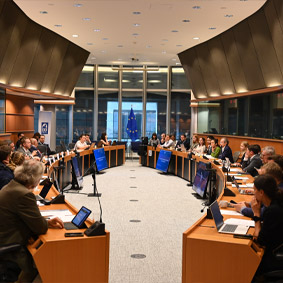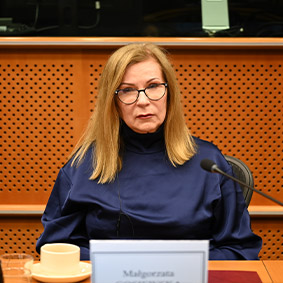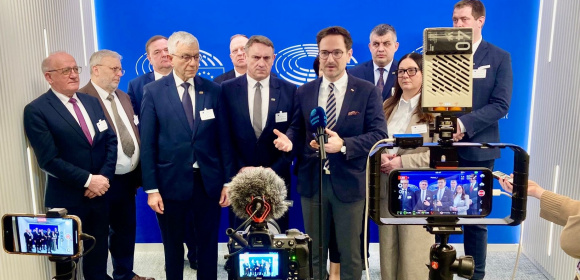
Today, during a meeting of the European Parliament’s Committee on Petitions (PETI) in Brussels, representatives of Polish agricultural organizations presented a petition calling for the imposition of trade sanctions against third countries importing Russian fuels and fertilizers, as well as for the establishment of the principle of full conditionality for access to the EU market. PiS MEP Waldemar Buda also spoke during the debate, expressing his support for the petitioners’ demands.
The petition, submitted by the Independent Farmers’ Solidarity Trade Union (NSZZ Solidarność Rolników Indywidualnych) and the Federation of Sectoral Unions of Agricultural Producers, was prepared with the participation of a broad range of organizations representing key food production sectors in Poland and the European Union. The document refers directly to the planned liberalization of trade with Mercosur countries, including Brazil, highlighting the risk of exacerbating unequal competitive conditions. The signatories point out that some of these countries have significantly increased their imports of Russian fossil fuels and fertilizers since 2022, thereby helping to sustain the Russian Federation’s budget revenues despite sanctions imposed by the European Union.
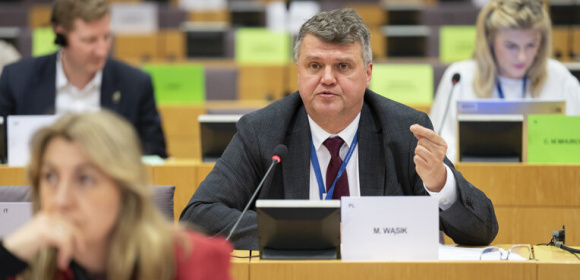
Tomasz Obszański, chairman of the Independent Farmers’ Solidarity Trade Union (NSZZ Solidarność Rolników Indywidualnych), emphasized that farmers fully support the EU’s actions targeting the Russian regime, but do not understand why the EU market is being opened to products from countries that—as he pointed out—indirectly fund Russia’s war budget. He noted that European producers operate under some of the most stringent environmental and sanitary standards in the world, including, among other things, a ban on the use of growth hormones, very low limits on pesticide and antibiotic residues, and full traceability of production. Meanwhile, in many third countries, these standards are less stringent or enforced inconsistently, which—according to the petitioners—leads to unfair competition and price pressure on EU producers.
Justyna Jasińska, representing the Federation of Agricultural Producers’ Trade Unions, pointed out that the organization brings together thirty trade unions representing producers of grains, corn, hops, tobacco, and sugar beets, as well as pig, cattle, and poultry farmers. In her remarks, she called for the introduction of a “zero-tolerance” policy toward violations of EU standards, the establishment of mirror clauses in trade agreements, an update to the reference price for grain purchases, and the strengthening of the certification system for European products. She noted that food security is one of the pillars of Europe’s security, and that shortening supply chains increases resilience to crises and geopolitical pressure.
President Wiktor Szmulewicz, speaking on behalf of Polish agricultural organizations, emphasized that the influx of cheaper products manufactured using substances banned in the EU destabilizes the markets for beef, poultry, milk, honey, sugar, and processed fruits and vegetables. In his view, the lack of sanctions against countries importing Russian raw materials—while simultaneously opening the EU market to their agricultural products—leads to the systemic displacement of European production and the weakening of family farms. He also referred to the solidarity shown by Poland and other member states toward Ukraine, pointing out the need to maintain consistency between political declarations and trade practices.
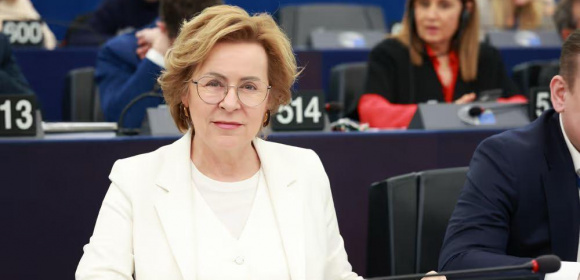
PiS MEP Waldemar Buda expressed his support for the petition. He emphasized that Europe cannot simultaneously provide financial support to Ukraine and—by failing to respond to increased trade between third countries and Russia—indirectly fuel the Russian war machine. “On the one hand, we’re providing money to Ukraine, and on the other, we’re handing it over to Russia. If we take no action against countries that have increased trade with Russia since the outbreak of the war, we are de facto supporting Russia on the front lines,” he said. The lawmaker cited the example of the United States, which imposes sanctions on countries that continue to trade in hydrocarbons with the Russian Federation or makes the cessation of such trade a sine qua non condition for concluding favorable trade agreements with the U.S. As he noted, the European Union should consider similar mechanisms for partners that have increased trade with Russia since 2022.
He also drew attention to the rising production costs faced by EU farmers, including higher fertilizer prices, while noting more favorable purchasing conditions in certain third countries. “Either we are logical and consistent in this matter, or we contradict ourselves by taking certain actions at the expense of others,” he added, calling for the petition to remain open and for further work to be done on its proposals. He described the initiative as an important voice in the debate on the future of European trade policy, food security, and solidarity with Ukraine.
The PETI Committee decided to keep the petition open and refer it to the European Parliament’s Committee on Agriculture and Rural Development (AGRI) and the European Parliament’s Committee on International Trade (INTA) for their opinions.