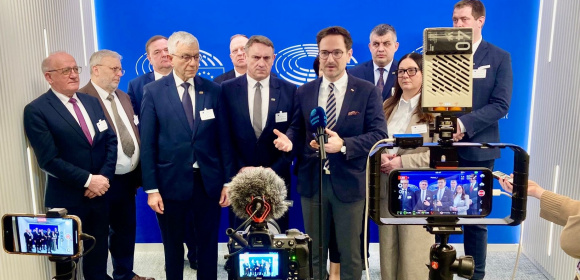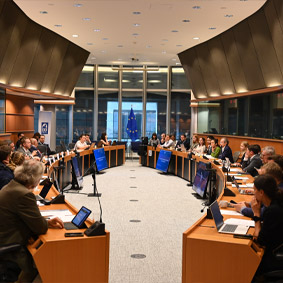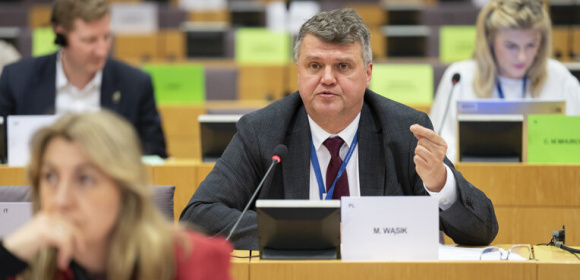
During the meeting of the Committee on Civil Liberties, Justice, and Home Affairs (LIBE) in the European Parliament held an exchange of views with Magnus Brunner, Commissioner for Home Affairs and Migration, on the EU’s visa policy strategy. PiS MEP Maciej Wąsik noted that while the document contains accurate assessments of the link between visa policy and security and the fight against illegal migration, it still lacks specific, decisive instruments that would allow for effectively countering abuses and hybrid activities directed against the European Union.
“Commissioner, I am very pleased that this strategy includes key points stating that visa policy is intended to support security policy and the fight against illegal migration. These are fundamental issues. I must admit that I am pleasantly surprised by this approach,” the MEP emphasized.
Maciej Wąsik drew attention to the scale of abuses related to visa-free travel. As he pointed out, one-quarter of asylum applications in 2024 came from people who had entered the EU under the visa-free regime. “That is a staggering number. It is essential to review the tools the Commission has at its disposal to address countries whose citizens abuse the visa waiver. I will urge the Commissioner to ensure that actions in this regard are decisive and far-reaching,” he noted.
The MEP also emphasized the need to closely link visa policy with cooperation on the return of migrants. Referring to the example of Ethiopia cited by the Commissioner, he noted that Poland had already advocated for such solutions at the European Council during the first migration crisis in 2015.
Wąsik also drew attention to the need to adjust visa policy toward countries engaging in hybrid and hostile actions against the European Union. “We need radical instruments that will serve as sanctions against these countries and their citizens, to make it clear that actions targeting the EU are not worth the cost,” he emphasized.
The PiS MEP also inquired about the possibility of introducing visa deposits for citizens of certain countries.
In response, Magnus Brunner acknowledged that the problem of abuse within the visa-free regime is significant and announced that it would be assessed later this year, including as part of the next report on the visa suspension mechanism. At the same time, he made it clear that the current EU strategy does not provide for the introduction of visa deposits, as the MEP had inquired about.
However, the Commissioner’s response did not include specific proposals for new, robust instruments or a timeline for legislative changes, which means that calls for more restrictive measures —including effective sanction mechanisms against countries that abuse visa-free travel or engage in hybrid activities against the EU—are not reflected in the Commission’s strategy at this stage.
The Commissioner limited himself to announcing closer monitoring of countries covered by the visa-free regime to ensure they continue to meet the criteria for visa liberalization, without, however, presenting any new preventive or disciplinary tools.