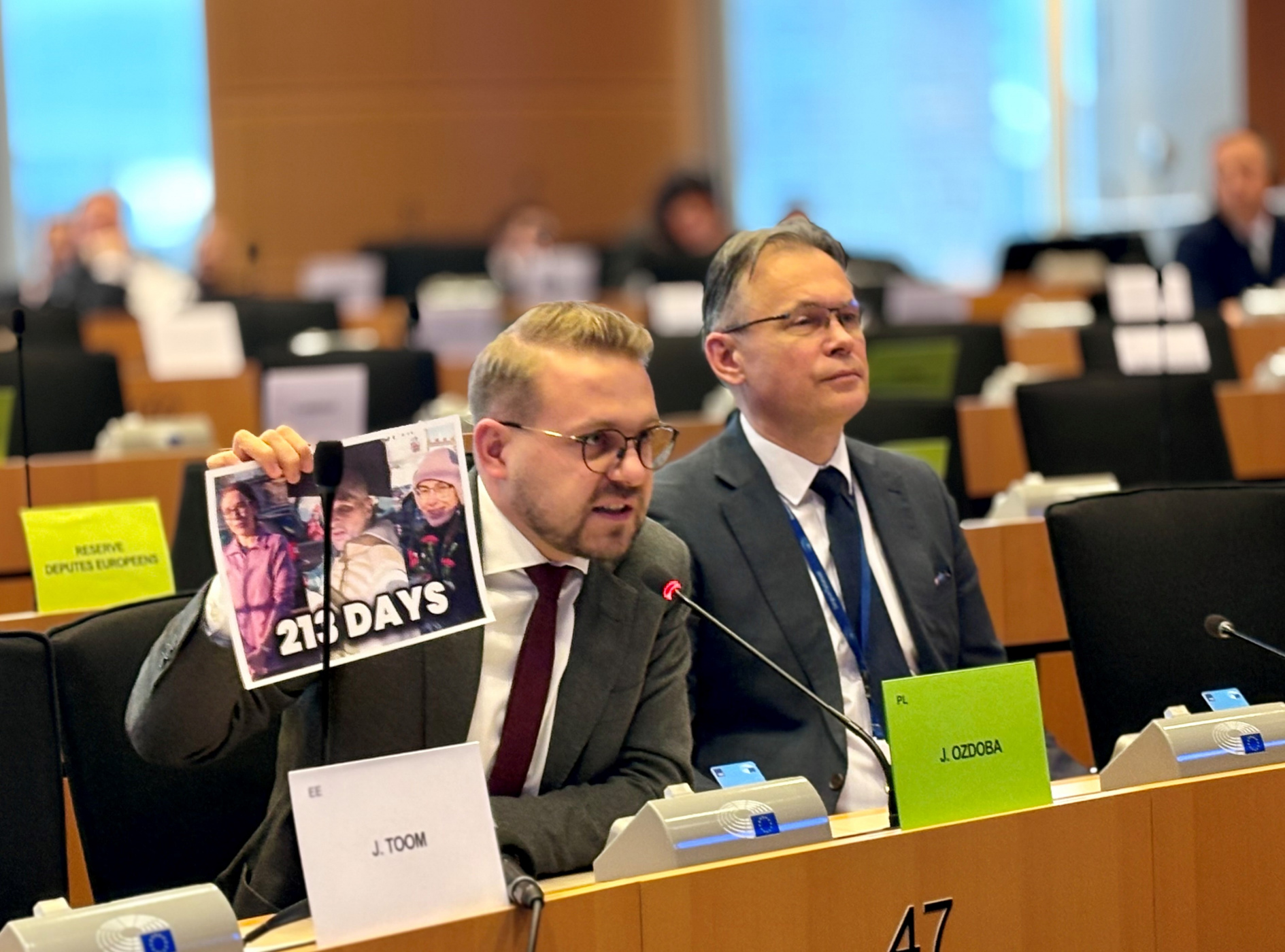
During today’s meeting of the European Parliament’s Committee on Petitions (PETI), a motion to grant urgent status to a petition concerning the alleged failure to execute a European arrest warrant and a violation of the principles of judicial cooperation between Hungary and Poland was rejected. Speaking on behalf of the ECR Group, PiS MEP Jacek Ozdoba strongly opposed the political nature of the initiative.
The MEP described the actions of some MEPs as a “gigantic political stunt,” expressing surprise that attempts are being made to fast-track a petition of a clearly political nature, while—as he pointed out—“ordinary citizens’ petitions wait months to be considered.”
In his speech, Ozdoba drew attention to cases of abuse that had occurred in Poland against individuals detained under so-called “pre-trial detention for interrogation.” He presented photographs of two female civil servants with no criminal records who, he said, had been held for many months in conditions degrading to human dignity, including being deprived of the right to privacy. He also referred to the situation of a priest detained by the Internal Security Agency (ABW), who—according to a report by the Ombudsman—was allegedly treated in an inhumane manner.
The MEP emphasized that one of the reasons for the political witch hunt is the activities of Minister Marcin Romanowski, who—as he noted—was deprived of the right to a fair trial and detained despite his Council of Europe immunity. Ozdoba pointed out that Polish courts have confirmed procedural violations related to his detention. “A crime was committed against Minister Romanowski; he was deprived of his liberty without respect for his immunity,” he said.
In the MEP’s view, Hungary’s decision to grant Romanowski protection is fully justified: “Hungary has the right and the obligation to protect EU citizens from political repression. Today, it is Hungary that is becoming a place of freedom and respect for the law,” he said.
Ozdoba also criticized the actions of Civic Coalition MEPs in the European Parliament, pointing to an attempt to impose a “propaganda narrative” targeting Hungary. He also recalled the irregularities identified by Polish courts regarding the removal of the National Prosecutor and the resignation of the head of the so-called “neo-prosecutors,” which—as he noted—constitutes “the best proof of the state of the rule of law in Poland under the current government.”
In conclusion, the MP addressed the members of the Committee, asking them to review the materials concerning the abuse of detained female officials. “These women were destroyed by the authorities because someone decided they could use force against defenseless people,” he emphasized.