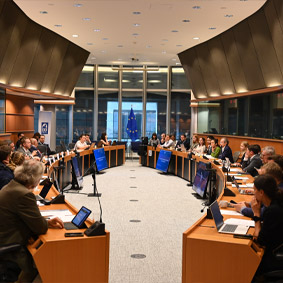
Today in Brussels, during a meeting of the Committee on Civil Liberties, Justice, and Home Affairs (LIBE), PiS MEP Jadwiga Wiśniewska presented a draft opinion on the report by the Committee on Employment and Social Affairs (EMPL) titled “Digitalization, Artificial Intelligence, and Algorithmic Governance in the Workplace—Shaping the Future of Work.” In it, the LIBE rapporteur emphasizes that the challenges associated with the digital transformation—including algorithmic governance and artificial intelligence in the workplace—require a clear legal framework that balances the rights of European workers with the obligations of businesses.
“As EU lawmakers, we must be aware of the potential and benefits of the digital transformation, including algorithmic governance and artificial intelligence in the workplace, while also recognizing the resulting risks and challenges,” emphasized the author of the LIBE opinion.
Jadwiga Wiśniewska said that her opinion aims to provide better protection for workers while keeping the regulations as simple as possible.
The document—focusing particularly on areas strictly within the LIBE Committee’s remit, namely personal data protection regulations—emphasizes that no additional regulations regarding the processing of personal data are needed at this stage. “The General Data Protection Regulation (GDPR) provides a strong and horizontal legal framework that applies to all sectors, including employment,” said the rapporteur for the opinion-issuing committee. According to the PiS MEP, introducing additional layers of legislation that could duplicate existing regulations would make it difficult for entities processing personal data to comply with the rules and could mislead individuals as to which regulations apply and how to exercise their rights. “By imposing additional regulations that duplicate existing ones, we are creating a fragmented approach that becomes overly complicated and introduces similar regulations across different sectors,” – explained Wiśniewska, noting at the same time that overlapping regulations threaten the fundamental purpose of data protection—ensuring transparency and the effective enforcement of individuals’ fundamental rights.
Furthermore, the opinion advocates for employees, recognizing that companies cannot monitor or control them without restrictions. “Companies cannot exercise unlimited control over employees. They must adhere to the fundamental principles and values enshrined in EU law,” she emphasized.
The opinion will be put to a vote during the LIBE Committee meeting on November 11 of this year.