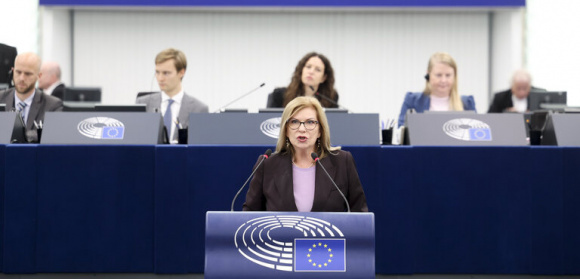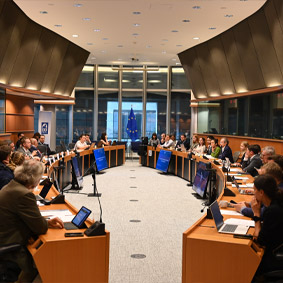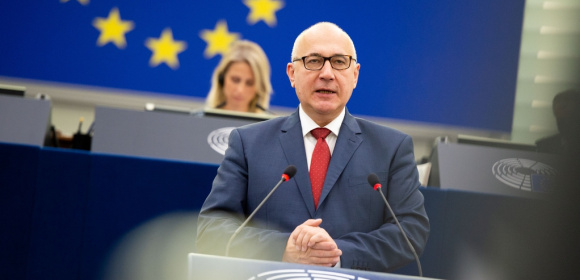
Today in Strasbourg, Members of the European Parliament, along with representatives of the Commission and the Polish Presidency of the Council, discussed the planned EU strategy for the Middle East. PiS MEP Joachim Brudziński spoke during the discussion.
Joachim Brudziński emphasized that the European Union should closely monitor the situation in the Middle East, but that it is not the Union’s role to draft a long-term agreement, as that is the task of the parties to the conflict.
“It would be a truism here to refer to the biblical conflict between Isaac and Ishmael, the sons of the same father, Abraham. Today, right before our eyes, we are witnessing another chapter in this biblical conflict, this time between Palestinians and Jews,” he said.
The PiS MEP noted that the EU should diplomatically support Israel and the Palestinians in working out the most stable solution possible that respects the rights of both nations. “But above all, we are obligated to ensure the safety of our own citizens in our own countries, and the ongoing destabilization in the Middle East, as always, could result in another influx of illegal migrants to Europe,” the politician warned.
Therefore, as he emphasized, the primary task of EU diplomacy should be to ensure that aid for the Palestinians, who have been struck by an enormous tragedy, comes first and foremost from the wealthy countries of the Persian Gulf region. “And for us Europeans, in accordance with the sacred principle of ordo caritatis, our priority should be to help the Christians who have lived in those countries for thousands of years. But this aid should not involve bringing them to Europe; rather, we should help them right there on the ground,” Brudziński argued.
In the summer of 2024, while presenting her political program to Parliament, Ursula von der Leyen stated that the EU’s active engagement in the Middle East would be one of her priorities if she were re-elected as President of the European Commission. In a mandate letter published in the fall of 2024, which President von der Leyen handed to Kai Kallas, she tasked the new head of EU foreign policy with presenting a comprehensive EU strategy for the Middle East, “with a view to the post-war period in the Gaza Strip.” The President emphasized that the strategy should focus on promoting “all steps necessary to achieve a two-state solution and strengthen partnerships with key centers of interest in the region.”
In their annual report on the Common Foreign and Security Policy, adopted on January 30, members of the Committee on Foreign Affairs call for the EU’s strategy for the Middle East to be “developed within the first months of the new Commission’s term and reflected in the upcoming multiannual financial framework in order to have any tangible impact on the rapidly deteriorating situation.”