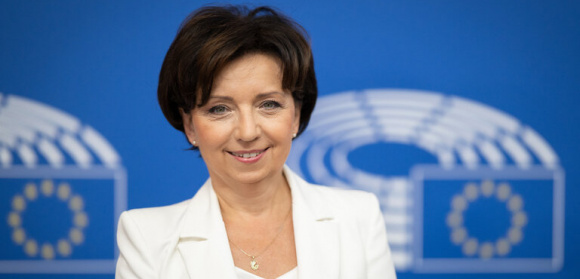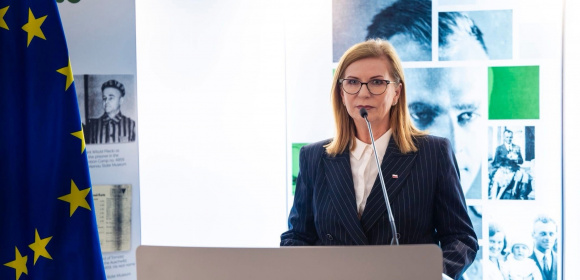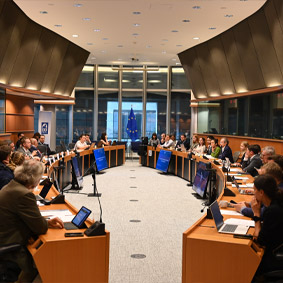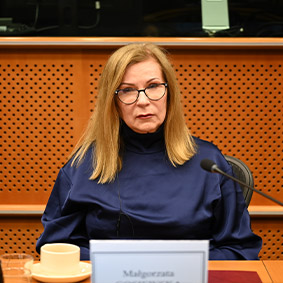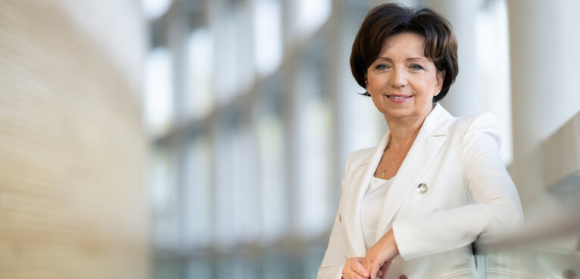
Today, during a meeting of the European Parliament’s Committee on Employment and Social Affairs (EMPL) of the European Parliament, a hearing was held on working conditions at Amazon warehouses, featuring Agata Wypiór, chair of NSZZ “Solidarność” at Amazon Poland, and Maria Malinowska, an Amazon Poland employee and union activist. PiS MEP Marlena Maląg also spoke during the discussion.
Agata Wypiór said that the difficult situation facing Amazon employees has persisted for a long time and little has changed in this regard, despite the fines imposed on the American company. “I get the impression that it’s more profitable for Amazon to pay fines than to treat its Polish employees fairly, to be fair to tens of thousands of people and their families, and to be fair to millions of its customers,” she said. She also noted that, among EU citizens, Poles likely have the lowest hourly wage, and all efforts to date to change this have come to nothing. She pointed out that, for example, a warehouse worker who has been employed since 2019 earns about 3,804 PLN after taxes. “With that amount, we’re living on the brink of poverty. We can’t afford to get sick because it reduces our pay. Instead, we have to work overtime to support our families,” she added. She explained that as a result, workers are leaving, and new, cheaper workers from temporary staffing agencies are taking their places—workers who are also “easier to get rid of.” “We’re on the margins, with wages that are nearly the lowest in the country. And we want someone to take notice of us. Will we, as Polish workers, be recognized? We’re asking—as Amazon employees—for someone to finally help us,” she pleaded.
Maria Malinowska noted that “Amazon isn’t just one of millions of jobs; this company shapes global labor standards, social hierarchies, and power relations.” She said that Amazon’s representatives do not want any social dialogue, even though they play such an important role on a global scale. She stated that Amazon represents a clash between two forces: “One—narrow in scope—striving to maximize profits at an astonishing pace, regardless of the enormous social and environmental costs. And the other—the workers, along with other affected groups, such as ethnic minorities and local communities, who are also fighting against this company. But mainly the workers, who generate its wealth and bear the heaviest burdens of producing it.”
“We demand a say in what these working conditions look like, because this isn’t just a job—it’s our lives,” an Amazon worker appealed. She said that the American company is doing a lot to “silence workers and unions and block their activities”. “There is no democracy in our workplace. We no longer want a dialogue that means nothing. Instead, we demand real influence over our workplaces. We want them to know that they must respect our position, our words, and what we want to change in our workplaces so that we can work in safe conditions,” emphasized Malinowska, calling on the European Parliament to do everything in its power to strengthen labor unions.
Marlena Maląg expressed regret that, once again, the hearing is taking place without Amazon’s participation. She noted that, at the same time, the company is attempting to reach out to MEPs, despite the ban on its entry imposed by the Parliament. “So it’s a shame that they openly refuse to address the issues raised here,” the MEP stated.
Maląg thanked the speakers, and in particular the representatives of Polish labor unions, for “speaking frankly about the problems faced by workers in the European Union.” “Amazon is a highly recognizable brand that is growing at an increasingly rapid pace—however, this growth cannot come at the expense of workers,” the Polish politician emphasized, adding that “people cannot be treated as mere tools.” She also drew attention to safety issues and pointed out that “urgent shipments or working beyond one’s limits cannot be used as an excuse for failing to comply with the rules and standards set forth by law.” Additionally, she noted, concerns have been raised for years regarding issues such as the amount and timeliness of wage payments and overwork; the problem of excessive monitoring of work and performance evaluations has also repeatedly surfaced. In light of this, the MEP asked whether the directive on artificial intelligence in the workplace could address some of the challenges raised here and how often labor inspections should be conducted at workplaces. “We cannot tolerate practices where an employer prefers to pay financial penalties for violations of workers’ rights because it is more advantageous for them than complying with established and binding standards. There can be no tolerance for the instrumental treatment and exploitation of workers,” emphasized the MEP from Greater Poland, and she asked whether the penalties imposed are adequate and sufficiently deterrent to prevent continued violations.