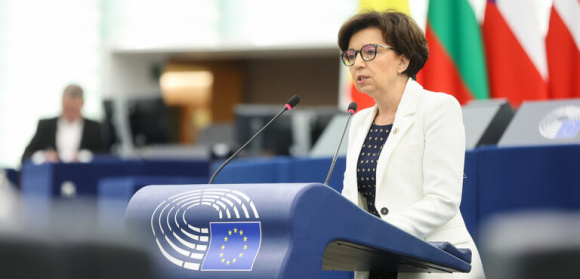
In Strasbourg, during the European Parliament’s plenary session and the debate on the European Central Bank’s 2025 report, Marlena Maląg, a Law and Justice MEP, sharply criticized the ECB’s course of action, pointing out the bank’s departure from its treaty-based independence and its encroachment into the realms of politics and ideology.
“We often hear about the European Central Bank’s treaty-based independence. About its supposed apolitical nature. About its ‘sacred’ autonomy. But is that sacredness respected today? No,” the MEP emphasized.
According to Marlena Maląg, the ECB is increasingly involved in projects of an unambiguously political nature, such as pushing for a digital euro, implementing the green agenda while ignoring economic and social realities, and pressuring member states to abandon their own currencies.
“We see the ECB as a tool of a federalist project that interferes with decisions concerning the sovereignty of nations—namely, who controls the money and who bears the consequences of mistakes,” she noted.
The MEP pointed out that the ECB’s decisions have a direct impact on the daily lives of European Union citizens.
“Raising or maintaining high interest rates is not some abstract concept from an annual report. It means loan payments for young families, small businesses going under, and having to choose between a vacation and paying energy bills,” she said.
Marlena Maląg also recalled the words of former ECB President Mario Draghi regarding the European Union’s transition “from a confederation to a federation,” noting that the central bank’s current actions are in line with this direction.
“We must repeat this like a mantra: independence means stability. Money does not mix well with politics. History shows that manually controlling money always ends badly—especially when it becomes a tool of ideology and centralization,” she emphasized.
In conclusion, the PiS MEP called for a return to the European Central Bank’s core mission. “We need a truly independent ECB. Not a ‘green’ one. Not a federalist one. Not an ideological one. Just a central bank that carries out its tasks—not the goals of politicians and lobbyists,” she concluded.