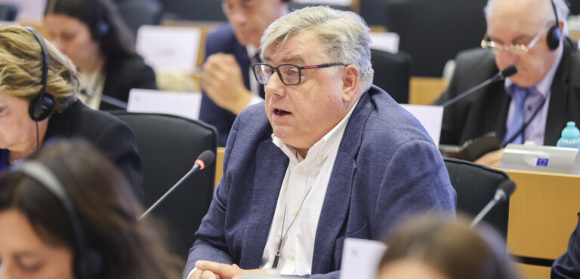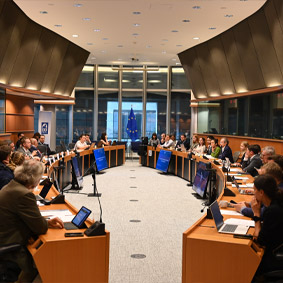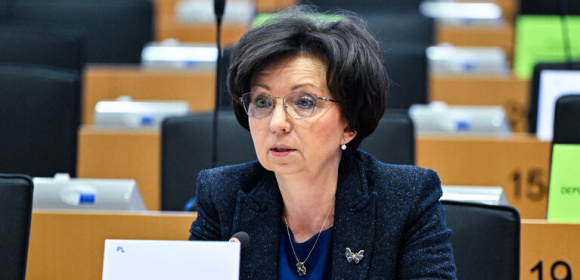
Today in Brussels, during a joint meeting of the Committee on Economic and Monetary Affairs (ECON) and the Committee on Employment and Social Affairs (EMPL), an exchange of views took place with Roxana Mînzatu (Executive Vice-President for Social Rights, Skills, Quality Jobs, and Resilience) and Valdis Dombrovskis (Commissioner for Economy and Productivity, and Implementation and Simplification) regarding the 2025 European Semester. PiS MEP Marlena Maląg spoke on behalf of the ECR Group.
Marlena Maląg addressed the issue of energy poverty, which—according to a report presented by the Commission—is steadily increasing in the EU. As she pointed out, in 2023 it reached an average of 10.6 percent in the EU, while in some member states it is already over 20 percent. “The Law and Justice government introduced protective measures to shield citizens from drastic increases in energy prices, but in the face of the war in Ukraine and the EU’s ambitious climate policy, no country can tackle this challenge on its own,” said the former Minister of Family and Social Policy. According to Marlena Maląg, it is impossible to talk about improving the housing situation, combating in-work poverty, or fostering business growth and job creation without addressing the issue of high energy prices. “That is why I would like to ask how the European Commission intends to address this issue and whether you have already taken any action on this matter together with Commissioner Jorgensen, who is responsible for housing and energy?” she asked.
Roxana Mînzatu addressed the issue of energy poverty and emphasized that the Commission intends to launch the EU’s first-ever strategy to combat poverty. “It won’t be launched this year. We want to take some time to ensure we include all the elements necessary to identify all types of poverty and all types of responses,” said the Romanian politician, pointing, for example, to areas of energy and transportation poverty. “Together with Commissioner Jorgensen, we are beginning work on an action plan for affordable housing, which will be integrated into the strategy to combat poverty,” she noted. She pointed out that one of the main tools—"but not the only one, and certainly not sufficient on its own"—will be the Social Climate Fund, through which the European Commission will allocate funds to plans submitted by member states, which will be co-financed by national governments to combat energy poverty through various types of measures—for households and small businesses—including direct income support or investment measures. “Of course, in addition to this, we need much greater, targeted support from future cohesion policy, provided through all the financing mechanisms that the government can make available, as well as from private investors,” added Mînzatu.
Commissioner Dombrovskis, in turn, spoke about energy prices, which affect the competitiveness of the European economy. “Member states are implementing significant fiscal support programs following the rise in energy prices after Russia’s invasion of Ukraine. Many of these programs are currently being phased out, but we are systematically looking for ways to ensure affordable energy, which is important both for our industry and, of course, for the public,” he stated.