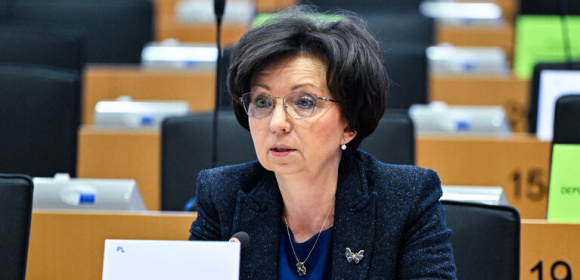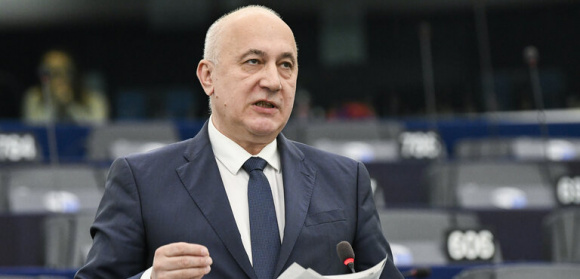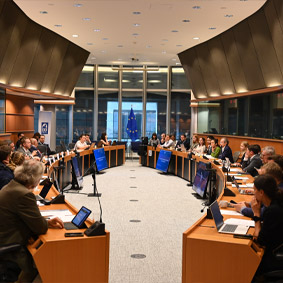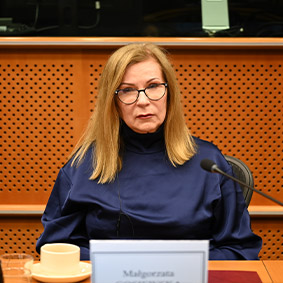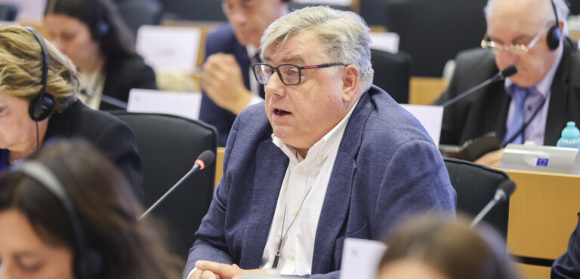
Today, during a meeting of the Committee on the Internal Market and Consumer Protection (IMCO), PiS MEP Kosma Złotowski presented an opinion on the proposal for a directive of the European Parliament and of the Council on adapting the rules on non-contractual liability to artificial intelligence. The PiS MEP believes that the directive on liability for artificial intelligence “is premature and unnecessary.”
The PiS MEP said that on the eve of the Commission’s presentation of the Competitiveness Compass, “we stand today at a critical crossroads for the future of European artificial intelligence.”
According to the author of the opinion, in this context, the directive on liability for artificial intelligence has no place. “The AI Act, which entered into force last August, is already changing the rules of the game. It introduces comprehensive rules on transparency, risk management, and due diligence,” said Złotowski.
The EP Quaestor noted that these measures, together with the newly adopted Product Liability Directive, represent a significant change. “Companies need time to adapt. We need time to assess their impact,” the rapporteur emphasized.
The PiS MEP noted that the implementation of artificial intelligence in the EU is proceeding at a painfully slow pace. He pointed out that the European Commission’s report on the Digital Decade reveals that only 8 percent of companies use artificial intelligence—far from the target of 75 percent by 2030. “Adding another layer of regulations now will not solve this problem. On the contrary—it will make it worse,” argued Złotowski.
The author of the opinion also referred to Mario Draghi’s report, in which he noted that “the EU says it supports innovation, but it’s drowning our companies in regulations.” At the same time, the PiS MEP pointed out, “the competition never sleeps.” In this context, he recalled that one of President Trump’s first moves was to dismantle the already narrow regulatory framework governing the development of artificial intelligence in the U.S. “I believe that ‘better lawmaking’ must be our guiding principle,” Złotowski emphasized, pointing out that the impact assessment for the European Commission’s directive on liability for artificial intelligence lacks concrete data. “It is based on hypothetical scenarios without taking into account the existing legal framework. How can we make laws when we do not yet understand the impact of the Artificial Intelligence Act and the revised Product Liability Directive?” the MEP wondered.
“Europe must choose wisely. Let’s seize the opportunity presented by artificial intelligence, support innovation, and avoid harming ourselves through excessive regulation. Let’s prove that Europeans are in favor of progress, not fear,” said Kosma Złotowski, calling for the rejection of the European Commission’s proposal.