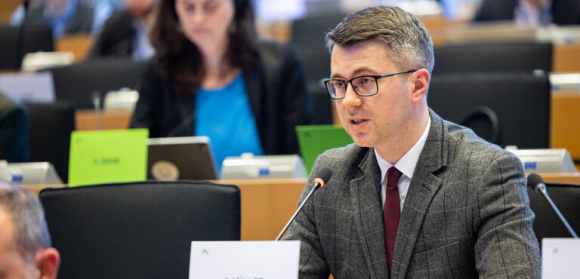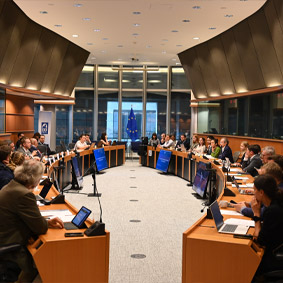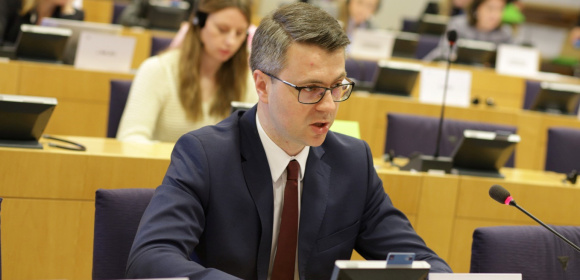
Today in Brussels, during a meeting of the Committee on the Internal Market and Consumer Protection (IMCO), PiS MEP Piotr Müller presented a draft European Parliament report on public procurement, in which he calls for the simplification of procedures for businesses, greater transparency in regulations, and an end to the push for a green agenda that forces entities organizing tenders to choose solutions that are “expensive, immature, and ineffective.”
In presenting the report, the PiS MEP stated that “at first glance, public procurement is complicated, time-consuming, and few SMEs take advantage of it.”
“Meanwhile, public procurement shapes everyday life in Europe—from the construction of schools and hospitals to innovative solutions in transportation and energy,” the rapporteur argued. Müller added that “this is not a topic reserved for armchair experts—it’s about how we spend taxpayers’ hard-earned money,” noting that it accounts for 14 percent of the European Union’s total GDP.
As he noted, despite earlier reforms, the legal framework for public procurement remains inefficient and overly bureaucratic, and the market share of public contracts is steadily declining.
“We must ask ourselves an honest question: have we created a system that promotes the best bids, or rather one that rewards contractors who navigate the bureaucratic maze and offer a cheap product or service?” said the PiS politician.
The IMCO rapporteur shared the findings from consultations conducted with public procurement practitioners—including both government officials and businesses participating in tenders. As he noted, a clear message emerged: they want fair competition, not ideology in tenders.
Among the issues raised by the experts was the need to maintain the procedural nature of public procurement, which establishes clear rules. “Adding mandatory criteria will lead to the collapse of an already inefficient system,” Müller emphasized, noting that complex procedures also pose a challenge for smaller administrative units.
Furthermore, the experts highlighted the need to effectively incorporate three key principles: cost-effectiveness, competition, and the prevention of corruption.
Another important issue raised by practitioners was the need to significantly streamline the current regulations. As the MEP noted, the current directives consist of nearly a thousand pages and 476 articles, which are burdensome even for “seasoned lawyers” and strongly discourage micro-entrepreneurs. He added that the Court of Auditors points to low effectiveness and a growing number of tenders with only one bidder or none at all. “As procedures take longer and compliance costs rise, those we need most—innovative, local, and flexible players—are disappearing from the market,” Müller argued.
The MEP also raised the issue of the EU’s climate policy and green technologies, which force entrepreneurs to choose solutions that are “expensive, immature, and ineffective.” “And the market is no place for ideological experiments—it’s a space where quality, price, and effectiveness matter,” he emphasized.
Müller also touched on the issue of cross-border relations. As he explained, the fragmentation of regulations across member states means that a business participating in a tender in Poland operates under different rules than the same business in, for example, Spain. “We’re talking about the single market! We need consistent standards, digital platforms, clear procedures, and mutual recognition. This isn’t about centralization—it’s about common sense,” he emphasized.
In light of these arguments, the IMCO rapporteur believes it is essential that any changes proposed by the Commission be fully consistent with the competitiveness agenda. “There is no support for measures that increase the costs of public procurement and hinder business operations,” he noted.
Furthermore, he said, it is necessary to introduce mandatory division of contracts into smaller lots, simplify eligibility criteria, and provide real support for SME consortia, because micro, small, and medium-sized enterprises are not “small players” but account for as much as 99 percent of the European economy. “These are passionate people who create jobs in our cities and towns. If they don’t have a chance, we’ll all lose out,” he argued.
He also emphasized the need for full transparency, “because only that will restore trust in institutions.” “Full publication of data is the foundation of accountability,” he stressed. He further pointed out that we must move away from "the obsession with the lowest price as the main selection criterion," because "such logic often leads to choosing the cheapest bids, but not the best ones—ignoring quality, innovation, or the life-cycle costs of a product or service." “Promoting the principle of the ‘most economically advantageous bid’—using digital tools—is a way to spend taxpayers’ money more rationally,” he added.
Piotr Müller also called on the Commission’s political leadership to “finally stop communicating a ‘green’ direction for the reform before reviewing the analyses and data,” because such a policy is simply “absurd.”
“The upcoming reform cannot be a technical adjustment. We need bold decisions that reduce regulations and ensure adequate flexibility. This is our duty to taxpayers,” emphasized the EP rapporteur.