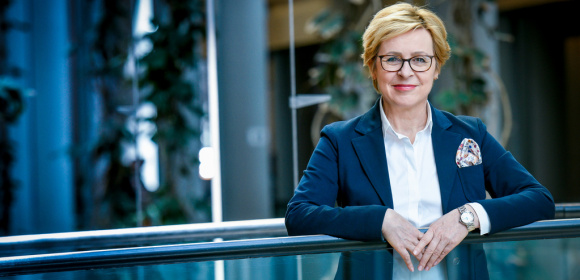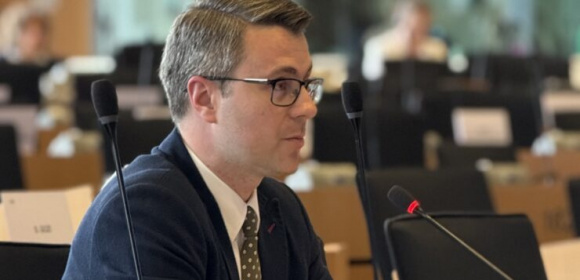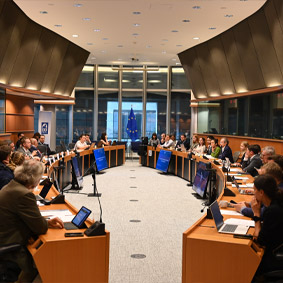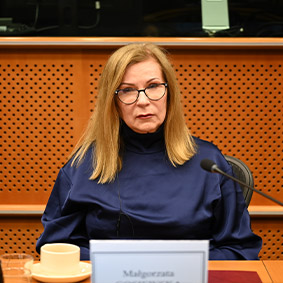
At the European Parliament in Brussels, during a meeting of the Subcommittee on Human Rights (DROI), in cooperation with the Delegation for Relations with Belarus, an exchange of views took place on the human rights situation in Belarus five years after the rigged 2020 elections. PiS MEPs Małgorzata Gosiewska, Arkadiusz Mularczyk, and Mariusz Kamiński took the floor during the discussion.
Małgorzata Gosiewska paid tribute to Ales Bialiatski—chairman of the “Viasna” Human Rights Center, winner of the Nobel Peace Prize and the Sakharov Prize for Freedom of Thought. She noted that today he is celebrating his 63rd birthday—for the fourth time behind the walls of a Belarusian prison. “He has fought for human rights his entire life. Today, he is once again celebrating his birthday as a political prisoner of the Lukashenko regime,” said the chair of the Delegation for Relations with Belarus, noting that his story is not an exception. As she noted, according to official data, there are over 1,000 political prisoners in Belarusian prisons, while unofficial sources put the number as high as 10,000. “These are not criminals, but teachers, students, journalists, and social activists—people who simply dream of a free, democratic Belarus,” said the Member of the European Parliament.
Gosiewska also drew attention to the case of Andrzej Poczobut—a Polish-Belarusian journalist and social activist who is a political prisoner of the Lukashenko regime. “He is an unyielding man. For years, he has paid a tremendous personal price for his fight for truth and human rights. Together with MEP Mariusz Kamiński, we proudly nominated him for the Sakharov Prize on behalf of the ECR Group. Andrzej is a symbol of courage and the fight for values,” she emphasized.
Referring to recent reports of pardons, the Polish politician noted that while every life set free is a cause for joy, one should not succumb to illusions. She noted that there have been nine waves of pardons since January. She pointed out that while 170 people have been released, 283 others have been granted political prisoner status during the same period. “We must not be misled by propaganda, and we must not ease sanctions against the Lukashenko regime,” she warned.
Małgorzata Gosiewska also expressed satisfaction with the results of the work carried out by the Delegation for Relations with Belarus, which she heads. “During the last meeting, we called for increased financial support for independent media in Belarus and for greater transparency in its allocation,” she said. She added that, according to the information she had received, the European Commission had heeded the delegation’s call, and aid is finally set to be directed to Belarusian media outlets such as Karta-97 and Radio Racyja. She also announced that the delegation would monitor the further course of this process. “In Belarusian prisons, people are dying not only because of torture or humiliation, but simply from exhaustion and a lack of medical care,” she said, highlighting the dire conditions in Belarusian prisons. “By fighting for their release, we are fighting for their lives,” she said, calling for decisive action to secure the release of political prisoners held by the Lukashenko regime, including Andrzej Poczobut.
Małgorzata Gosiewska also noted that the names of Lukashenko’s criminals are missing from the “Magnitsky sanctions list.” She called for appropriate legal measures and support for the imprisoned, their families, and those who have been released. “Standing firmly in solidarity with the Belarusian people, we must be certain that a democratic, independent Belarus will emerge,” she concluded.
Arkadiusz Mularczyk drew attention to the international community’s waning interest in the situation in Belarus. “The ongoing war in Ukraine and the tense situation in the Middle East have caused the issue of Belarus to take a back seat in international public opinion,” he stated.
The politician pointed out that it is precisely Belarus’s neighboring countries—in particular Poland and the Baltic states—that should take action to keep this issue high on the EU’s foreign policy agenda. “The issue of Belarus must not disappear from the European Union’s agenda,” he urged. The Member of the European Parliament also recalled that Poland was one of the first countries to provide tangible support to Belarusians following the rigged presidential election in 2020. “Following the rigged elections in Belarus, Poland granted over 50,000 humanitarian visas to citizens of that country from 2020 to 2024,” he noted, wondering why this process had slowed down.
“Putin and Lukashenko are responsible for what is happening in Belarus. If it weren’t for Lukashenko’s strong support for and cooperation with Putin, there wouldn’t be such a drastic policy toward Belarusians,” he said, unequivocally pointing to those responsible for the repression of Belarusian civil society. Mularczyk was critical of the lack of consistency in the actions of some European Union member states. “We must speak out loudly about the European Union’s inconsistent policy. There are still member states that buy gas and oil from Russia, thereby not only financing the war in Ukraine but also supporting the Putin and Lukashenko regime,” he emphasized.
Mariusz Kamiński stressed that the issue of Belarus in the European Parliament is “fundamentally important” and assured his Belarusian friends: “Rest assured, we will never forget you. We know how much you are suffering as you fight for freedom and for your country’s independence. This meets with our immense appreciation, respect, and political wisdom.” He stressed how important it is for Belarus to be free and that Belarusians are “an important nation for the entire European community.” At the same time, the Polish politician asked what the international community could do beyond offering sincere, genuine words of solidarity and recognition. As an example of meaningful action, he cited the initiation of criminal proceedings against Lukashenko before international tribunals. “Lukashenko, like most dictators, is nothing but a coward. His meanness and cruelty also stem from his fear of his own future—the fear that he himself might face just retribution for the crimes he has committed,” – said Kamiński, emphasizing that this is why a legal assessment and the initiation of criminal proceedings against Lukashenko—just as is the case with Putin—are so important. “That will be something he will genuinely fear,” added the PiS politician. Kamiński also pointed to the need for consistent economic sanctions against the regime and a complete political blockade. "Let’s not refer to Lukashenko as ‘President Lukashenko.’ Let’s not allow that. He is not a president. He is a dictator—cruel toward his own people, who brings shame upon Europe by continuing to hold office," the MEP urged.
Kamiński noted that the helplessness in the face of the dictator stems largely from the fact that his patron is Putin, who provides him with a political protective umbrella. “But regardless of everything, we must be consistent; we must fight this regime resolutely; we must unequivocally and consistently show solidarity with those fighting for freedom—with our Belarusian brothers,” he emphasized.