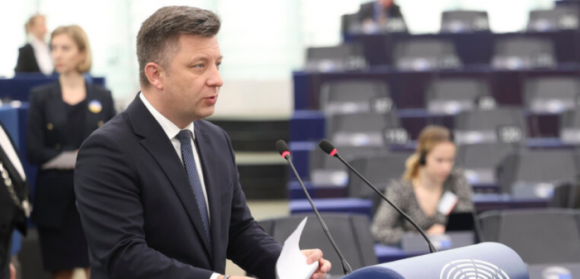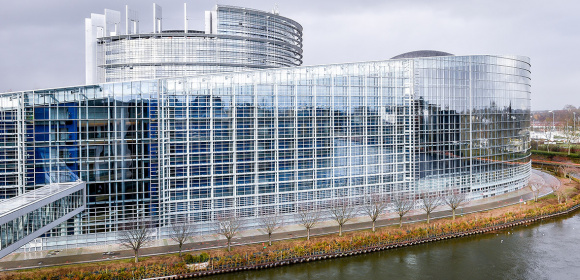
In Strasbourg, during a plenary session of the European Parliament, a discussion took place on the new European internal security strategy. During the discussion, which included Magnus Brunner, the European Union Commissioner for Home Affairs and Migration, PiS MEPs Mariusz Kamiński, Joachim Brudziński, and Maciej Wąsik took the floor.
Addressing the commissioner, Mariusz Kamiński stated that the document under discussion today contains “several interesting ideas.” “But the Commission has adopted similar strategies before, only to later contradict them with its own actions,” he recalled.
In this context, the PiS MEP cited the disastrous migration policy, which has significantly undermined the security of Europeans. “It has thrown the doors wide open to criminal groups, smugglers, and terrorists,” he added. Referring to the announcement by Frontex officials about “strengthening the borders,” Kamiński asked Brunner: “Are you aware that instead of supporting the border guards protecting the Lithuanian-Belarusian border, Frontex officials—acting almost like left-wing NGOs—sent reports undermining their actions?”
On the topic of combating hybrid threats, the PiS politician then asked the Commissioner for Migration whether he was aware that the European Commission had criticized Poland for detaining Paweł Rubców, a GRU agent posing as a journalist. “You say that the security services should be provided with modern tools because criminals and our enemies use them. Have such messages been coming from Brussels so far? Absolutely not!” the MEP stated.
The PiS politician agreed that cooperation in combating cross-border organized crime should be intensified. As he noted, many threats can be detected by targeting the sources of criminal financing. “My government knew how to effectively combat VAT mafias. The Minister of the Interior in the PiS government shared his concern that the strategy—despite many valuable elements—will remain nothing more than another piece of paper. Security can no longer be held hostage to political correctness,” he emphasized.
Joachim Brudziński stressed that the internal security of member states should mean, first and foremost, “the security of citizens in our countries.” “And how does this look in practice? I’ll use the example of my country, Poland. Well, Donald Tusk, appointed by Ursula von der Leyen as prime minister of the Polish government—supposedly to restore the rule of law threatened by the Law and Justice government—is indeed implementing it in a spectacular manner," —said the MEP.
To support this claim, he recalled the case of a colleague of former Prime Minister Mateusz Morawiecki, “who is led to interrogations in handcuffs—as if she were a very dangerous criminal—a mother of a very sick child, blackmailed with the threat of dismissal.” Brudziński also mentioned the women being held in detention centers without basic hygiene supplies, who must relieve themselves in the presence of men, and “whose ‘crime’ was that they collaborated with previous ministers or the prime minister, and attempts are being made to coerce them into giving compromising testimony against their predecessors.” “And what’s most interesting is that in recent days, an exceptionally brutal murderer has been released from prison—a man who, after failing in his attempt to kill Jarosław Kaczyński, murdered an innocent employee of a parliamentary office, slit another’s throat—and he is being released three days after the long-time director of Jarosław Kaczyński’s office was hounded, having been denied access to a lawyer during her interrogations. “This is what Donald Tusk’s rule of law looks like,” said Brudziński.
Maciej Wąsik stated that “today we must confront the question of why Europeans feel less safe.” He pointed out that studies identify three main factors that cast a shadow over security in Europe. “First, migration and significant difficulties with integration,” said the MEP, recalling that after 2015, millions of migrants crossed the European Union’s borders. “People on the streets fear for their safety, especially after incidents such as those on New Year’s Eve in Cologne, where over 1,200 assaults were reported,” he added. The second factor he mentioned is terrorism. “Repeated attacks, such as those in Paris, Berlin, Strasbourg, Nice, and Brussels, often make residents afraid to be in public spaces,” Wąsik pointed out. The third factor mentioned by the PiS MEP is ordinary street crime. As he noted, in 2023, Paris recorded over 10,000 violent robberies, while Stockholm saw 62 gang shootings and 300 rapes. “This instills fear on the streets and paralyzes residents. These concerns require action: effectively blocking illegal migration and strengthening Europe’s borders. The Migration Pact is not the answer to migration-related problems,” said the PiS politician, noting that it merely shifts Western Europe’s problems to countries that are still safe, such as Poland, the Czech Republic, and Hungary. "We must withdraw from the pact and implement swift and effective methods to defend our borders and return illegal migrants from Europe," he urged.