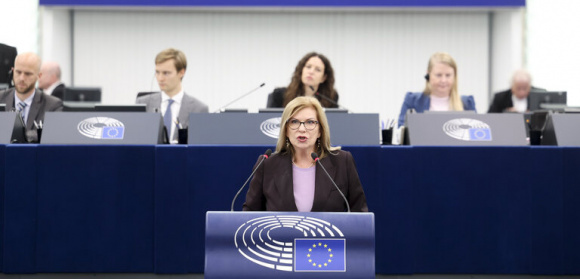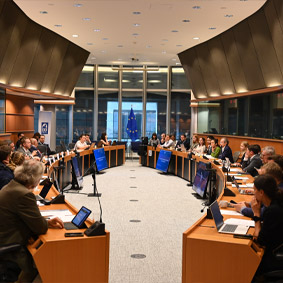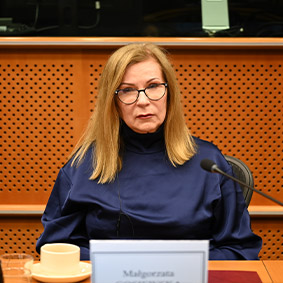
In Strasbourg, during the ongoing plenary session of the European Parliament, the EU’s strategy for the Union of Readiness was discussed. PiS MEPs Beata Szydło and Michał Dworczyk took part in the discussion with Hadja Lahbib, the European Commissioner for Development and Humanitarian Aid.
Beata Szydło noted that the commissioner’s remarks focused primarily on crisis management in relation to threats arising from natural disasters, but the document published by the Commission on preparedness addresses the issue more broadly.
The PiS MEP addressed this broader dimension. She stated that she has doubts—based on her experience as Prime Minister of Poland—as to whether centralized management at the European Union level is the best approach in such crisis situations. “Support, solidarity, and cooperation are certainly needed. There’s no doubt about that,” said the former head of the Polish government. However, in crisis situations, she noted, it is necessary to act quickly and make decisions here and now. “I fear that the bureaucratic machinery will move too slowly,” stated the PiS MEP. The second issue the Polish politician addressed was the fact that there is a very fine line between support, assistance, and the desire to defend the democratic process, on the one hand, and attempts to interfere in the democratic processes of individual member states, on the other.
Michał Dworczyk emphasized that Poles have repeatedly proven their readiness and resilience. “Recent crises related to the hybrid attack on our borders and the influx of war refugees from Ukraine have shown that member states and their citizens play a key role in responding to threats,” — noted the PiS politician, also pointing to the commendable attitude of Poles during the recent floods in Lower Silesia and the Opole region, when they “demonstrated solidarity and determination.” “Another daily expression of preparedness is the involvement of thousands of Poles in the territorial defense force established by the Law and Justice government,” – said Dworczyk, noting that this is precisely why—although the ideas of cooperation and solidarity in the face of threats, as outlined in the EU Strategy for a Union of Preparedness, are commendable—it is worth asking the following questions: “Does the European Commission really know better how to build preparedness in Poland or Finland? Does central planning of societal resilience from Brussels make more sense than solutions tailored to local realities?”
“This strategy is yet another proposal from the Commission in which a remedy of dubious quality has been proposed for a problem that was accurately diagnosed,” the MEP argues, noting that it goes beyond the bounds of coordination and shifts the focus from nation-states to the EU level. “Proposals such as the EU Preparedness Act or the inclusion of ‘preparedness’ as an element of the European Semester are nothing more than a slow but systematic pushing of member states out of areas where they perform significantly better than officials in Brussels,” – said the PiS politician.