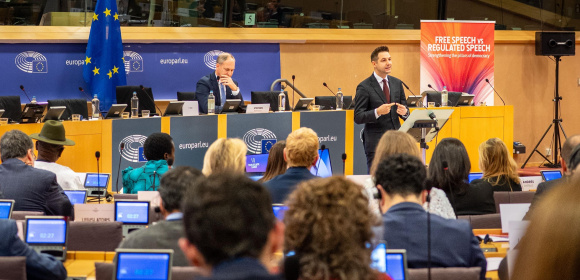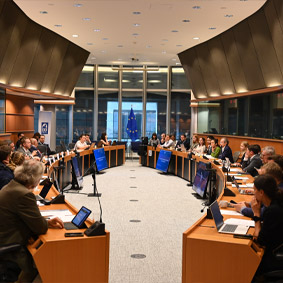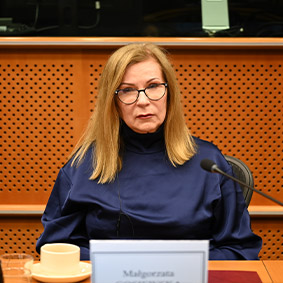
During a meeting of the Special Committee on the European Democracy Shield in the European Parliament, a discussion took place on the EUDS activity report, for which PiS MEP Beata Szydło served as shadow rapporteur on behalf of the ECR Group.
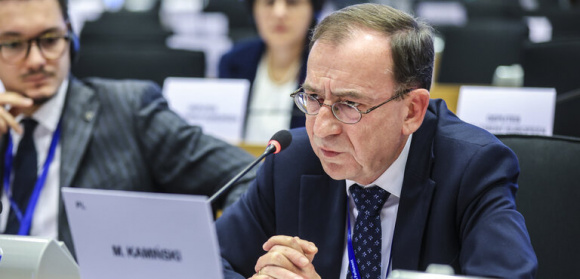
During the discussion, MEPs Beata Szydło and Mariusz Kamiński emphasized the need to intensify efforts to combat Russian influence and hybrid attacks, and strongly criticized proposals that would lead to the centralization of powers within the European Union.
MEP Beata Szydło emphasized that strengthening the resilience of democracy, protecting the integrity of elections, freedom of speech, and civic engagement remain fundamental values.
“I fully support the need to strengthen the resilience of democracy and to protect elections, freedom of speech, and civic engagement. However, the European Democracy Shield raises serious concerns regarding the principle of subsidiarity, the sovereignty of member states, and institutional balance,” noted the ECR coordinator.
She also noted that the European Union faces a real threat of external information warfare, particularly that waged by the Russian Federation. As she emphasized, the Union’s response to these challenges must not lead to EU institutions assuming competences that belong to the member states.
“The EU’s response must strengthen the member states, not replace them in areas such as the organization of elections, civic education, or the protection of the information space,” she emphasized.
Referring to proposals to create new EU structures, including a European Center for Democratic Resilience, the former Polish prime minister expressed an unequivocal position. “Cooperation—yes. Centralization and political oversight—no. New structures can only be voluntary and supportive in nature,” she stressed.
Mariusz Kamiński pointed out significant shortcomings in the draft document and the omission of issues that undermine the credibility of European Union institutions. “The report failed to mention matters that are deeply embarrassing for the European Union—such as the scandal involving Commissioner Reynders. Today, he is accused of money laundering, and the authorities are investigating the nature of his ties to Russian oligarch Oleg Deripaska. Reynders interfered in my country’s affairs, even interceding on behalf of the Russian spy Gonzales, who was arrested by Polish intelligence services,” said MEP Kamiński.
He also drew attention to cases of foreign interference in the European Parliament’s activities and the use of the parliamentary platform to advance the interests of third countries. “The draft report fails to mention that foreign states have bought the votes of MEPs in the European Parliament to advance their interests, as evidenced by the still-unresolved Qatargate scandal. And what about the case of Nathan Gill, the MEP who read statements written by Russian intelligence services from the parliamentary rostrum?” Kamiński recalled.
“Perhaps the European Center for Democratic Resilience should first and foremost address the resilience of the EU institutions themselves,” he asked.
In conclusion, MEP Mariusz Kamiński unequivocally emphasized his opposition to any interference by the European Union in Poland’s electoral processes. “We will treat any interference by the European Union in the course of Polish elections as an attack on our sovereignty. We have not grown tired of an independent Poland, and we are capable of fighting for it!” he concluded.