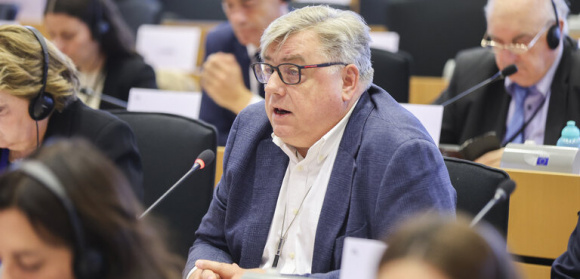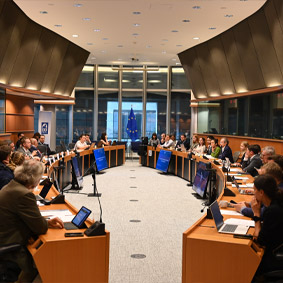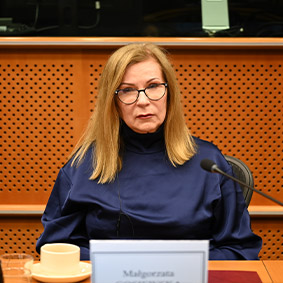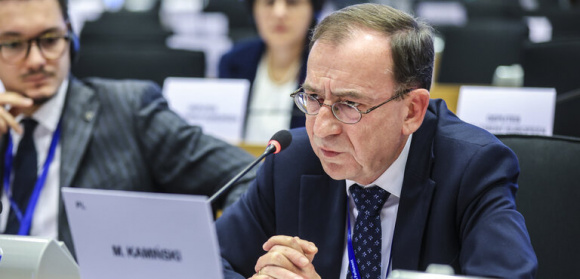
In Brussels, during a meeting of the European Parliament’s Committee on Civil Liberties, Justice, and Home Affairs (LIBE) of the European Parliament, and an exchange of views with representatives of the European Commission and the authorities of member states—represented by Lithuanian Minister of the Interior Władysław Kondratowicz and the commander of the Lithuanian Border Guard, Gen. Rustamas Liubajevas— Mariusz Kamiński, a Law and Justice MEP, drew attention to key issues related to the protection of the European Union’s eastern border in the face of growing threats.
In his speech, the MEP raised the issue of the reliability of data on illegal migration. He referred to a Frontex press release dated January 15, according to which the number of illegal crossings of the EU’s borders last year was reported to have fallen by a total of 26 percent, and on the eastern flank—by 37 percent, to 10,846 so-called “irregular border crossings.” As he emphasized, these figures contradict the information provided by the Polish Border Guard, which reports nearly 30,000 attempts to illegally cross the Polish-Belarusian border last year. Reports from Lithuania and Latvia also point to a different scale of the phenomenon, including new daily records and an increase in the number of so-called “secondary crossings.”
Mariusz Kamiński asked the European Commission for the actual picture of the situation at the EU’s border with Belarus and asked Lithuanian representatives for data regarding their section of the border and an assessment of the situation in Latvia. According to Lithuanian representatives, last year saw a 20 percent increase in illegal crossings at the Lithuanian-Belarusian border. The influx of migrants through Latvia has also risen significantly.
The MEP also emphasized that an essential element of effective protection of the EU’s external borders is the expansion of border infrastructure, including both physical barriers and modern electronic systems. He noted that for years, the European Commission had approached these solutions ideologically, criticizing countries that decided to build border barriers. In light of this, he asked whether the Commission had changed its position and whether Member States protecting the Union’s external borders would be able to count on financial support from EU funds. The Polish politician was supported by Minister Kondratowicz, who highlighted the necessity of such support.
“Last year, Lithuania filed a case against Belarus with the International Court of Justice, accusing it of orchestrating the migration crisis and using illegal migration as a weapon. What is the current status of this case? Does Lithuania have the Commission’s support on this issue?” asked Mariusz Kamiński, also inquiring why the current Polish government had not joined the complaint.