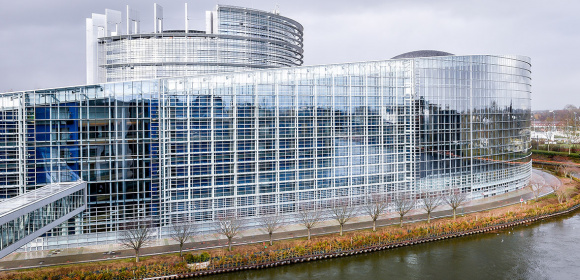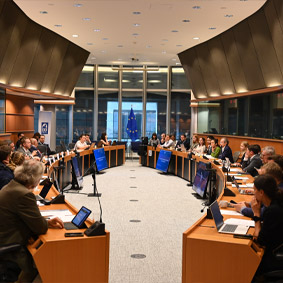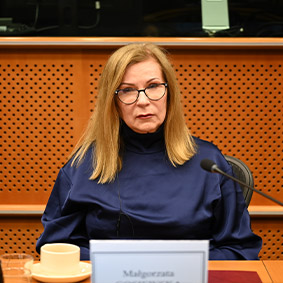
In Strasbourg, during a plenary session of the European Parliament, a debate took place on foreign interference and espionage by entities from third countries at European universities. PiS MEPs Małgorzata Gosiewska and Piotr Müller took part in the discussion.
Małgorzata Gosiewska pointed out that European universities are being infiltrated by foreign intelligence services. “It is here that the ‘battle’ for young minds is being waged—minds into which harmful, left-wing ideologies are being instilled, disinformation is being spread, and influence over important decisions is being built. A battle is underway for access to knowledge, scientific research, and modern solutions,” she noted.
The PiS MEP noted that Russia, Belarus, and China are planting their spies in academic circles to weaken and destabilize European countries. She said that the Russian spy network has access to data that helps it influence societies and institutions, and that there is evidence of this in Poland, Estonia, and the United Kingdom. The Polish politician cited the example of a university in Siedlce, which, in cooperation with Russia and Belarus, organized conferences on Polish-Russian relations, including security issues. She added that the university’s rector, a colonel in the former Military Intelligence Services, is the doctoral advisor to the head of the Military Counterintelligence Service—the agency responsible for the Polish state’s counterintelligence protection.
“The struggle against Western civilization is being waged on many fronts. An open battle is being waged in Ukraine, while an invisible one is being fought through influence and manipulation. Universities must remain free, but it is the state’s role to ensure security—both in terms of protecting ideas and technology, as well as influencing the minds of the younger generation,” she emphasized.
Piotr Müller pointed to three external influences emerging in Europe across various sectors. Discussing the first sector—energy—he highlighted Russia’s influence on many universities across Europe. “Russia has argued that natural gas is a better way to power Europe than, for example, electricity from nuclear power plants,” the MEP recalled, adding that many Members of the European Parliament had fallen for this rhetoric.
He also pointed out that, under the pretext of promoting science and environmental protection, the development of large-scale infrastructure—such as on the Oder River in Poland—has been restricted. He noted that “scientific arguments were often cited here, but in reality, they were driven by lobbies from other countries behind the scenes.”
The PiS MEP stated that another area of external interference in Europe is identity. “Often, through various initiatives at universities, attempts are made to build a cosmopolitan identity, so that we do not have strong nations in Europe; but in reality, this will result in a weak Europe in the future,” the Polish politician warned.