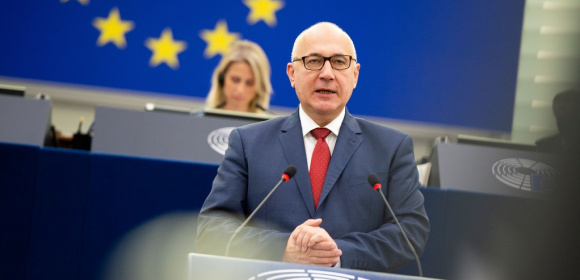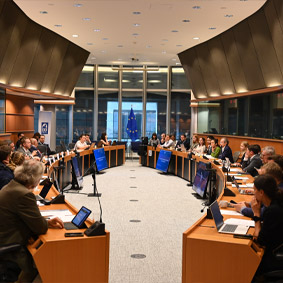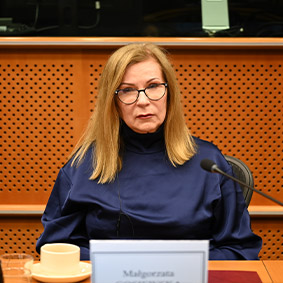
During the European Parliament’s afternoon debate in Strasbourg, a discussion took place on the need to detect and prevent acts of sabotage carried out by the Russian “shadow fleet,” which is destroying critical infrastructure in the Baltic Sea. PiS MEPs Michał Dworczyk, Adam Bielan, and Maciej Wąsik participated in the debate.
Michał Dworczyk noted that the issue of Russia’s criminal activities, carried out with the help of its so-called “shadow fleet,” is once again on the Parliament’s agenda. “The European Union’s lack of adequate and effective action to date has meant that the shadow fleet has not only failed to curtail its activities but, on the contrary, it has expanded them, this time moving on to terrorist activities and causing the severing of undersea cables on the Baltic seabed,” the Polish politician commented. He emphasized that these were undoubtedly acts of international terrorism and, as such, require a decisive response. In light of this, the MEP called for concrete action to be taken. “Above all, close cooperation with NATO is necessary to restore security in the Baltic Sea, as well as decisive action against those involved in acts of terrorism,” he said. He noted that sanctions imposed on the shadow fleet must be strictly enforced, and the list of vessels must be effectively updated. He reported that the list currently includes 79 vessels, while the active shadow fleet consists of over 600 ships. He also highlighted the need to impose further sanctions against Russia, including those that would target the Russian gas and chemical sectors.
Adam Bielan stated that Russia’s aggressive war is slowly encroaching on the EU and its neighbors, “highlighting both the commendable work of national security forces and our collective shortcomings in defending against hybrid threats.” “It is essential to strengthen our resilience against provocations that threaten our societies, infrastructure, and values,” the MEP argued. He also pointed out that the exchange of information and the resources allocated in national programs to detect and counter threats to undersea infrastructure are insufficient. As examples of possible solutions in this situation, he cited improved EU-NATO cooperation, investments in backup systems, enhanced collective security in the region, and stricter enforcement of the United Nations Convention on the Law of the Sea (UNCLOS).
The Polish politician emphasized that undersea infrastructure is just the tip of the iceberg. “Exploding packages, arson, death threats, and interference in elections are situations that continue to occur, and it is our duty to provide a joint response to these challenges,” the MEP argued.
“For many years, the European Union turned a blind eye to what Russia was doing,” stated Maciej Wąsik. He also pointed out that the European Union’s largest country—Germany—had built infrastructure that gave Putin the opportunity to amass enormous financial resources, allowing him today to wage an aggressive war against Ukraine and use fuel blackmail against Eastern European countries. “Today, instead of calls in Germany to rebuild the Nord Stream gas pipeline on the Baltic seabed, I would like to hear calls for new sanctions against Russia and those who support it,” commented the PiS MEP.
The MEP reported that the Americans imposed new sanctions a few days ago on Russian oil and gas companies, as well as on more than 100 tankers. He noted that, as a result, the cost of transporting Russian oil via the “shadow fleet” immediately tripled. “Only through new, tough sanctions can we counter Russia’s aggression,” the Polish politician argued. He urged support for new, far-reaching sanctions against an empire that today threatens not only Ukraine but all of Europe and the world. “We are once again facing an evil empire. Putin’s Russia must be brought to its knees, and it is the duty of the entire civilized world to ensure that happens,” the politician urged, warning that a lack of decisive action could lead to a situation where “in a few years, we’ll be forced to learn Russian.”