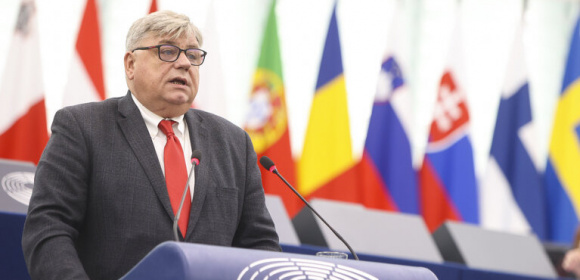
During the European Parliament’s plenary session in Strasbourg, Law and Justice MEPs Bogdan Rzońca and Kosma Złotowski spoke in the debate on the activities of the European Ombudsman in 2024. Rzońca, the report’s rapporteur and chair of the Committee on Petitions, emphasized the importance of transparency and accountability in EU institutions, while Złotowski drew attention to the crisis of public trust in European institutions.
At the beginning of his remarks, Bogdan Rzońca explained the circumstances surrounding his appointment as rapporteur. As he noted, following a vote in the Committee on Petitions, the original rapporteur decided to step down from the role; consequently—in accordance with parliamentary practice—as committee chair, he was asked to take over work on the report.
The PiS politician emphasized the importance of the Ombudsman’s office in strengthening standards of good administration in the European Union and increasing the transparency of EU institutions’ operations. He noted that in 2024, the Ombudsman’s office assisted nearly 18,000 citizens, and over 400 investigations were launched into potential cases of maladministration within European institutions.
“Transparency, access to documents, and respect for ethical standards are not optional principles. They are legal and democratic obligations. Citizens expect European institutions to apply the highest standards of accountability,” Rzońca emphasized.
The MEP also highlighted the importance of transparency in the decision-making process, the need to prevent conflicts of interest, and the necessity of basing decisions on reliable scientific data. He also pointed to new challenges for public administration related to the use of artificial intelligence, emphasizing the need to maintain human oversight of decision-making processes.
“A strong and effective Ombudsman means better European administration, and better administration means greater public trust in the European Union,” he noted.
Kosma Złotowski, for his part, drew attention to the growing crisis of trust in European institutions.
“European institutions are experiencing a massive crisis of confidence because the decisions made in Brussels in recent years have had many negative consequences for Europe’s economy and security,” he said.
The MEP emphasized that the European Conservatives and Reformists Group appreciates efforts to increase the transparency of the legislative process, but expressed disappointment at the lack of response to certain controversial issues concerning the European Commission’s activities.
Although certain amendments were successfully introduced into the report during the work in the Committee on Petitions—including those emphasizing the importance of protecting the European Union’s external borders and critical references to the European Commission’s practice of funding organizations that subsequently lobby for specific policies —in the opinion of the PiS delegation, the document still contains elements that go beyond a neutral assessment of the Ombudsman’s activities.
As highlighted in the explanation of vote, the report also introduces political themes—including those concerning migration and the role of civil society organizations in the European Commission’s decision-making process—which do not fall directly within the administrative mandate of the European Ombudsman. For this reason, the PiS delegation in the European Parliament abstained from voting.