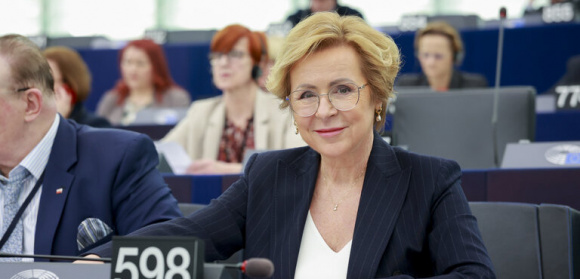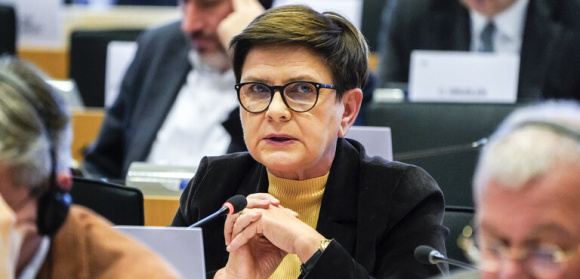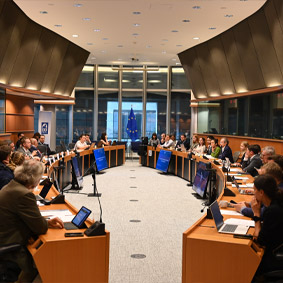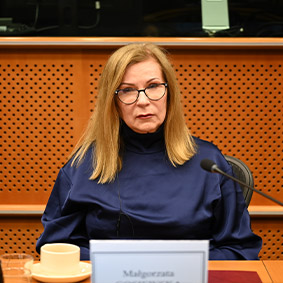
A conference titled “A Just Green Transition: Let’s Not Leave Anyone Behind in the EU’s Efforts Toward Sustainable Development” was held at the European Parliament in Brussels. The event, organized by ECR MEP Gheorge Piperea, was attended by PiS MEPs Bogdan Rzońca, Arkadiusz Mularczyk, and Kosma Złotowski. The main goal of the conference was to promote a substantive dialogue on how to achieve a “just green transition” in the EU.
Bogdan Rzońca noted that energy independence is a key goal pursued by the European Union and that achieving it requires creating an energy mix. He said that the United States, China, and India currently have such an energy mix, which includes renewable energy sources (RES) and traditional energy sources. “To this end, national budgets should be utilized, and nations should retain control over their own energy systems to ensure energy sovereignty within the European Union in the event of a conflict of interest between a nation-state and the European Union,” said the MEP.
Although the Polish politician supported the EU’s slogan “Energy efficiency first,” he also noted that implementing it too quickly is and will continue to be devastating for the poorer EU member states. “Prioritizing energy efficiency above all else conflicts with the current situation in the European Union, because the state of the building and energy infrastructure varies greatly from one EU country to another,” he said. He added that the countries of the post-Soviet bloc have far more work to do than Western European countries and will have to bear significantly higher costs. “While advocating for natural gas as a transition fuel during the previous term of the European Parliament, I succeeded in having it recognized as an energy source eligible for European Union funding,” Bogdan Rzońca recalled in this context.
Commenting on the current global economic situation, the MEP noted that the EU is losing out to the United States and China. He referred to remarks by Donald Trump, who announced that “Americans will withdraw from the Paris Climate Agreement, increase spending on gas exploration, and will not give up on coal.” “We should expect the European Union’s economic and energy situation to deteriorate if the European Commission does not change its dogmatic climate policies,” the MEP predicted. He pointed out that the EU purchases 97 percent of its solar panels from China and called on the European Commission to address this situation and stop providing capital to China. “For years, the European Union has been buying coal and gas from Russia; now it has imposed sanctions against Putin, yet it is providing financial resources to China,” the MEP pointed out, describing the situation as “downright comical.”
The MEP also drew attention to the rise in the European Union’s debt. He recalled that Draghi’s recently presented report projects an increase in the EU’s debt of 800 billion euros per year. He added that this demonstrates the ineptitude of previous European Commission administrations. “If the EU is to be competitive, it cannot keep taking on debt indefinitely. It must scale back its ideological commitment to ‘helping the whole world’ and focus on a few priorities, including the energy mix,” — stated the PiS MEP. As a proposal for measures to support the EU’s energy policy, the Polish politician cited the purchase of new technologies for the coal-fired power sector that would reduce its emissions and provide cheaper energy. “If the European Union is to take out new loans, it should allocate them exclusively to research and development, to the creation of joint global research centers, and to hydrogen energy,” he noted. He argued that this form of energy offers the greatest hope for increased efficiency and environmental protection in the EU.
“The EU cannot become a single European state with a single energy system, a single army, a single tax system, and a common foreign policy. This poses a huge threat of domination by richer countries over poorer ones,” warned the Polish MEP. He added that the European Union “must be the Europe of Schuman’s vision, not Spinelli’s,” and that its member states must feel secure in order to develop their economies. “Realism within the European Union calls for collaboration and cooperation, not closing ourselves off from the best technologies originating from outside the European Union,” he emphasized.
In his speech, Arkadiusz Mularczyk referred to a document published in January by the EU’s Directorate-General for Economic and Financial Affairs (EFCIN). He said that it is incomprehensible and unclear to most Europeans. “The EU does not communicate in plain language because it does not want us to understand anything,” the MEP stated.
He noted that the text presents data on rising energy prices—and consequently higher production costs and a loss of competitiveness—and describes the downward spiral of the European economy, “because where electricity prices have gone up, economic growth has slowed.” “To put it simply, this means that companies in the eurozone will have to change their business plans and potentially sacrifice profits to remain competitive, since electricity is more expensive,” the MEP said, summarizing the document’s findings.
“We all know that the EU is losing competitiveness compared to the U.S. and China—the numbers are clear. Moreover, despite this obviously harmful direction, the EU continues down this path, which can only be described as economic madness,” commented the Polish politician.
He stated that the solution to this problem is painfully simple and widely known—a change in the policy that drives up energy prices. He added, however, that this would mean the EU admitting to a misunderstanding of that policy. “I am convinced that if there were a more environmentally friendly way to ‘power’ the world—one developed in a free market and competitively priced—EU citizens would embrace this project, and it would be a ‘just green transition,’” — Mularczyk stated, referring to the conference’s title.
He explained that such an approach would also mean that “no one would be left behind,” as is currently the case. He pointed out that, after all, it is EU citizens who are being forced to bear the financial burden of complying with the harmful conditions of the Green Deal imposed on them. He stated that this would leave people without financial resources and abandon them to face financial difficulties on their own. “If the EU were a corporation, it would not be fulfilling its fiduciary duties toward its shareholders—in this case, EU citizens,” —the MEP remarked, referring to the panel’s title, which included “corporate responsibility” and “due diligence.” He noted that the way the EU operates—and seemingly sabotages itself—means that we all suffer under its leadership.
The PiS MEP suggested that one of the next steps could be the development and refinement of the Three Seas Initiative framework, as well as regional cooperation among the Three Seas countries. “If the Three Seas countries establish an agency, take responsibility, and cooperate, investments in the Three Seas region will yield high returns and generate significant international interest in investing in this area,” — the Polish MEP argued in favor of intensifying efforts in this regard.
Kosma Złotowski noted that the Green Deal is a policy that has proven to be a complete failure. “Dictated by lobbyists and environmental organizations, it benefits everyone else in Europe while destroying our economy,” the MEP stated. According to the EP Quaestor, countries such as Poland and Romania, whose development was a thorn in the side of the wealthy countries of the old EU, were not treated as partners in setting climate policy goals. “On the contrary, this was used as a pretext to limit the development opportunities of new EU member states,” Złotowski believes.
He also stated that “no just transition fund will compensate for the losses resulting from the Buildings Directive, the phase-out of internal combustion engine vehicles, or the exodus of industry from the EU.” The MEP mentioned the ETS tax, saying that it is the main problem making the EU uncompetitive and allowing third countries to colonize its market. “The economies of our region will be the first victims of this policy,” he stated.
In the Polish politician’s view, the only way to move away from fossil fuels is through a massive investment program in nuclear energy. He emphasized that this is the only energy source that is both efficient and environmentally friendly. “We must also enable the widespread use of transition fuels, such as hydrogen from all possible sources, biogas, biofuels, and natural gas,” the politician said, pointing out that Poland has modern technologies to offer in this area.
“This is exactly what a just transition should look like—one based on market principles and technological progress. What we received from the Commission during that term was a climate policy based on ideological premises. As long as this motivation persists, there is no chance for a real change in the direction of the EU’s development,” Złotowski believes, expressing hope that discussions such as these “will help win this battle for common sense.”