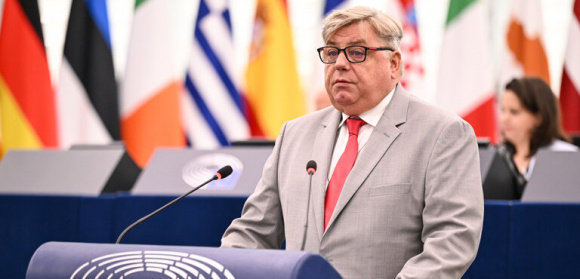
Today, during the European Parliament’s plenary session in Strasbourg, a debate was held on the development of the sustainable aviation and maritime fuels sector. PiS MEP Kosma Złotowski took the floor during the discussion, addressing both the challenges associated with the development of the sustainable fuels market and the ongoing work on reforming air passenger rights.
In his remarks, MEP Złotowski noted that, in parallel with the debate on the future of alternative fuels, negotiations are underway on Regulation 261 concerning air passenger rights. He emphasized that the Council has consistently blocked the Parliament’s proposals aimed at expanding passenger protection, arguing that this could reduce the profits of European carriers. “The Council is right! Airlines are a business, and businesses must make a profit. That’s the rule of the free market,” he said ironically.
At the same time, he stressed that passenger rights are not the source of the rising costs incurred by airlines. “The right to compensation isn’t the problem. It’s not a free seat for a child next to a parent or the ability to bring a stroller or wheelchair on board that’s driving up costs,” he said.
According to Złotowski, the real burden on carriers is the growing requirements stemming from EU environmental policy, including the introduction of a mandatory blend of sustainable aviation fuel (SAF). He recalled that as early as 2022, he had warned the European Parliament against overly ambitious and unrealistic targets in this area.
“It is precisely these regulations that are driving up the costs borne by European carriers, and they are passing these costs on to ticket prices and other services,” he noted, adding that these burdens also indirectly affect the level of passenger protection.
The MEP called for a review of the current assumptions regarding the development of the sustainable fuels market, arguing that in their current form, they are unfeasible for both airlines and the fuel industry. “We need the courage to abandon measures that destabilize the aviation market, reduce the competitiveness of our airlines, raise ticket prices, and indirectly undermine passenger protection,” he emphasized.