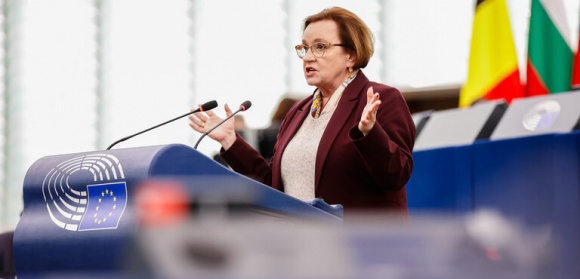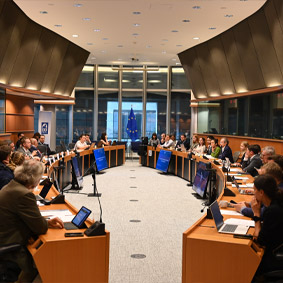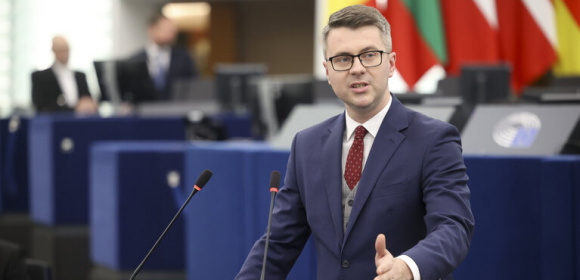
Today, during the European Parliament’s plenary session in Strasbourg, MEPs adopted by an overwhelming majority a report authored by PiS politician Piotr Müller on public procurement, in which he calls for the simplification of procedures for businesses, greater transparency in regulations, and more flexible procedures.
A majority was successfully built to block attempts by the Greens and the Left to impose mandatory climate criteria. The report clearly emphasizes that regulations should specify how to buy, not what to buy. The report emphasizes that it is necessary to maintain technological neutrality—that is, the principle whereby the law and public institutions do not impose a single “correct” technology, but rather allow countries, companies, and investors to choose the solutions that best suit their needs —in terms of quality, price, innovation, or local conditions.
Piotr Müller, in presenting the report, stated that when we talk about public procurement, we are actually talking about something much broader—namely, how Europeans’ money is spent. The EP rapporteur noted that the report focuses on several key elements.
First and foremost, the document emphasizes the need to simplify procedures for businesses. “In the report, we explicitly identify areas that should be streamlined and ways to simplify procedures,” Müller added.
Furthermore, the report addresses the issue of leveraging technological capabilities, such as artificial intelligence, as well as ensuring broad access to them by enabling public procurement to be conducted online, while ensuring the transparency of procedures.
On the subject of science and innovation, the document notes that Europe lags behind the United States, China, and South Korea, all of which allocate enormous resources to these areas. The report emphasizes that Europe must also use public funds to invest in science and ensure that procedures are simplified so that public institutions can take on the risks associated with innovation. “In the report, we encourage making special innovation pathways more accessible not only to the scientific community but also to public institutions that will commission them from companies,” Müller explained.
The report also calls for public procurement to reach small and medium-sized enterprises within the supply chain. “This is to prevent a misguided form of subcontracting that results in small and medium-sized enterprises receiving a disproportionately small margin relative to the tasks they actually perform under the contract,” argued the PiS MEP.
Another priority issue addressed in the report is shortening supply chains and ensuring the possibility of purchasing goods directly from farmers, as close as possible to where they live, in a way that complies with public procurement law and does not discourage farmers with excessive regulations.
Finally, it addresses the issue of technological neutrality and national autonomy when it comes to public procurement. “So that, ultimately, it is the Member States and contracting authorities that can decide how taxpayers’ money is spent in a given country, and so that they have the freedom to choose technologies,” he noted.
“Thank you for the broad support for my report. I hope the Commission will take the EP’s position into account and make bold decisions that will streamline regulations and ensure adequate flexibility and transparency in procedures,” the EP rapporteur emphasized.
The report clearly states that taxpayers’ money must be spent effectively and transparently. “Public funds must be spent in the interest of citizens—public procurement is meant to serve the people, not the bureaucracy,” Müller added.