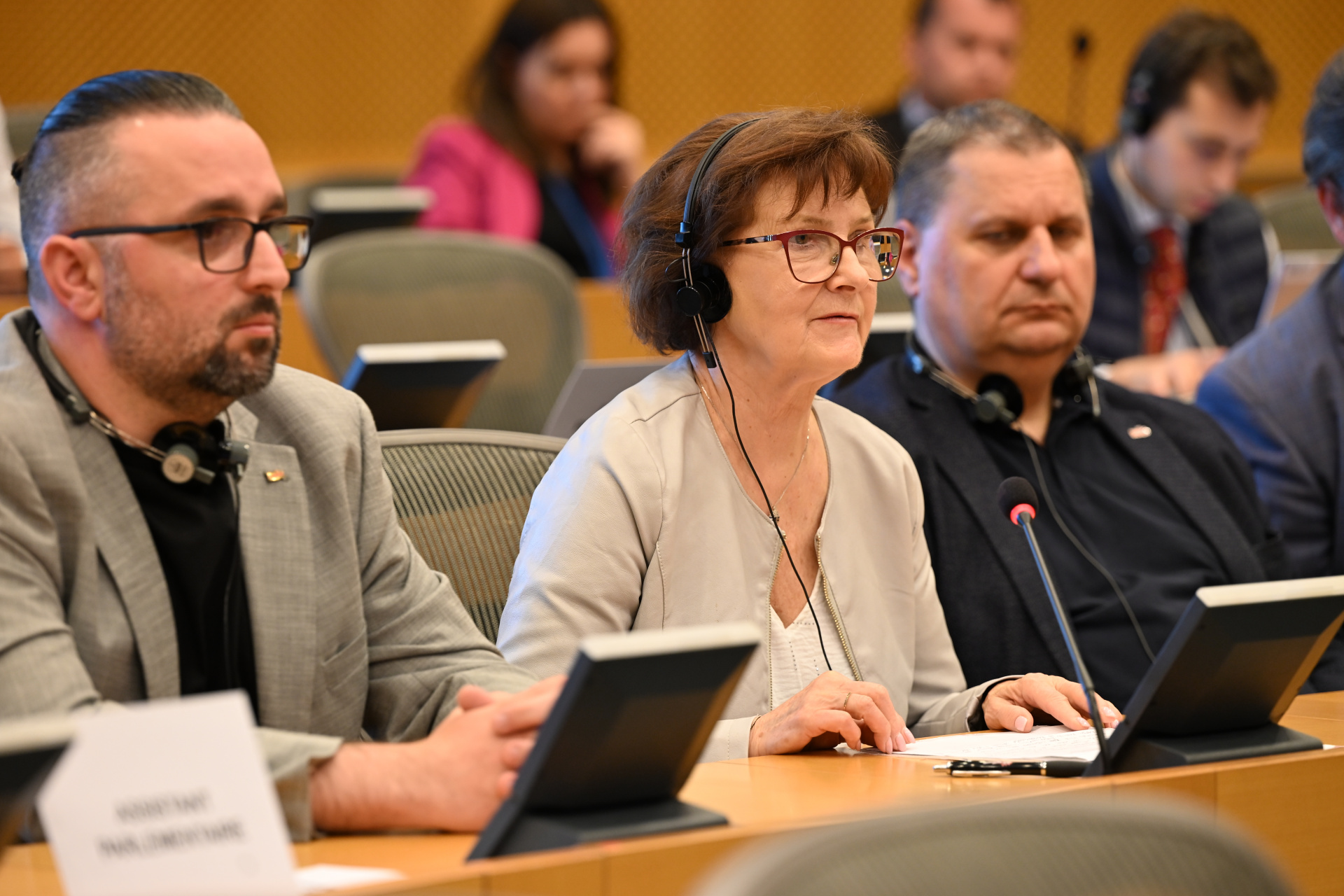
Today in Brussels, during a meeting of the Committee on Petitions (PETI), a petition was discussed regarding the protection of workers’ rights at Poczta Polska in the context of mass layoffs, which took place at this state-owned company from November 2024 to the end of March 2025, resulting in approximately 10,000 people losing their jobs. The petition, submitted on behalf of the Council by Wiesław Królikowski, chair of the National Communications Secretariat of NSZZ Solidarność, was presented by Wiesława Mażarska, a member of the National Communications Secretariat of NSZZ Solidarność and the Executive Council of UNI Global Union.
Speaking on behalf of 52,000 employees of Poczta Polska, Wiesława Mażarska addressed “a flagrant violation of workers’ rights at Poczta Polska, which runs counter to the European Union’s social policy and the principles enshrined in the EU Charter of Fundamental Rights and the European Pillar of Social Rights.”
The representative of NSZZ Solidarność provided a detailed account of the events that have taken place since August 2024, which led to the removal of employee representatives from the Supervisory Board and the staff representative from the Company’s Management Board, in violation of Directive (EU) 2022/2041, which requires member states to promote and strengthen collective bargaining agreements.
In the petitioners’ view, these actions constituted a deliberate operation aimed at eliminating employee oversight and resistance to the further deterioration of working conditions. “Such actions are a glaring example of the erosion of workers’ rights and the elimination of control mechanisms designed to ensure fair treatment of employees and stability in working conditions,” Mażarska pointed out. As she explained, as a result, employees lost their influence over decisions that directly affect their employment, wages, and future at the company. “The elimination of collective bargaining agreements has not only worsened the situation for thousands of employees but has also set a dangerous precedent for other state-owned and private companies in Poland,” she emphasized.
As she pointed out, this is compounded by mass layoffs at Poczta Polska, estimated at 15 percent of the workforce —according to information published by Poczta Polska’s management, the official number of Poczta Polska employees is approximately 52,000, whereas in September 2024 it was 62,000.
“These issues not only affect employee morale and working conditions but may also potentially impact the quality of services provided to the public, as well as public opinion regarding postal services,” Mażarska emphasized.
At the same time, she noted that Poczta Polska is a strategic institution for the state and its citizens—especially for residents of rural areas and small towns. In the opinion of the representative of the National Communications Secretariat, the management’s current policy poses a serious threat to the public interest and national security.
“In the current geopolitical situation and in light of the need to strengthen the resilience of critical infrastructure, further marginalization of Poczta Polska’s role runs counter to the national interest,” she emphasized.
The petitioners are demanding that the European Union, in accordance with the provisions of Directive 2022/2041, which clearly states that European Union member states are obligated to increase employee participation in the collective bargaining system and achieve a collective bargaining coverage rate of at least 80 percent of workers, take action against a member state that not only fails to implement the required reforms but is actively working to eliminate them. “We expect firm action to be taken against the Polish government, which, as the owner of Poczta Polska, has deliberately violated EU labor law standards,” they urge.
The petitioners also presented specific demands to the European Parliament. First, they expect urgent action to be taken to assess the compliance of Poczta Polska S.A.’s policies with Directive 2022/2041 and its statutory obligation to promote collective bargaining agreements. Furthermore, they call for an official inquiry to be sent to the Polish authorities and the European Commission regarding the deliberate exclusion of employee representatives from the company’s governing bodies and the termination of the collective bargaining agreement, which constitutes a violation of EU principles on the protection of workers’ rights.
They also demand that a procedure be initiated to monitor the employment situation at Poczta Polska and assess its compliance with Directive 2022/2041 and the European Pillar of Social Rights.
Finally, they are demanding that the Polish government be required to take immediate action to restore the collective bargaining agreement at Poczta Polska and implement regulations that promote collective bargaining in the public sector.
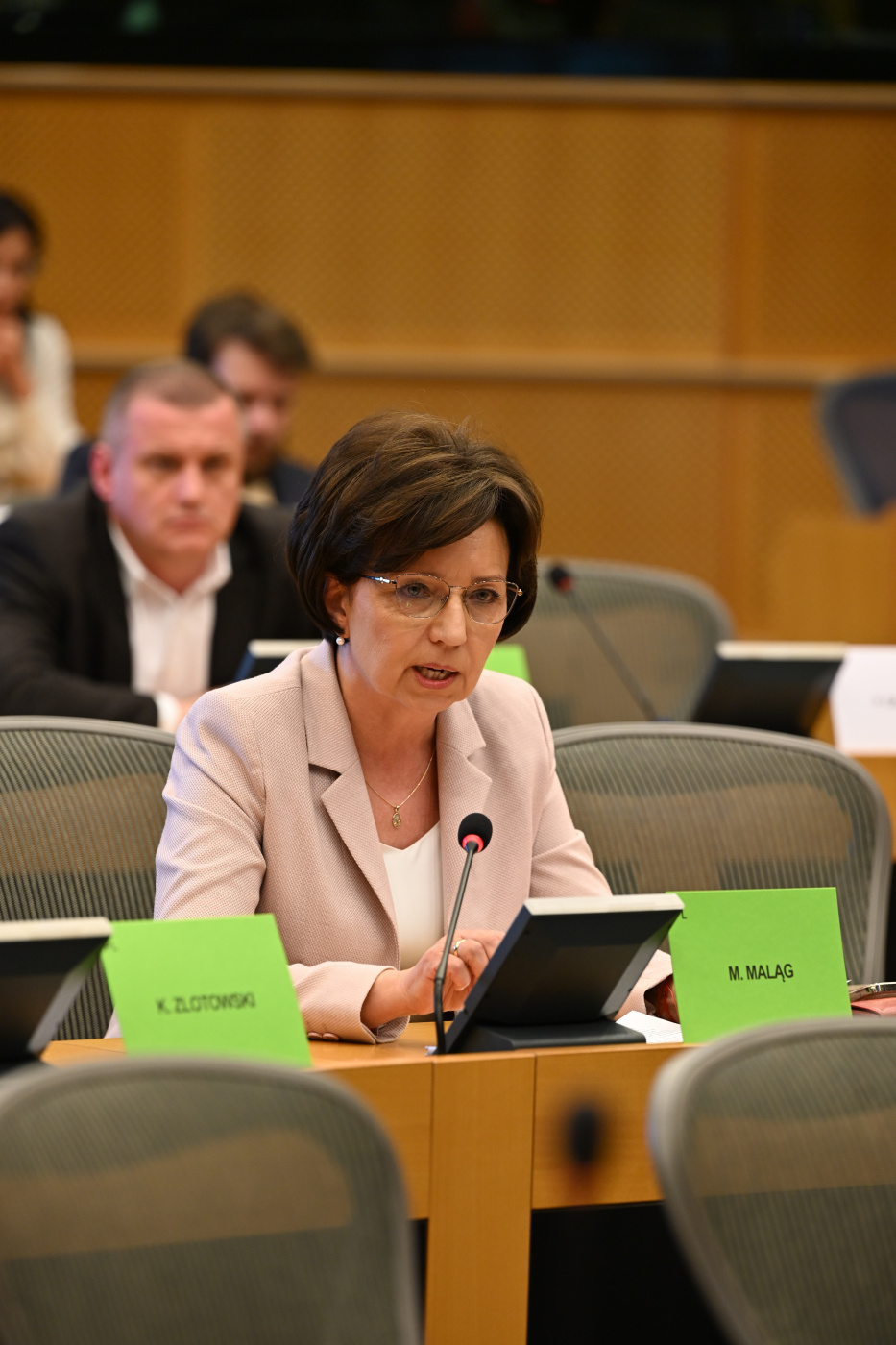
PiS MEP Marlena Maląg commented on the matter: “First and foremost, I would like to thank you for giving us the opportunity to hear the voice of a Polish company here in the European Parliament.” The MEP noted that there is much talk within European institutions about building a social Europe, and that the adoption of the directive on adequate minimum wages was one of the achievements the European Parliament was particularly eager to tout. According to the MEP, this makes it all the more surprising that the European People’s Party, whose MEP served as a co-rapporteur for this directive, tried to prevent today’s debate on this extremely important petition from taking place. “This petition clearly demonstrates that we are still very far from achieving the goals set out in the directive,” – stated the Polish politician, pointing out that instead of improving social dialogue and expanding the scope of collective bargaining, we are witnessing the dismantling of collective bargaining agreements and the curtailment of workers’ rights. As she explained, from November 2024 to the end of March 2025, over a thousand people lost their jobs, and further measures taken by the company are aimed at significantly reducing the number of positions by transitioning to a B2B model. “This therefore means a worsening of the problem of job instability at the state-owned enterprise, as well as more difficult access to postal services for users and recipients,” – explained Maląg, noting that Poczta Polska delivers, for example, pension payments to many elderly people who have no other way to receive this essential benefit. In light of this, the MEP appealed to keep this petition open and to refer it to the special monitoring group tasked with overseeing the implementation of the Adequate Minimum Wages Directive within the EMPL Committee. Marlena Maląg also asked the committee to request that the Polish government explain how Poland is fulfilling its obligation to implement the Adequate Minimum Wages Directive and to promote collective bargaining agreements, particularly in light of the situation at Poczta Polska.
“The right to work gives each of us a sense of stability and dignity. What is happening today at Poczta Polska unfortunately means we are returning to the situation prior to 2015, when Poland faced massive unemployment and families were deprived of stability and a sense of security,” the PiS MEP noted. The Polish politician appealed for people to set aside political divisions and address the social situation of these workers. “Because behind these workers are their families, and we have a duty—if we want to build a strong Europe—to support them, not just talk about that support,” she emphasized.