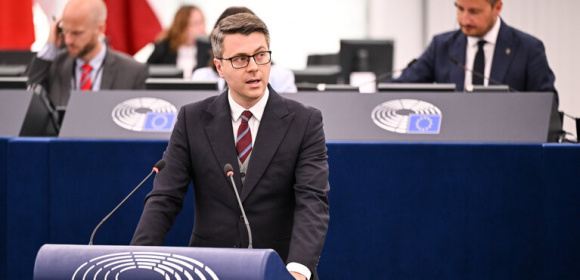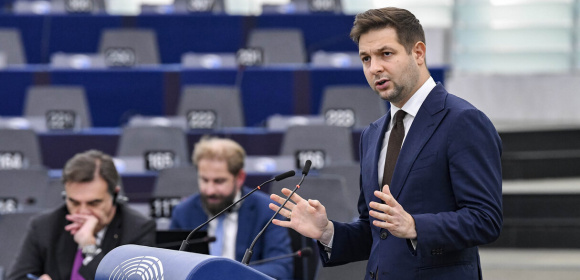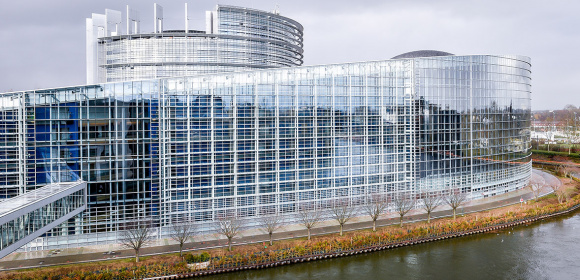
During a plenary session of the European Parliament, a debate was held on the implementation of the rule-of-law conditionality mechanism. Speaking on behalf of the ECR were Law and Justice MEPs Patryk Jaki, Tobiasz Bocheński, Maciej Wąsik, and Jacek Ozdoba, who unequivocally criticized this tool as political, contrary to the treaties, and destructive to the unity of the European Union.
Patryk Jaki emphasized that the conditionality mechanism is an “illegal tool” that contradicts the EU treaties. He pointed out that secondary law cannot take precedence over primary law, and that the European Commission’s definitions of the rule of law are vague and arbitrary. He also pointed out that the use of this mechanism during a war on the EU’s eastern border undermines solidarity among member states and serves Russia’s interests. As an example of selective application of the rules, he cited the situation in Poland, where funds were unblocked following a change in government, despite the absence of legislative changes in the judiciary. The PiS MEP accused EU institutions of applying double standards toward other member states and of a lack of credibility among the individuals and organizations involved in rule-of-law assessments.
Tobiasz Bocheński argued that EU institutions defend neither the rule of law nor democracy, but interpret them in a manner dependent on election results. As he pointed out, acceptance of democracy ends where right-wing groups win. The MEP also criticized the European Commission’s credibility in the context of corruption scandals and questioned the democratic legitimacy of commissioners compared to governments elected in member states.
Maciej Wąsik called the conditionality mechanism “brutal political blackmail” designed to discipline countries governed by parties outside the EU mainstream. In his view, the European Commission rewards governments that comply with its will and punishes those that pursue independent policies. He proposed that member states introduce their own regulations enabling them to respond to treaty violations by the Commission, including by reducing their membership contributions.
Jacek Ozdoba drew attention to the propagandistic nature of the concept of the rule of law in the EU debate. He argued that this mechanism serves to exert real control over governments in member states and to build a centralized “superstate,” which—as he emphasized—Europeans have never agreed to. Referring to the National Recovery Plan, he pointed to the lack of consistency on the part of EU institutions following the change of government in Poland and criticized the language used by some MEPs during the debate.
PiS MEPs unanimously emphasized that the conditionality mechanism, in its current form, deepens divisions within the European Union, undermines trust among member states, and poses a threat to national sovereignty and the principles enshrined in the EU treaties.