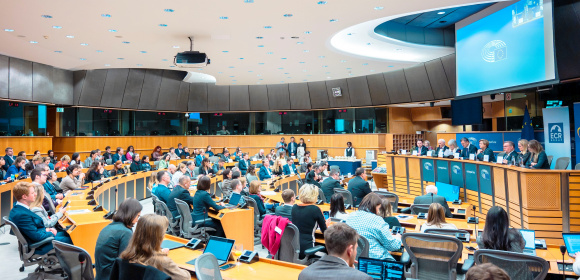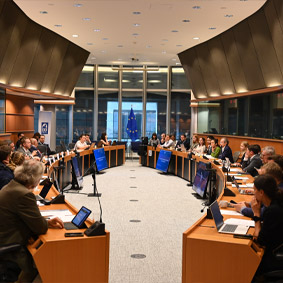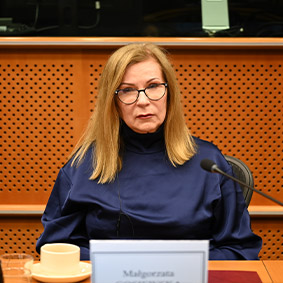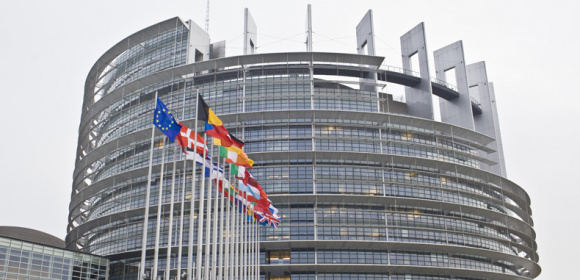
The Belarusian Inter-Party Forum “8+100” took place in Brussels at the initiative of, among others, PiS MEP Anna Fotyga, with the participation of leaders and representatives of eight Belarusian democratic opposition parties. The main goal of the event was to coordinate the efforts of political parties in Belarus and Europe to restore democracy in Belarus and integrate the country into the Euro-Atlantic community. The issue of political prisoners was also raised during the discussions.
Anna Fotyga emphasized that it is extremely important to maintain unity in supporting a democratic Belarus, despite political differences. She stated that the European Parliament should continue its efforts, show solidarity, and expand its support. “Keeping issues such as the situation in Belarus high on the political agenda of international organizations is extremely important, not only because of the tangible results, but also to sustain the morale and spirit of those who remain in their countries. So that they know the world cares,” the MEP emphasized.
As she said, the most important thing is for the international community to recognize the problem. She stated that this can be achieved through actions on many levels—media coverage, drafting documents and resolutions, practical measures, and exerting pressure on the regime. “We must remember that Lukashenko is, above all, a usurper, and we were right to confer the title of president-elect on Sviatlana Tsikhanouskaya. We must now ensure that this title is widely recognized,” she commented. The Polish politician praised the engagement of Belarusian society, which demonstrates the difference between Belarus and Russia. She emphasized that the Belarusian people are being intimidated by an unwanted, unaccepted, and unelected regime that is collaborating with Russia in an aggressive war against Ukraine, waged against the will of the Belarusian people. “Kalinowski’s regiment, fighting on the Belarusian side, embodies the views of Belarusians who do not tolerate this kind of aggression, and that is why promoting its activities is also important,” Anna Fotyga noted.
The PiS MEP recalled the era of communist rule in the Eastern Bloc countries, when, although it was very difficult and extremely painful, one could rely on the efforts of the International Red Cross, which made it possible to visit prisoners—something that is not happening in Belarus today. “It is very important to allow relevant international institutions to visit prisoners, and these institutions must begin taking action,” Fotyga said, calling on the European Union to expand its efforts, including by exerting pressure on relevant international institutions, monitoring court proceedings in Belarus, and highlighting political prisoners in the media. She added that, with regard to political parties in Belarus as well, there has been a clear violation of the International Covenant on Civil and Political Rights, so there are many tools available. “There are no independent courts in Belarus; very often, minor charges are used solely to imprison political prisoners,” she said.
“The European Parliament has many tasks ahead of it; it promotes individual and reciprocal sanctions targeting the Lukashenko regime’s activities and sends messages of support to those imprisoned, which is also very important,” the PiS MEP noted. As she pointed out, it is also important to remember that the Lukashenko regime is undertaking many actions aimed at destabilizing the West as a whole and the countries of the European Union. Minsk uses the tools at its disposal at the Kremlin’s urging, as evidenced, among other things, by its extremely harsh treatment of the opposition and attempts to dismantle it. The Polish politician expressed concern that the goal of both Putin and Lukashenko is to eliminate all those who would like to create a free and independent society, and she supported strong calls for the evacuation of prisoners in need of humanitarian aid. “I believe that in order to truly reform Belarus and ensure a healthy future for the country, what matters most is what the democratic society does within its own country,” concluded the former head of Polish diplomacy.
The purpose of the event was to create an effective platform for cooperation between Belarusian and European sister parties based on the priorities developed at the Forum. Furthermore, the goal was for European political actors to recognize the Belarusian political parties and organizations that have been persecuted and formally dissolved by the Lukashenko regime, and to affirm that they are the foundation of Belarus’s democratic revival. Finally, the meeting aimed to engage a greater number of European actors in the agenda for future cooperation with Belarus.
During the three panels, participants discussed the key challenges facing the European community of democratic nations and Belarus, threats to its independence, as well as the prospects for a democratic Belarus and its integration into the Euro-Atlantic space.
The discussions focused on a comprehensive analysis of the situation and generated proposals for a coordinated strategy and a joint action plan.
The Inter-Party Forum developed a unified position regarding the parliamentary and local “elections” in Belarus scheduled by the ruling regime for February 2024, as well as future democratic elections in Belarus.
Forum participants sought to identify the most effective ways to foster pro-European sentiments among the Belarusian public and to promote the European agenda within Belarus.
The Forum presented its assessment and position on the issue of political prisoners in Belarus, which has reached the level of a humanitarian catastrophe. The organizers of the discussion put forward proposals on how to alleviate and minimize the scale and danger of this challenge.
As a result, the Forum adopted a final resolution on a joint strategy and action plan.