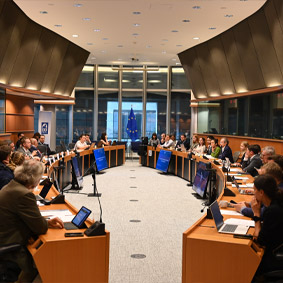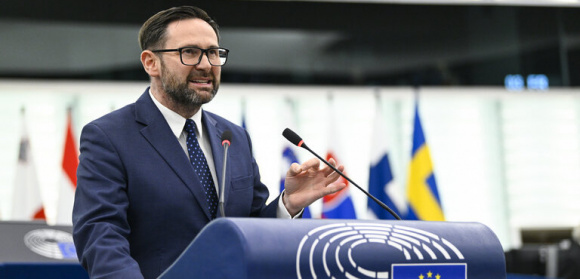
Today in Brussels, during a joint meeting of the Committee on International Trade (INTA) and the Committee on Industry, Research and Energy (ITRE), MEPs adopted a draft report on the gradual phase-out of natural gas imports from Russia and the improvement of monitoring of potential energy dependencies. The shadow rapporteur for the ECR Group was PiS MEP Daniel Obajtek.
On September 30, MEPs negotiating a regulation banning Russian energy imports reached a compromise—imports of Russian gas would be completely banned as of January 1, 2027—one year earlier than the Commission had proposed in June. New gas contracts and temporary storage would be banned starting in January 2026, and existing short-term gas contracts would be banned starting in June 2026, in line with the Commission’s proposal. MEPs also expanded the scope of the regulation to include Russian crude oil and petroleum products (thus mirroring the scope of the current sanctions regime against Russia), the import of which—including via third countries—is to be banned. Importers must report the origin of the gas to the relevant national authorities at least one month before importation or storage.
MEPs from nearly all political groups supported the text of the report, which provided a mandate to begin trilogue negotiations with the Council. The ECR Group also supported the text, despite several reservations, which it will seek to address during negotiations in the Council. The ECR Group was keen to include in the text a potential ban on imports of Russian petrochemical products, or those derived from Russian crude oil, which is particularly important from the perspective of the European petrochemical sector. Additionally, at the ECR’s request, the document includes a system for verifying the origin of crude oil and petroleum products, in order to curb attempts to circumvent the sanctions regime, as a number of European refineries continue to receive subsidized Russian oil under the guise of, for example, Kazakh oil.
“We were able to convince our colleagues in Parliament of the importance not only of introducing a permanent ban on Russian gas imports, but also of establishing an effective system to verify the implementation of that ban,” commented Daniel Obajtek, ECR coordinator in the ITRE Committee. “In addition, the Commission is to conduct an analysis of the impact of imports of Russian petrochemical products—or those derived from Russian crude oil— imported from third countries, which are currently flooding the European market, undermining the sanctions regime against Russia, and at the same time weakening the European petrochemical sector,” said the PiS politician.