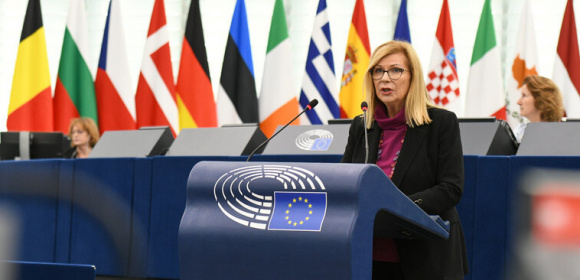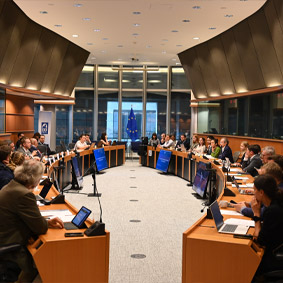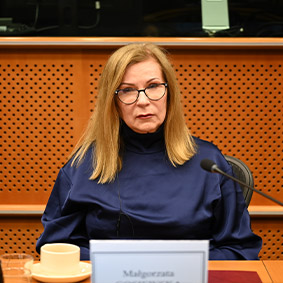
A debate on the state of the Energy Union took place in Strasbourg during the European Parliament’s plenary session. ECR MEPs Daniel Obajtek, Beata Szydło, Jacek Ozdoba, and Jadwiga Wiśniewska spoke during the discussion.
Daniel Obajtek noted that the reform of the European Emissions Trading System and the creation of the ETS 2 system place a very heavy burden on all economies. He explained that this includes an additional tax on fuels, as well as the Construction Directive covering the renovation of buildings, installations, and heating systems. He noted that as a result of the decisions made by the EU, some people will have to give up their homes because they will be unable to afford them.
The MEP also addressed the ban on internal combustion engines. Referring to the catastrophic flooding in Europe, he asked whether electric cars would prove reliable during such floods. He also noted that only 30 percent of chargers are manufactured in Europe, with the rest imported from China. The Polish politician also stated that a hydrogen economy is unrealistic and that even the European Court of Auditors has opined that it is impossible to implement such an economy, either technologically or financially.
“It would be better if the European Union did not make any decisions for five years—even if it meant having to pay for it—and let the business sector regulate itself and invest in modern technologies on its own,” said Daniel Obajtek. He added that such a business environment would be competitive, new jobs would be created, and technologies that reduce emissions would be introduced. To support this argument, he cited the example that the EU’s GDP grew by 0.5 percent in 2023, while at the same time it was 2.5 percent in the U.S. and 5 percent in China.
Speaking about the European Union’s competitiveness, the PiS MEP referred to the EU’s constantly changing plans regarding nuclear power. He noted that the European Union is constantly changing its mind, including on whether natural gas is a carbon-emitting or carbon-neutral fuel. “Enough with the dreams! Europe must wake up, or it won’t be competitive,” Obajtek urged, saying that “Europe could use an alarm clock to rouse it from its slumber.” “Although we talk about various European programs and how important policy is for the economy, that’s not actually the case,” the MEP emphasized, adding that he was not speaking as a politician but as the CEO of the largest company in Central and Eastern Europe. “No one in Europe will invest because it’s overregulated, and Europeans will lose their jobs,” Daniel Obajtek reported on the outcome of his discussions with international businesses.
Beata Szydło stated that the Energy Union was supposed to guarantee Europe’s energy security, the competitiveness of the European economy, and low energy prices and lower housing costs, which would help improve economic conditions in European countries. “The longer this project drags on, and the more various projects and ideas—such as the Green Deal—emerge, the more their weaknesses are exposed,” the Polish politician noted.
The MEP reported that mass layoffs are taking place across the European Union. She cited Germany as an example of job losses in various countries, where large automobile manufacturers are laying off workers and relocating their production outside the European Union. She noted that this is causing the European economy to lose its competitiveness.
Beata Szydło also addressed the issue of energy security. She pointed out that the war in Ukraine has exposed the mistakes made, for example, during the construction of the Nord Stream 2 pipeline.
The PiS MEP also addressed high prices, which are causing Europeans to become poorer. She stated that a project that isn’t working cannot be continued. “We must learn from our mistakes, correct what can be corrected, and truly create a European Union that is energy-secure, economically competitive, and provides a dignified life for Europeans,” she urged.
Jacek Ozdoba stated that the energy sector has become a tool in the hands of Vladimir Putin. He pointed out that Germany is responsible for the energy crisis due to the construction of the Nord Stream pipeline. “Nord Stream is a matter of conscience that should be addressed in Berlin, because if it weren’t for Berlin’s alliance with Moscow, there probably wouldn’t be a war in Ukraine,” he pointed out. The ECR MEP argued that coal, natural gas, and nuclear power are the only stable energy sources that can function at this time. He noted that the push to phase out coal is understandable given certain climate concerns. At the same time, he argued that if we are moving away from coal, we should focus on nuclear power. He recalled that the EU had relied on gas as part of the Energiewende strategy because “Berlin had concocted a business deal with the Russian Federation.” He stated that European families paid the price for all of this. He explained that this required the European Union Emissions Trading System—an artificial tax that causes industry and European families to pay more and more. “Industry is being driven out of Europe because speculators decided so, and instead of understanding this, Europe continues to head in a direction that will lead to an energy crisis,” the Polish politician said. “If the European Union does not reform its approach and reject these artificial mechanisms, it will lead to another crisis and once again provide a tool that Vladimir Putin has already used in the past,” noted Jacek Ozdoba.
Jadwiga Wiśniewska noted that although the energy union was founded on the principles of building energy security and the competitiveness of the European economy, Draghi’s report clearly illustrates the conclusions and diagnosis. “The diagnosis is clear: high energy prices are causing Europe to lose competitiveness, the speculative emissions trading system is stifling the European economy, and industry is moving production outside the European Union due to high costs,” stated the PiS MEP. She explained that as a result, the EU is losing jobs, and energy poverty is also on the rise. “We should reshape our climate policy and our approach to the Energy Union so that our policies serve citizens and the competitiveness of the European economy, which must be the foundation of the European Union’s prosperity and future,” — argued Jadwiga Wiśniewska. She added that the current proposals on the table aim to tighten climate policy, thereby exacerbating energy poverty, undermining the competitiveness of European industry, and leading to job losses. “It’s time to stop this climate madness,” the Polish politician urged.