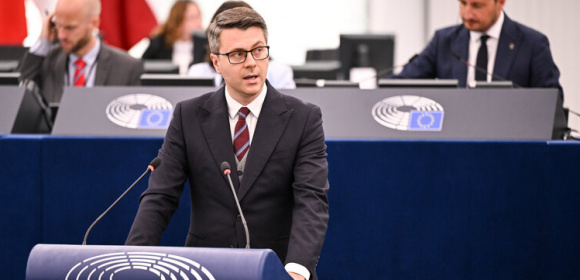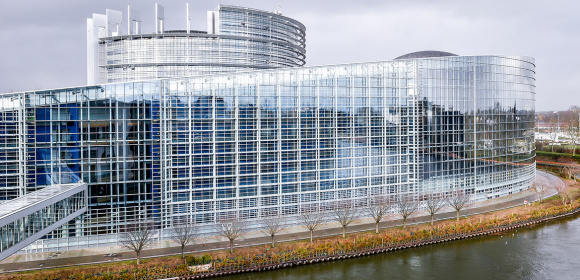
Today in Strasbourg, during the European Parliament’s plenary session, a debate took place on continued financial and military support for Ukraine from EU member states. ECR MEPs Adam Bielan, Michał Dworczyk, and Arkadiusz Mularczyk took the floor during the debate.
Adam Bielan emphasized the ECR Group’s unwavering and steadfast support for Ukraine in its fight against Russia. He noted that the Ukrainian people are a nation whose history has all too often been marked by aggression, oppression, and disregard. “The European Union, its member states, and our partners—with NATO continuing to play a leading role—must renew and strengthen their commitment to supporting Ukraine’s war effort and stand with the victim rather than the aggressor,” — urged the head of the Polish delegation to the ECR.
Adam Bielan noted that to date, the European Union has provided military aid worth approximately 43.5 billion euros, as well as essential humanitarian and civilian assistance, “without which the past and coming winters would have had even more severe consequences for the Ukrainian people, who are bravely resisting.” He added that the war fatigue felt by Western countries cannot be compared to what our Ukrainian allies are currently facing. “Russia will not stop at Ukraine. Cyberattacks and other security threats will spread to other countries,” the MEP warned. He also stated that Ukraine is a European country that belongs alongside its other like-minded partners and friends. “We call on EU member states not only to renew but also to strengthen their commitment to this just cause, regardless of political preferences, because President Zelenskyy is working for peace,” the Polish politician appealed on behalf of the ECR Group. He also encouraged MEPs to “uphold our values and alliances and give Ukraine the means to do the same.”
Michał Dworczyk noted that today’s debate is taking place on a special day—namely, the 85th anniversary of the Soviet invasion of Poland, which violated the non-aggression pact. “Why am I bringing this up? Because as I listen to today’s debate, I get the impression that some people either do not know or have forgotten that Russia was, is, and will always be a barbaric, treacherous, and aggressive state that understands only the language of force,” he explained. The Polish politician emphasized that the EU’s actions must be bolder and more consistent than they have been so far. Dworczyk also noted that it has been 2.5 years since Russia launched its war against Ukraine, during which tens of thousands of people have lost their lives and millions have been forced to flee their homes. And—as he noted—although the European Union continually expresses its solidarity, there are still a great many companies that easily export sanctioned goods to Russia. “We must put a stop to this scandalous practice,” he urged. He emphasized that greater export controls are essential, as is identifying smuggling routes that circumvent the sanctions imposed on Russia, followed by their ruthless elimination. “This requires cooperation among European agencies. It is high time to put an end to doing business with Russia at the expense of human lives. The governments of countries whose companies are involved in this practice must take concrete action,” he noted.
Arkadiusz Mularczyk also referred to the events of September 17, 1939, when the Soviet Union invaded the Republic of Poland, leading to the partition of the country. “Over 300,000 Poles, including my family, were deported to Siberia. They remained there forever,” he said. He also recalled that hundreds of thousands of Poles were imprisoned, many were taken captive, and the Katyn massacre took place, during which over 20,000 Polish officers were murdered. He explained that Poles are so sensitive to what is happening in Ukraine because they remember what the Soviet Union did to them and see similar actions by Putin in Ukraine. “We cannot allow Ukraine to be left on its own, just as Poland was left on its own in 1939. We must support Ukraine,” he urged. The MEP emphasized that Poland has supported Ukraine from the very beginning—both militarily and humanitarily—by taking in millions of Ukrainian refugees. Regarding peace talks, he said it is important to remember that Russia must return the occupied Ukrainian territory—that is, more than 20 percent of the country. “War criminals must be punished, Putin must face an international tribunal, and all those who have committed crimes should be held accountable. Russia must pay war reparations to Ukraine,” he stressed.