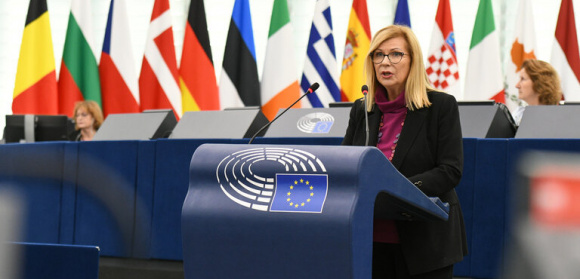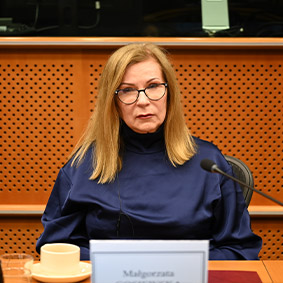
During this year’s final plenary session at the European Parliament in Strasbourg, a debate was held titled "Misinformation and disinformation on social media platforms such as X and TikTok, and the associated threats to the integrity of elections in Europe." ECR MEPs Patryk Jaki, Maciej Wąsik, Piotr Müller, Kosma Złotowski, and Adam Bielan took part in the discussion.
Patryk Jaki referred to the unprecedented decision by Romania’s Constitutional Court to annul the first round of the presidential election due to the alleged use by one of the candidates — Călina Georgescu — of opaque digital technologies and artificial intelligence that violated electoral law in the conduct of her campaign. He noted, however, that while he himself would never vote for such a candidate, political sympathies cannot be grounds for invalidating the vote.
The MEP reported that Georgescu is accused of hiring an agency to share content online. He stated that this is a common practice in politics. “Let anyone whose political group has never done this raise their hand,” he said, pointing out that Facebook’s algorithms routinely promote left-wing content while blocking right-wing content. “In fact, if we were to cancel elections based on the support of specific media outlets—80 percent of which in Europe are left-wing—we would have to cancel the elections of nearly all governments in Europe,” the Polish politician noted. He also pointed out that the accusations of outside assistance to Georgescu are not supported by any evidence.
“Have you forgotten how you illegally interfered in elections in Poland and other countries to support your candidates?” Patryk Jaki asked the politicians present in the plenary hall. He mentioned that they had even gone so far as to illegally block European funds in order to support them. In this context, he considered it absurd to hold others accountable for interfering in national elections. “It doesn’t matter how many times you repeat the word ‘democracy’ in every possible way. You hate democracy, people, differing views, and freedom, and you love tyranny. That is why this is a fight for something much greater. It is a fight for the freedom of European citizens,” the MEP commented.
Maciej Wąsik stated that the integrity of elections in Europe is under threat and pointed out that the main source of this threat is not disinformation coming from social media, but rather the European Commission’s interference in the internal affairs of member states, including through disinformation. He cited the actions of Commissioner Reynders, who has been accused of money laundering, as the most glaring example. “Do you remember Reynders’ reports attacking Poland and his criticism of the use of the Pegasus system by European intelligence services?” the MEP asked the audience, noting that the Belgian politician was apparently concerned about his own impunity. Wąsik also recalled Didier Reynders’ recent visit to Poland, during which he praised the Tusk government for its alleged “restoration of the rule of law.” He noted that the EU commissioner had failed to acknowledge the unlawful takeover of media outlets in Poland, the illegal purge of the prosecutor’s office, the refusal to recognize rulings by the Supreme Court and the Constitutional Tribunal, or the violation of the president’s prerogatives. He added that the activities of the Reynders Commission, including regarding the National Recovery Plan (KPO), constituted unlawful interference in Polish politics. “Today in Poland, the National Electoral Commission, which is subservient to the government, is cutting off funding to the largest opposition party,” — the PiS MEP stated. He explained that this is being done in defiance of a Supreme Court ruling, through the actions of, among others, politician Ryszard Kalisz, who was appointed to the National Electoral Commission by Tusk’s coalition. He noted that Kalisz had represented companies on the Russian-Belarusian sanctions list, as well as an individual accused of spying for Russia, including in the European Parliament. He stated that these pose enormous threats to democracy and appealed to Members of the European Parliament not to “turn a blind eye” to them.
Piotr Müller reminded the audience that freedom of speech is the foundation of every democratic system. “And I have the impression that there are people in this chamber who would like to undermine the foundations of democracy precisely by infringing on freedom of speech—in this case, freedom of speech on the Internet,” he said. He stated that the European Commission, EU institutions, and representatives of the left cannot act in this manner and preemptively ban certain content. “We must ensure freedom of speech and freedom of expression under various circumstances,” he said. The PiS MEP argued that the fight against disinformation should be based on educational efforts, showing how to combat it and how to debunk the fake news that appears. “Do not resort to instruments of censorship, which, unfortunately, we know all too well from Poland’s communist era,” the Polish politician urged.
Kosma Złotowski stated: “Attempts by our enemies to influence election results in Europe are not a new problem. The internet simply makes it easier than ever.” As he explained, there are tools to combat this, and the methods of Russian disinformation are well known. “Government agencies must be more effective in fulfilling the mission for which they were established,” he emphasized.
He noted, however, that there is a temptation—one to which many succumb—to attribute every defeat to “disinformation.” He pointed out that young politicians, just starting their careers, are skilled at using social media and inspire envy, prompting attempts to use this term as a pretext to combat political rivals.
“There is no appeal against democratic verdicts. Fears of foreign interference in elections cannot justify invalidating their results without cause. The fact that an election result does not meet expectations is also—and sometimes primarily—the fault of the loser,” the politician said.
“When discussing disinformation campaigns ahead of various recent elections in Europe, we must remember that evidence has emerged in recent days showing that the Russians attempted to interfere in the election campaign ahead of the parliamentary elections in Poland in October 2023,” said Adam Bielan. He noted that this information appeared in the liberal media. “Gazeta Wyborcza, which can hardly be accused of collaborating with the Law and Justice party, published evidence suggesting that Russian hackers likely sent out as many as several hundred thousand text messages intended to attack the then-ruling Law and Justice party,” the Polish politician reported.
He also cited the example of companies registered in Estonia and Hungary that organized a campaign aimed at increasing voter turnout. He pointed to social media posts that primarily attacked the ruling conservative party. He added that it was, after all, this very party that put an end to the misguided policy of a “reset” with Vladimir Putin and provided the most aid to Ukraine as it fought. “Was it a coincidence that the Russians attacked the Law and Justice government before the parliamentary elections?” asked Adam Bielan, calling for “less hypocrisy in this Chamber and a closer look at the facts.”