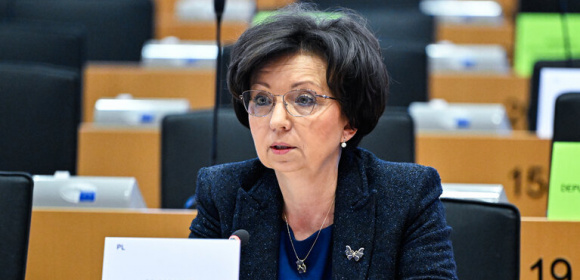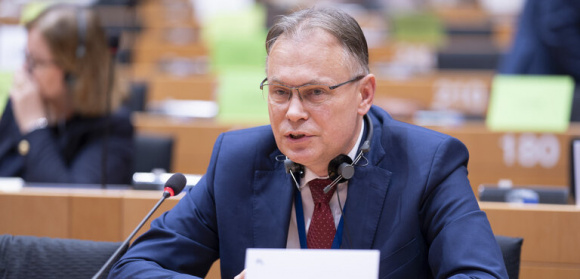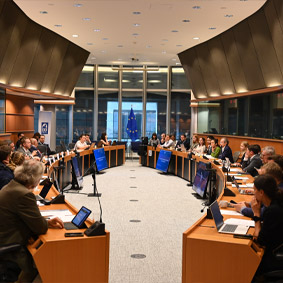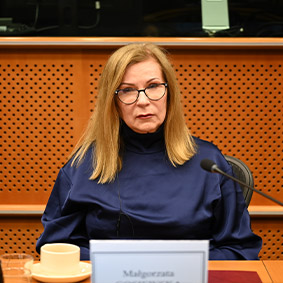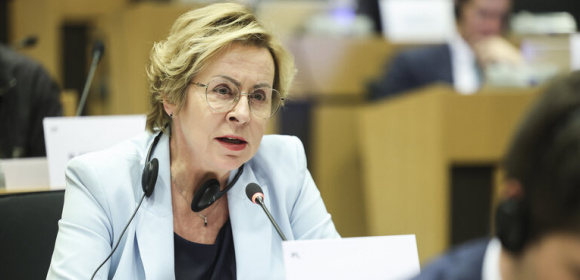
In Brussels, during a meeting of the Committee on Civil Liberties, Justice, and Home Affairs (LIBE), a debate took place on hybrid attacks at the EU’s borders carried out by the regimes in Minsk and Moscow. PiS MEP Jadwiga Wiśniewska spoke during the discussion.
Jadwiga Wiśniewska recalled that since June 2021, Poland, Lithuania, and Latvia have faced a crisis at their borders with Belarus, which were being breached by thousands of illegal migrants. She also pointed out that in 2021—during the Law and Justice party’s time in power in Poland—a decision was made to build a border barrier. “The person responsible for implementing this decision was a current member of our committee and the initiator of today’s debate, Mariusz Kamiński, who was the Minister of Internal Affairs and Administration at the time,” she added. Wiśniewska recalled that this decision was met with sharp criticism at the time, including in the European Parliament, where exhibitions were held and a film was screened that slandered border defenders. “That is why, taking this opportunity, I would like to mention today a soldier who lost his life on the Polish-Belarusian border—21-year-old Mateusz Sitek,” said the MEP, recalling that he was stabbed by an illegal migrant, which resulted in his death. Wiśniewska asked for a moment of silence for the murdered soldier, “because it is Polish border guards and Polish soldiers who safeguard the security not only of Poland but also of the entire European Union.” She also pointed out that “we are facing an unprecedented situation, an unparalleled attack on the European Union’s external borders.”
The PiS MEP also addressed the European Commission representative present at the debate, Beate Gminder, Director-General for Migration and Home Affairs, who, in her remarks, clearly reiterated that the European Commission would consider funding border infrastructure, as it had been urged to do by both the European Parliament and the European Council. Jadwiga Wiśniewska requested detailed information on how these funds would be allocated to specific sections of Europe’s external borders.
Beate Gminder stated that financial support would be provided under the so-called border instrument—the European Union’s Financial Support Instrument for Border Management and Visa Policy (BMVI). “The legal basis was negotiated with the European Parliament, and we are transferring 60 percent of the funds to member states based on the programs they submitted in advance, while 40 percent can be allocated to address specific emergency situations,” she added. Gminder also noted that member states had been asked to submit proposals detailing the support they needed. “We then evaluate these proposals and allocate additional funding. However, the demand always exceeds our capacity, and unfortunately, we do not have sufficient funds to meet all the needs expressed,” said the EC representative.