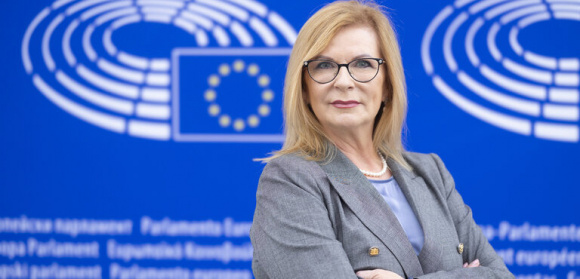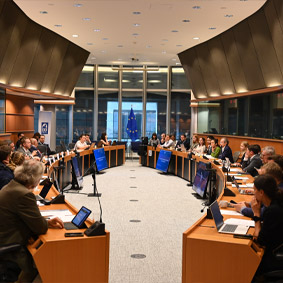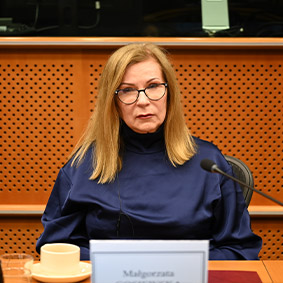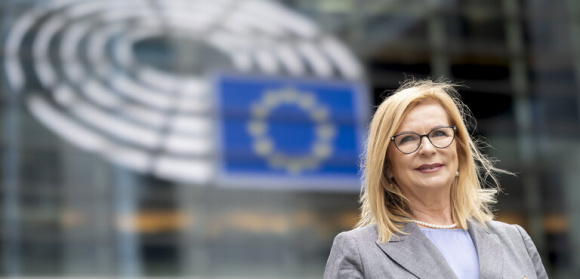
Today, during a meeting of the European Parliament’s Committee on Development (DEVE) in Brussels, a discussion took place with Janez Lenarčič, the Commissioner for Crisis Management. During the discussion, PiS MEP Małgorzata Gosiewska asked, among other things, about the dire social and economic situation in Madagascar and the activities of the International Committee of the Red Cross in Ukraine.
The Polish MEP stated that global food security is currently “under critical pressure” resulting, among other things, from the pandemic and the economic shocks it triggered, the climate crisis, and the effects of protracted conflicts, including Russia’s invasion of Ukraine, which have led to unprecedented hunger. She also cited the 2023 report by the Food Security Information Network (FSIN), which indicates that 10 percent of the world’s population suffers from chronic hunger. “We must remember that, in addition to meeting the most urgent needs, we must also address the structural causes of food insecurity,” Małgorzata Gosiewska emphasized.
The Polish politician described the dire situation in one of the world’s poorest countries—Madagascar—which she recently visited, where 70 percent of the population lives in extreme poverty. She explained that this situation is driven, among other things, by a lack of access to healthcare—which is commonly replaced by shamans—and dramatically limited access to education for children, as schools require tuition fees. The MEP also drew attention to the dilapidated road infrastructure and the bridges that have not yet been rebuilt after being destroyed during last year’s rainy season and massive flooding. She reported that the dire situation in Madagascar is also exacerbated by widespread corruption, large-scale marijuana cultivation, and mafia-style networks.
Referring to the situation described, MEP Małgorzata Gosiewska asked Commissioner Lenarčič what steps the European Union had taken to address the urgent needs of the population in countries of the Global South, such as Madagascar. The MEP also inquired about the results of the Commission representatives’ mission to Madagascar during the previous term. “Did this mission lead to new multilateral cooperation initiatives or specific projects aimed at improving food security?” she asked. “What measures have been taken to improve the health of malnourished children, to reduce child labor and employment, or to ensure their access to education?” the MEP pressed. The Polish politician also addressed the Commissioner for Crisis Management regarding NGOs. “Have you considered increasing the role of small, local NGOs in delivering aid—organizations that are on the ground, close to the beneficiaries, and have a deep understanding of their needs?” she asked.
Małgorzata Gosiewska also asked Commissioner Lenarčič about his experience working with the International Committee of the Red Cross. She noted that the ICRC is a separate institution but also receives European funding. She referred to the Red Cross’s highly controversial activities in Ukraine and asked whether, in light of this, the European Union has any influence over the work of that institution.
Commissioner Lenarčič, responding to the MEP’s question regarding the Global South, including Madagascar, emphasized that EU aid is primarily development aid. “The EU is active in Madagascar when humanitarian crises arise, which are mainly caused by cyclones or tropical storms resulting in natural disasters,” he stated.
Addressing allegations that the Red Cross is not functioning properly and the fact that the ICRC is unable to visit prisoners, he explained that this is not due to a lack of willingness on the part of the Red Cross, but rather to restrictions imposed by the Russian side. “The European Union’s relations with the Red Cross are excellent and are an indispensable part of the international human rights landscape,” he stated.